
Overview – developed by Steve Gal and published by Red Art Games, Skautfold: Usurper is a metroidvania style adventure, with eldritch horrors set in an alternative Britannia during the late 1800’s. This title is the sequel to Skautfold: Shrouded in Sanity, taking place a year after the events previous title. This title is available on the Nintendo Switch, Xbox and PlayStation systems, with a link to each version of the game at the bottom of this review.
Disclaimer: before I get into the review, I would like to thank Red Art Games for providing the copy of Skautfold: Usurper used for this piece via the Keymailer service. The provision of this software has not influenced the contents of this review, all thoughts and opinions contained within are my own.
Now with the introductions out of the way, let’s get into the review, starting off with the story of Skautfold: Usurper. When discussing the gameplay, I will be covering the core aspects of the title, as there are many nuances to the experience that must be experienced first-hand.
Story – taking place in an alternative timeline, in 1898 an otherworldly entity called the Citadel has crashed into the city of London, causing panic and releasing a fog of madness. After this event, the Empress Eleanor has assembled her royal forces to enter the Citadel, in hopes of finding a way to rid the city of the terror. Meanwhile, Waltham, the leader of the Veimar has employed his own forces to challenge the Navigator of the Citadel for his own, unknown purposes.
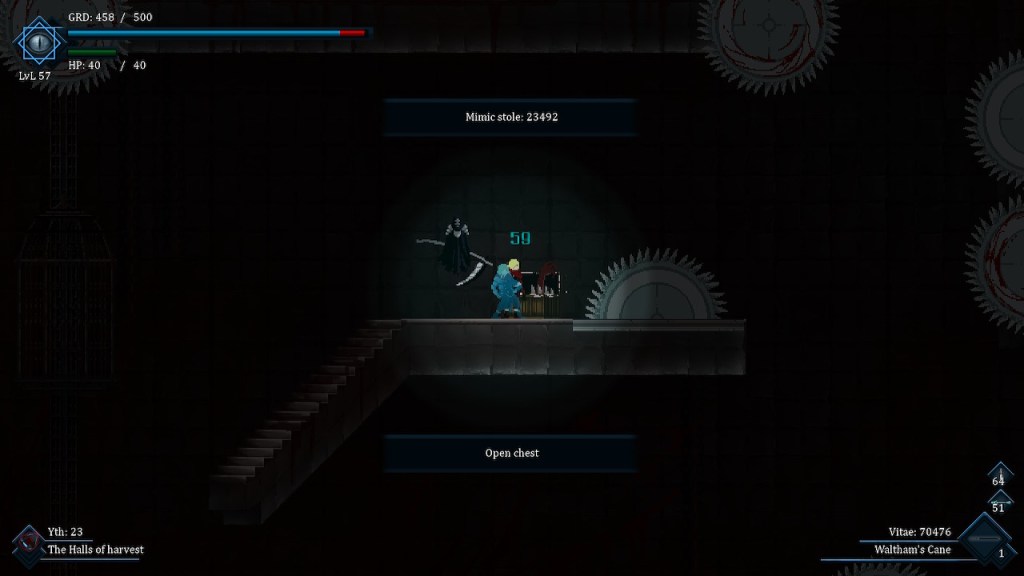
Gameplay – Sakutfold: Usurper is a search action RPG, where the player takes the role of Saragat, a Holy Knight who was revived by Waltham, by fusing his own damaged body with the corpse of the Knight. This has empowered the knight with new abilities, as he is now the only being that stands between the horrors of the citadel and the people of Britannia. This all takes place, while the mysterious Waltham guides the player through the Citadel.
The core objective of this title is to explore the Citadel, made up of a sprawling map that the player can explore, with new areas that will open up during the course of the game. In the different areas, the player will encounter various monsters and eldritch abominations, with the strength of these beasts changing depending on their location. There will also be horrific boss monsters in the Citadel, which will have relics that the player needs to progress.
These relics will provide the player with new abilities, empowering them further to get past the hazards and obstacles they will face. The relics include the ability to stick and jump off walls, break sealed doors and even levitate to fly freely through the Citadel. As this is a Metroidvania style of game, there will be a need to return to different areas, backtracking to get past hazards and uncover treasures that were unobtainable before, which can be eased by warp points and relics.
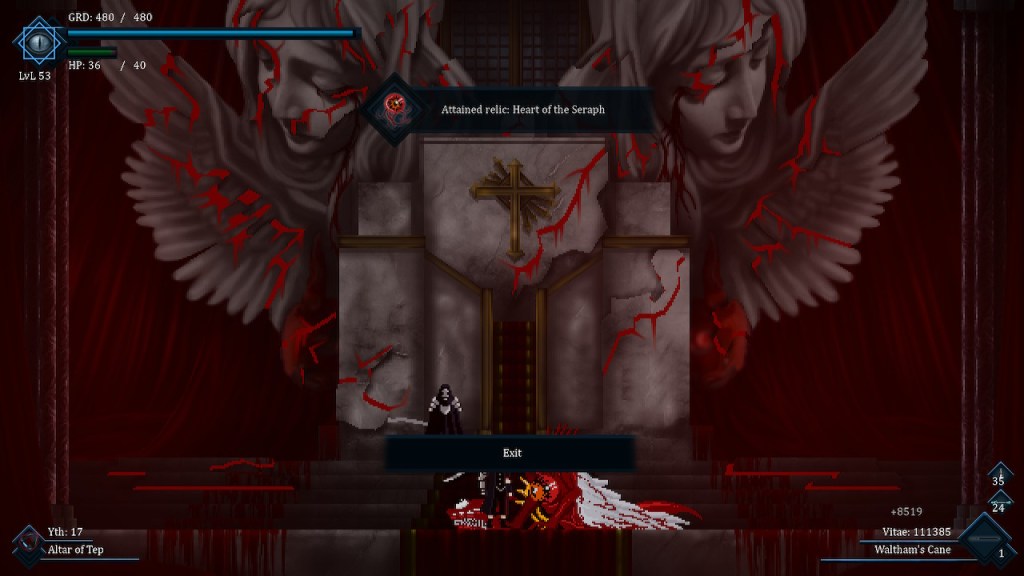
Alongside the relics that players can obtain is an arsenal of over 90 different weapons, which range from swords and axes to guns, bows and eldritch spells. These weapons can be collected from coffins that are scattered throughout the Citadel, with the ability to equip up to 4 different weapons at once. This allows players to change their strategy on the fly, which is important when fighting strong foes, as some weapons will deal extra damage if the enemy is weak to it.
There is also a companion system, which allows special entities to follow the player and assist them in their adventure. These include a spirit, a reaper and a fox, which will assist in combat to increase the strategic options in battle. This makes for an interesting experience, having to decide which familiar to use at any one time, adding further depth to the overall combat system. The familiars can also be strengthened if requirements are met.
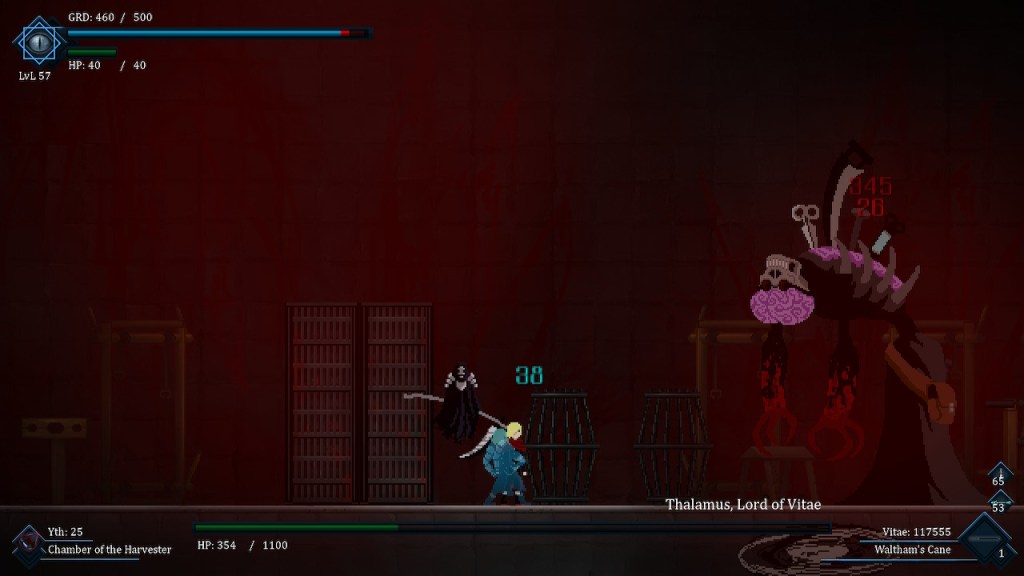
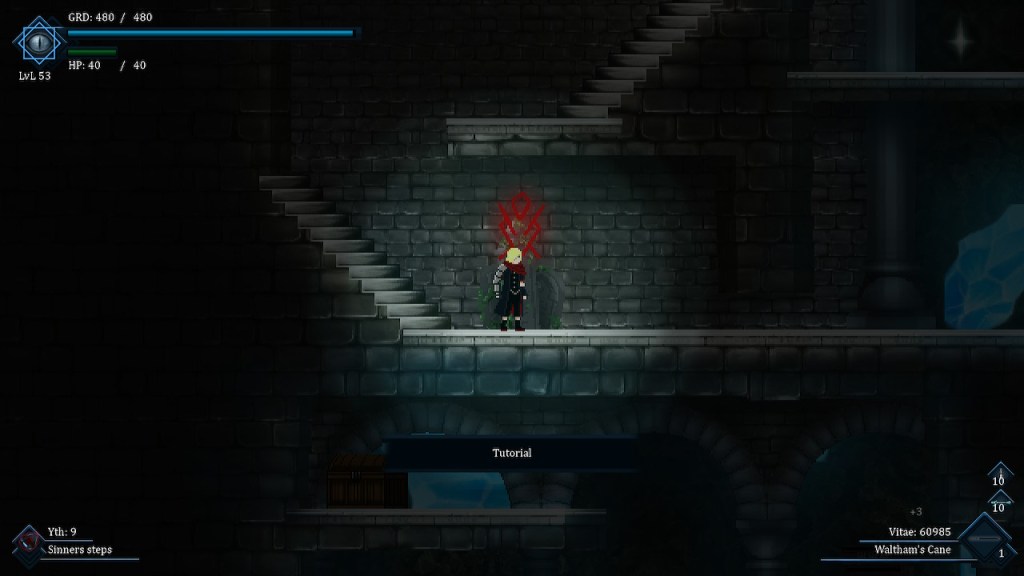
Speaking of combat, there is a relatively deep combat system which uses a special system called “Guard Points”, which act as both a shield from damage and stamina for attacks. If the player takes damage or uses a weapon, they will lose Guard Points (referred to as GRD in game) at varying levels based on the enemy/weapon. When this meter is depleted, any damage that the player takes will reduce their HP, which will result in death when fully depleted.
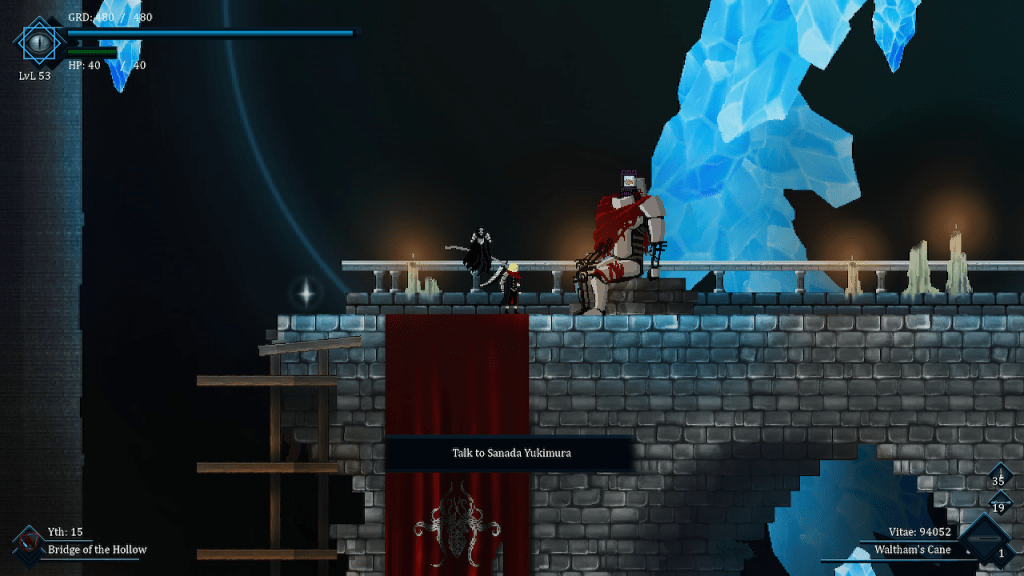
During intense battles in this game, the player can use some defensive skills that will be affected by the GRD meter. The first is the dodge roll, which will allow the player to escape an attack, with the ability to gain GRD if the move is timed correctly. Then there is the Shield, which will reflect projectile attacks and potentially damage enemies if reflected with the right timing. These skills can mean the difference between life and death, especially when fighting many enemies at once.
When enemies are killed, they will drop a resource called Vitae (which can also be found in large containers), which is a very special currency that is tied to the progression of the game. The Vitae is used to level the player, by paying a set amount of points while at the navigator throne, either in the main base or one of the seats throughout the Citadel (the throne is also used to save the game). However, Vitae is not the only item needed to make Saragat stronger.
Throughout the construct that is the Citadel are chests, which will contain special stones called Yth. These are finite, with a limited number of them available throughout the entire game, and these are key to being able to strengthen the player. When levelling up, the player must pay an increasing amount of Vitae per level, but only 1 Yth stone, adding a level to one of eight stats to enhance the player and the efficacy of different weapons.
The player can also use vitae to increase their Devotion to eldritch gods, which will enhance the power of some of the spells. There is even the ability to reset the levels that players have chosen for their character, allowing them to take a different approach. However, this comes with a few caveats, as the cost to refund the levels are Vitae for the next level, a single Yth stone and if the player has bought levels in the ELD stat they will not be refunded.
There is a lot to do in this title, with a lot of exploration options and the ability to move around the game in a non-linear fashion. However, it is important to take care when exploring uncharted areas of the Citadel as the threat of death looms around every corner of this labyrinthine construct. If the player is killed, they will be sent back to the last throne they activated, while also losing a percentage of the Vitae that has been accumulated by the player.
Within the confines of the Citadel and the areas that surround it are many secrets to discover, with hidden paths and items, walls that can be destroyed and even optional boss battles. There is much to discover, with hidden interactions, powerful items and so much more. There is even the ability to modify the experience through modifiers, including a speedrun mode, difficulty modifiers and even a permadeath challenge where saves are disabled.
Now with the core gameplay covered, it is time to move onto the other aspects of this release, starting with the controls.
Controls – Skautfold: Usurper has a control layout that is complicated when starting the game, with a lot of inputs that need to be memorized to succeed. But the game does provide some tutorials for players to get adjusted to the gameplay, which does make it easier to adapt to the complex controls. When playing in either handheld or docked modes, the game is comfortable to play, with all of the inputs laid out in a comfortable way, regardless of the controller used.
Difficulty – this title is very challenging in terms of difficulty, as the non-linear nature of the game can lead players into dangerous situations. If the wrong path is chosen, players can enter areas that they are not prepared for, which will lead to a quick, messy demise and a loss of Vitae. It is also important to be aware that boss battles cannot be escaped, with a particular boss being easy to fall into without warning while exploring, and only has one weakness.
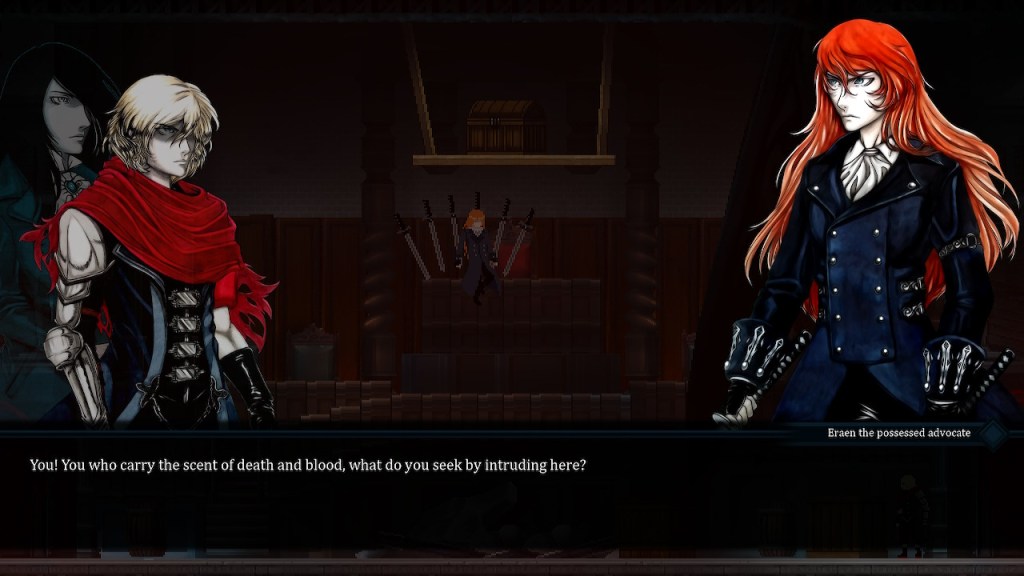
Presentation – the visual style for this title is reminiscent of Castlevania Symphony of the Night, with fluid and detailed sprite work, haunting backdrops and unsetttling character portraits. The game performs well, with no slowdown or lag issues during play, especially when fighting the gory and horrific blood soaked bosses. There is a fantastic soundtrack that builds tension and atmosphere within the setting of the Citadel, with music that adds a chilling feel to the world presented.
Final Thoughts – I had not played the previous entry in the Skautfold series, however, I have had a lot of experience with similar titles within the genre. That being said, this title exceeded all of my expectations and makes me want to explore the other games in this series. The narrative was engaging, the atmosphere really pulled me in and the gameplay loop was very challenging, but never frustrating during my time with it.
I have no issue recommending this game to those who are fans of the genre, as this embodies everything that Search Action games are about without being cryptic or confusing. I spent a lot of time with this game, trying (and failing) to beat the final boss, exploring the Citadel for hidden items and grinding out Vitae for upgrades. I am sure that I have only scratched the surface of the game with this review, as there is so much more to it but it would take all day to discuss.
In the end, I give Skautfold: Usurper a final score of 4.5/5. This title is a challenging and often brutal search action title, with horrific bosses in the form of eldritch abominations, haunting environments and intense combat that is wrapped in an intriguing narrative. The only negative is that the difficulty of the game may be off-putting to some. If you want to check this game out for yourself, a link to each version of the game will be below.
Link to Nintendo Switch version (HERE)
Link to PlayStation version (HERE)
Link to Xbox version (HERE)
 W.Kohaku Media
One thought on “Skautfold: Usurper – Nintendo Switch Review”