
Overview – developed by PixelHeart and published by QUByte Interactive, the VISCO collection is a compilation of 7 classic arcade games from the Neo-Geo from the titular developer. Take on a variety of challenges that cover a range of genres, with some additional features to update the game for modern games. This release is available on the all platforms, with a link to each version of the game at the bottom of this review.
Disclaimer: before I get into the review, I would like to thank QUByte Interactive for providing the copy of VISCO Collection that was used for this piece. The provision of this software has not influenced the contents of this review, all thoughts and opinions contained within are my own.
Now with the introductions out of the way, let’s get into the review. As this is a compilation release, I will be covering each of the titles in this release, providing a brief rundown of each of the games then discussing the overall package. Titles will be discussed in chronological order.
Andro Dunos – 1992

The game is set in a distant future where mysterious aliens have been invading the solar system. This is a two player scrolling shooter, where the players control the Yellow Cherry and Red Fox crafts, as they set out to take down the invading forces. The gameplay loop consists of several challenging stages, where the players are able to switch between different weapons. This was a key selling point for the game when it was first released.
Each of the four weapons can be strengthened, alongside powerful sub-weapons that can be collected by destroying enemy ships. The power-ups that are collected the level of the active weapon, allowing players to unleash a powerful attack, but this will weaken the ships arsenal when used. If the player is downed, they respawn with a power level penalty, when continuing after losing all lives, 2 levels and 3 sub weapons are given as an assist.
Goal! Goal! Goal! – 1995

Taking place during an unspecified world soccer tournament, players pick a team from one of 28 world teams in either a single player tournament or head to head. Matches last 2 minutes, with an extra period of injury time when the in game clock hits zero. If there isn’t a winner in tournament mode, the player can continue and decide whether to replay the match or choose penalty shootout.
The tournament mode plays out in two stages, with the first being a group match, with the second being a knockout elimination stage. This will continue until the only one team is left, with the player tasked with taking out the other teams on the road to their final victory. All of the teams that are featured in this title each have their own strengths and weaknesses, with the ability to select the formation of the team before starting.
Neo Drift Out: New Technology – 1996

This is an arcade rally title where the player takes on rally stages in an isometric style, where the goal is to reach the goal as fast as possible. The player can choose one of three cars, each based on a Japanese rally car from the time period. The cars vary in the ability of control and speed, with a unique feel to each of them. During the rally stages, the player has a time limit that they must reach the goal by, with on screen directions to guide the player.
The rally takes place over six stages, with a practice stage that will let the players get the hang of the race. After the initial practice, the player must challenge six stages that are set across the globe, including Scandinavia, Africa and Great Britain. Each of the stages have their own unique obstacles, where the player must be careful to prevent crashing. There will be checkpoints for the player to hit, gaining extra time or failing based on their performance.
Battle Flip Shot – 1997

This is a competitive action title, similar to Pong, where the player must bounce back a ball with a shield to hit the enemy markers. The objective of the game is to take out all six of the opponents targets first, while protecting their own with their shield. The player can select one of 5 playable characters, each with their own unique style and special attacks that they can use, with the choice being down to character preference.
The arcade mode plays out like a traditional fighting game, with the gameplay loop consisting of battles against the other characters. These battles play out in best 2 out of 3 round matches, where the first to score two points is the winner. After all of the playable characters are defeated, there is a final battle against an unplayable boss. There is also a two player mode, where players are pitted against each other in 1 on 1 battle.
Captain Tomaday – 1999
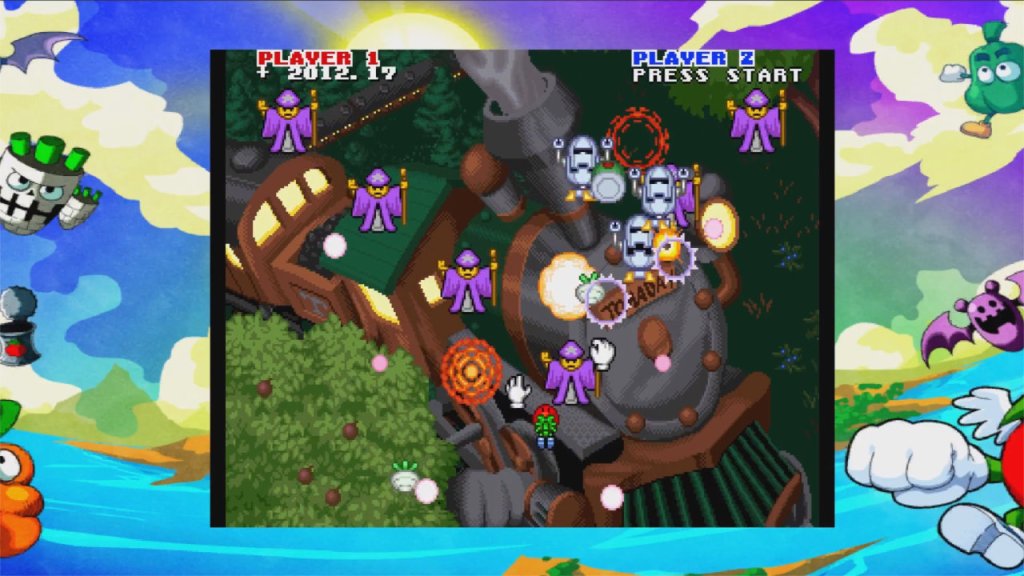
Set in the near future, the institute for space research was developing weapons to counter the invasion of eggplant aliens. Inside the institute, there were tomatoes that were being cultivated, but one stormy night a tomato fell into a chemical agent, transforming it into Captain Tomaday. Now, this tomato must battle the invading alien forces, taking them on in vertical scrolling action. The brave captain, flies through each stage striking down the eggplant aliens.
This scrolling action title is different from the traditional shooter, as the player throws their hands at the enemies, with a left and right punch. The captain can power up their fist attacks by charging them up for a powerful attack, or rapidly punch to deal damage quickly. When enemies are destroyed, they can drop a variety of items, increasing the power and score for the player. Two players can take on the challenge together, taking down the aliens as a team.
Ganryu – 1999
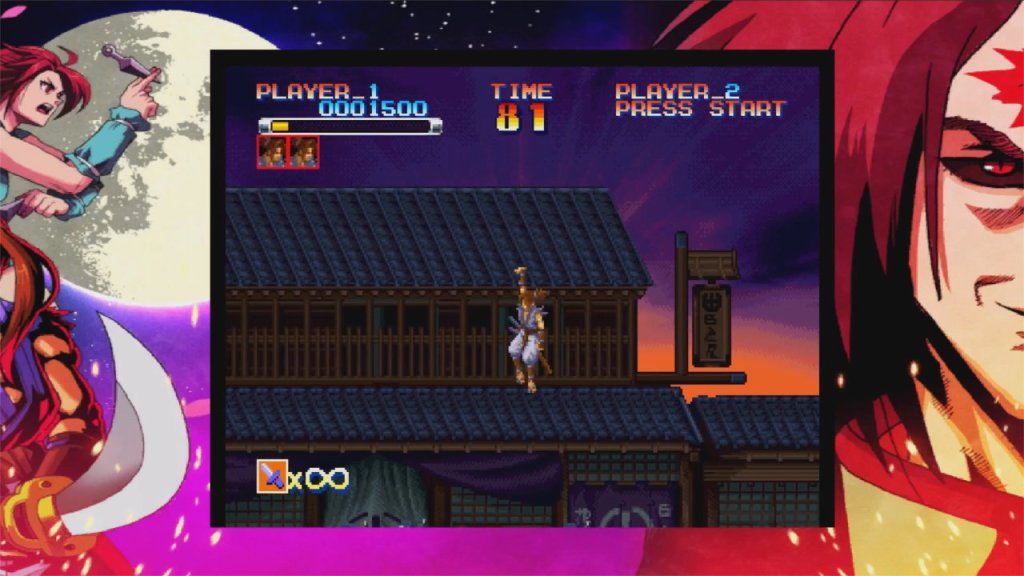
This side scrolling hack and slash title takes place in a fictionalised feudal Japan, where the two warriors take on the ninja of Sasaki Kojiro. In this title, the player must travel through each of the large stages, cutting down the ninja that get in their way with their sword or chain. The two playable characters are Musashi and Suzume, who each have their own unique qualities, with Musashi being stronger whereas Suzume has more speed.
While making their way through the stages, the player will be able to uncover hidden rooms, paths and treasure chests containing treasure to collect. The items that can be found include health recovery, coins for points and extra sub weapons. These can be very useful as the different areas are swarming with enemy ninja, attack the player from all sides. There are also very powerful bosses, who can wipe the player out in seconds.
Bang Bead – 2000

This title is the sequel to Battle Flip Shot, taking the established Pong formula and tweaking it into a more exciting single/multiplayer experience. The core objective is changed from simply hitting targets, to scoring a goal afterwards. Also in this version, the shields have been removed, with the player able to dash and deflect the ball with their body. There is also a power attack system, with a gauge that fills up over time, allowing for special moves to be used in battles.
The roster is also expanded in this entry, with two new playable characters entering the arena, expanding the playable selection from five to seven. All of the characters have their own unique moves, adding good variety to the action on screen. The arcade mode is the same as the previous, where players will challenge the CPU to best 2 out of 3 battles. However, after defeating five opponents, the player will encounter two bosses that will put their skills to the test.
Now with each of the games covered, it is time to move onto the other aspects of this package, starting with the control system.
Controls – as these are titles originally developed for the Neo-Geo arcade system, there is a simple 4 button set up that is implemented fairly well. The game supports a variety of controllers on PC, which makes it easy to find the set up that works for you. The games play fairly well with a controller, but the preferred way to enjoy these games is with an arcade stick. Sadly it does feel like there is some input lag, but that may be down to the emulation.

Difficulty – there is a set difficulty for all of the games, which is the default as they were set in the original arcade machines. This can make for a difficult experience for some players, as there is no way to alter the settings for the game. Most of the games are difficult, with a lot of continues required to get through them. This may be off putting for those who may not have played these before, as the challenges can feel very punishing and even unfair.
Presentation – the visuals and sound are as close to the original hardware as possible, with a clean and crisp look to all of the games by default. This makes all of the games look good with the distinctive style of VISCO standing out well. There are some options for the screen to be modified to fit the screen, with other minor tweaks that can be made. Overall the package looks very good however you play it.
Features – as an arcade compilation, there were some features that I was expecting this game to have, which are unfortunately missing. There doesn’t appear to be a way to access the dipswitch settings for the included games, which does hamper the experience. This lack of access to the settings is a disappointment, as it makes it hard to get into some of the games. There is an online multiplayer component, but I wasn’t able to try this out.

Final Thoughts – I was hopeful when this was made available to me, as I have a fondness for the VISCO library and Neo-Geo as a whole. However, this collection has been a slight disappointment for me, which is due to several issues that I faced. When playing the games themselves, they worked fairly well, albeit with some minor input issues. The biggest problem is the lack of access to game settings, which are present in almost every other emulator available.
I am unsure if I can make a general recommendation for this release. There is a good selection of games here, with the excellent Captain Tomaday and Neo Drift Out as a stand outs, but everything is hindered by the locked difficulty. There is online multiplayer, which attempts to connect players all over the world, but I just couldn’t get connected to another player. This had the potential to be a fantastic celebration of VISCO, but it falls short.
In the end, I give the VISCO Collection a final score of 3/5. This is a competent compilation of games that attempt to celebrate the VISCO name, but sadly the overall package is marred by a disappointing lack of features that are common in other emulation offerings. If you want to check this package out for yourself, a link to each version of this release will be below.
Link to Steam version (HERE)
Link to Nintendo Switch version (HERE)
Link to PlayStation version (HERE)
Link to Xbox version (HERE)
 W.Kohaku Media