
Overview – developed by Flazm and published by BlitWorks, Train Valley 2: Community Edition is a rail management puzzle sim, with an emphasis on strategy and planning. Take your rail company across several eras, from the steam powered era to the space age. This version of the game is available on all console platforms, with all previously released DLC included. A link to the game will be at the bottom of this review.
Disclaimer: before I get into the review, I would like to thank the rep from BlitWorks for providing the copy of Train Valley 2 that was used for this piece, via the Keymailer service. The provision of this software has not influenced the contents of this review, all thoughts and opinions contained within are my own.
Now with the introductions out of the way, let’s get into the review. This title doesn’t have any story tied to it, so I will be moving directly into discussing the gameplay of Train Valley 2. I will be focusing on covering the core elements of the gameplay experience, as there are some mechanics that need to be experienced first-hand.
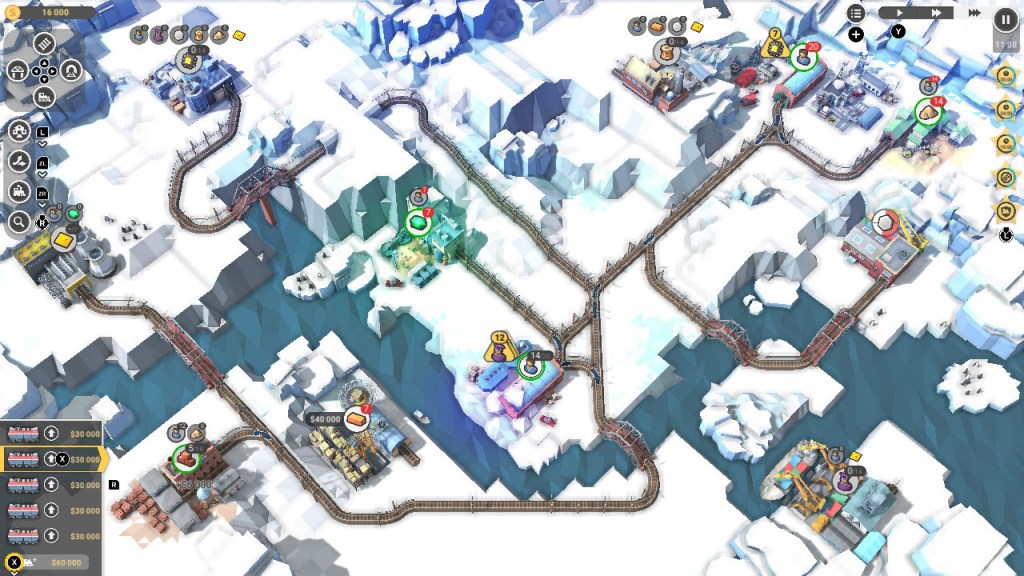
Gameplay – this title is an isometric rail management puzzle sim, where the core objective of each of the stages is to connect rails and transport cargo. The way that this is achieved is by connecting the different stations, as the player is able to build a network of railways through the stage map. Each of the rails can be connected to others, allowing for multiple directions and intricate layouts to be built. However, this does come at a cost.
In order to build the rails, players must pay for each tile that they lay, as well as the cost of demolitions for areas that spaces that contain objects. This can become very costly, very quickly and drain the bank if the player is reckless. To earn more money, the player must deploy trains from the stations, transporting resources and cargo to different destinations. For each successful transport, the balance for the player will increase.
When moving resources, it is important to keep in mind what is needed to complete an objective, as there are limits to what can be accepted at a station. If the wrong cargo is sent to a station, the train will be sent back, quickly departing the station. This can lead to chaos and potential issues for the player, which may just result in disaster. As the trains are sent along the rails, it is important to watch the paths, switches and station functions.

If there is contact made between the locomotives, or if the rails aren’t connected, there will be a crash. When trains crash, there will be craters left behind, which need to be cleared before new tracks can be laid, which can be costly mistakes. It is also possible to build bridges and tunnels as the game progresses, further expanding the building options for the player even further. But, these features are expensive and can eat into the budget.
To help speed up the flow of gameplay, there are three speed settings that can be used. These will speed up the flow of time, allowing for rapid transport of resources through the map. But there are some risks associated with speeding time up. If the player sends a train out without taking rail switches into account, there is the risk of collision between trains or going to the wrong station. This can cause significant delays and costs to the player.
In order to clear a stage, the player must manage their rails and send resources to the different stations to make the required items. These include gold bars, furniture, glass and more, with some requiring more resources than others. When the required items are complete, the player must send them to the base stations, which are where the workers are deployed from. Once all required cargo has been delivered, the stage is cleared.

There is one fail condition that is present throughout the game, which players must be very careful of. If the player runs out of money, with no way of raising needed funds, then the stage will be failed, leading the player to need to start over from the beginning. This can occur in a few ways, the main one, being due to train crashes, as the player must pay to replace their lost engines. If the player cannot repair the engines, the game is over.
Outside of the standard win/loss conditions for the stages, there are bonus objectives that players can challenged. The main ones are completing the stage under a specified time limit, usually with three stars that are tied to time and two bonus objectives. These additional challenges provide the player with stars, which will unlock new train designs that can be used in game. These additional rewards promote repeated play of stages.
The main game mode is split into 5 distinct time periods, with their own unique locomotives and map details, which are tied to that era. These give the stages their own distinct feel, adding a good feeling of progression to the main game mode. But the main game mode isn’t all that the game has to offer. There are extra stages that were included as DLC, alongside bonus community levels that massively expand the scope and value of the game.

There is a tremendous amount of content contained in this title, with a variety of locations, settings and challenges for players to take on. The depth of the challenge is satisfying and rewarding, with new obstacles being introduced over time, adding more complexity to the stages as the game goes on. There is also an in-depth tutorial system, which provides explanations of important mechanics as they are introduced during the game.
Now with the gameplay covered, it is time to move onto the oter aspects of this release, starting with the controls.
Controls – there is an accessible control system to this release, attempting to translate a traditionally PC play style to console, with on screen prompts to aid the player. This for the most part works, but can be a little clumsy given the isometric viewpoint of the maps. There is a feeling of inaccuracy with the rail building and switching, which does let the game down a little bit. The biggest miss is the lack of touch controls for the switch, which would have elevated the game in handheld mode.
Difficulty – there is a very forgiving difficulty curve, as there is no tremendous pressure on the player while making their way through the game. The lack of a hard time limit lets players take their time, planning out the approach that they want to make. This provides a comfortable and relaxed gameplay loop, where players are able to experiment freely. The only real difficulty is the bonus objectives, which are optional for those who really want to do them.

Presentation – visually, this game shines with its low poly style, giving the feel of the older games in the tycoon series. This works in the favour of Train Valley 2, as it makes for stages and environments that can be navigated easily. It can be a little tough to see at times in handheld, but there is a handy zoom feature to help with this. The soundtrack has a cosy overall feeling, with relaxing melodies that enhance the calm atmosphere present throughout.
Final Thoughts – I am not usually one for tycoon or sim management games, so when I was offered this I wasn’t sure how I would feel. But after spending a little time with the game, I became more engaged with the gameplay loop. There is a nice and relaxed atmosphere, which helped me get used to the new mechanics over the course of the game. I found that the slower pace made for a calming experience, where I didn’t feel rushed to complete the stages.
I am happy to recommend this to pretty much everyone, even those who may want to dip their toes into the management sim/strategy genre. The game is accessible to everyone, with a difficulty curve that is about as steep as a gentle hill, alongside an in-depth tutorial system. There is also 200+ bonus stages, adding even more play value to this package. I do wish however, that the controls were more refined and the option for touch was available on Switch.
In the end, I give Train Valley 2: Community Edition a final score of 4/5. This is a very accessible rail management experience, perfect for beginners and veterans alike, featuring a wealth of content and replay value for players, with a calm and cosy atmosphere that reinforces the laidback approach to gameplay. If you want to check this title out for yourself, a link to each version of the game will be below.
Link to Nintendo Switch version (HERE)
Link to PlayStation version (HERE)
Link to Xbox version (HERE)
 W.Kohaku Media