
Overview – developed by Sunsoft and Tasto Alpha with publishing handled by Red Art Games, Ufouria: the Saga 2 (Hebereke 2) is a brand new sequel to the cult classic NES release form 1991. Take on a brand new adventure set in a felted arts and crafts world, with the penguin Hebe and his friends as they set out to save the world. This title is available on PlayStation 5, Xbox Series, Nintendo Switch and Steam, with a link to each version of the game at the bottom of this review.
Disclaimer: before I get into the review, I would like to thank Red Art Games for providing the copy of Ufouria: the Saga 2 that was used for this piece, via the Keymailer service. The provision of this title has not influenced the contents of this review, all thoughts and opinions contained within are my own.
Now with the introductions out of the way, let’s get into the review, starting with the story. Please note that I will be referring to this game as Hebereke 2 during the review for the sake of brevity, this is the Japanese name for the game. I will also be focusing on the core mechanics of this game, as there are some surprises that I feel players should discover for themselves.

Story – one day Hebe the penguin was sleeping at his house, but he was awoken by a sudden loud noise. Getting up from his bed and heading towards the disturbance, he encounters Utsujin, an alien invader that has crashed on earth. This UFO is armed with a sticky threat called a Bumyon, which has covered the land in their icky presence. However, Hebe and his friends can use their Popoons to counteract these blobs and clean up the planet to thwart Utsujin.
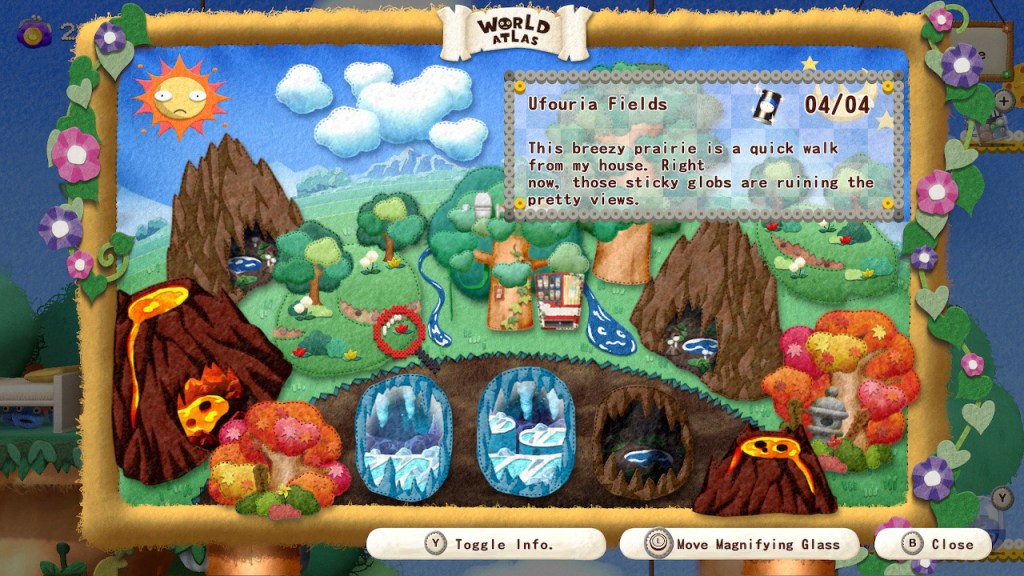
Gameplay – Hebereke 2 is a side scrolling platformer, utilizing aspects of the original title with brand new mechanics to create a fresh and exciting experience. This new version of the game features an interconnected world, using a metroidvania style of gameplay and a procedurally generated stage system. The objective is simple, clear the stages and complete the objectives while pushing the story forward with each area that is explored.
As a side scrolling platformer, the player can jump and slam down on enemies using an attack called a butt bounce. Then there is the Popoon, a colored blob that the player can throw at Bumyons, purple blobs that stick to the environment and some characters. The Popoon can also be thrown at enemies to stun them, allowing for players to butt bounce on them easier. The enemies aren’t the only thing that players need to be aware of in stages.

Throughout the course of the game, players can collect gold coins that are scattered through the world. These coins will be put on platforms, can be dropped by enemies and put in hidden places for players to discover. The coins collected will be added to the bank, which happens when a stage is cleared and the player returns to Hebe’s home by riding Bobodori the bird. The coins collected can be used at vending machines, which provide a range of benefits.
There are two types of vending machine, the first is Hebe’s home vending machine which contains upgrades and power-ups. Then there are the stage vending machines, which will give the player the ability to buy health items, replenishing lost hearts. Speaking of hearts, the player starts off with three hearts and 3 extra lives, with a life lost when all hearts are gone. Total hearts can be upgraded at Hebe’s home, with power-ups related to hearts also available.
When clearing a stage for the first time, players will be encounter bosses that they will engage in battle with. The loop for bosses is pretty easy to get to grips with, the player must hit the boss with a Popoon and then butt bounce on them. When the boss has been hit enough times, they will be defeated and the player can progress. At set points during the story, the boss will be one of Hebe’s friends who will be available to recruit when returning home.

In order to recruit a friend to join in on the adventure, the player must buy them an item from the vending machine at Hebe’s home. These items may be locked, with the player needing to collect Utsu-Cans in order to unlock them. To obtain Utsu-Cans, the player will find them in areas of the stages, with some being harder than others to obtain. There are a set number of cans that will appear in an area, with the chance for a can to appear varying.
Utsu-Cans as well as coins can also be obtained by completing stage challenges, which will give the player an objective to accomplish. These challenges include defeating a set number of enemies, reaching the goal within a time limit and not taking a limited number of hits. The difficulty of a challenge is determined by the number of stars, ranging from 1-3. As the stages are randomized, the challenges and rewards are also random.
Once a character has been added to the party, the player can freely switch between them and use their abilities to progress further. As the game has a metroidvania-lite style to the progression, these characters will be crucial to being able to get further into the game. The skills that characters introduce allow the player to swim, hover across gaps and even have better traction on ice. This makes all of the characters in the team important.
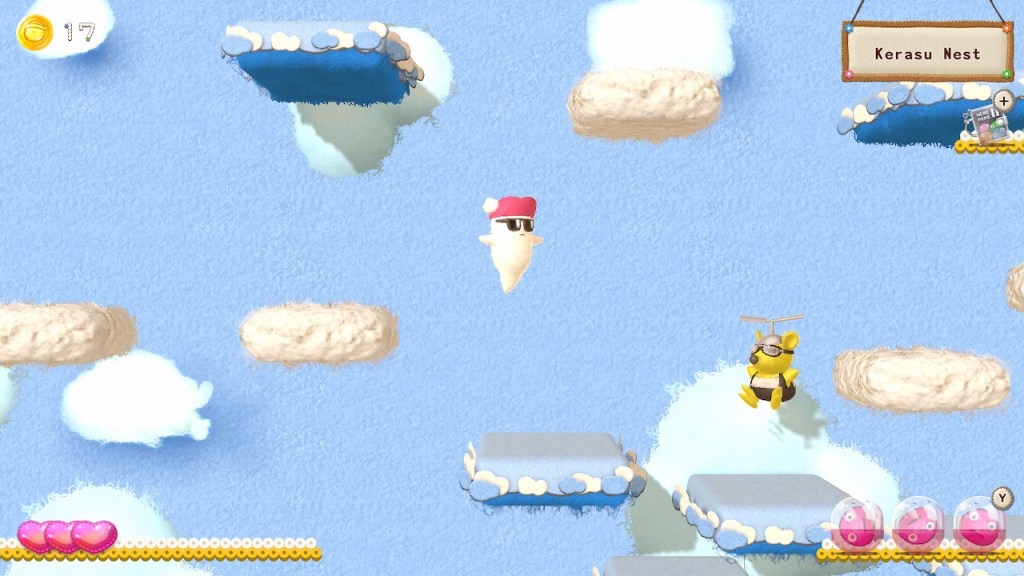
Each of the characters has their own unique special abilities, unlocked by buying them from Hebe’s vending machine if the requirements are met. These special skills can provide the player with a boost through tougher section, expanding their overall toolkit for the adventure, allowing hard to reach areas to be a little easier. When there is at least one more character in the team, they can also give players coins by pressing the prompt that appears on screen.
There is a need for some backtracking and replaying of stages to progress, which serves two purposes. The first is to collect more Utsu-Cans/coins to complete objectives and the second is to reach new areas. As the world is interconnected, the player will need to move through already cleared areas to reach new ones when they are opened. This can be mitigated later when new features and skills are unlocked.
The gameplay loop is fun and doesn’t have the issue that a lot of metroidvania style games have, as there are new layouts which keep it from being tedious. The way that vending machine items alter the stages makes return visits more enjoyable, giving added depth to the game the more time the player spends in the game. All of the different elements of the game come together, creating an experience that is unique and fresh with each play through.

Now with the gameplay covered, it is time to discuss the other aspects of this release, starting with the controls.
Controls – Hebereke 2 is a platformer, so there is a fairly simple system for the inputs, with the face button for jumping, throwing Popoons and interacting. The front shoulders are for switching characters and the back triggers are for quick butt bounces. The movement and inputs are very responsive, with no issues when it comes to lag. There is no trouble when playing the game in handheld or docked modes, with all control types working well.
Difficulty – there is a fairly moderate difficulty curve to the game, with it being easy to pick up and play by everyone. The biggest part of the challenge are the objectives, especially the time and damage missions. In later stages of the game, no damage missions are the most difficult parts of the game, but they can be cleared if the player takes their time. If the player wants a bigger challenge, a harder difficulty can be unlocked during the course of the game.
Presentation – the overall look and feel of the game is adorable, with the world having an arts and crafts feel to it. The playable characters have a stop motion feel to them, enhancing the overall style with iron bead sprites and details which complement the felted look. There is an equally cute vibe that comes from the sound design, with the soundtrack having a happy and bouncy feel to it, taking the original music and remixing it make it fresh.
Final Thoughts – Hebereke is a franchise that I have known of for many years, having played the different games on Super Famicom and Sega Saturn long ago. When I saw this game was available in Japan, I was interested in checking the game out as an import, but then I discovered that Red Art Games were bring it to the west. I can say with no uncertainty that this is one of the best platformers I have played in recent years.
The world that has been crafted for Hebereke 2 is gorgeous, with the whole arts and crafts look of the sewn together landscape and felted characters. This style has been done in a few ways before, but this may be the most adorable variation. I can’t recommend this game enough as both a Hebereke and a Platformer fan, this is perfect everyone regardless of if you have played the first game or not. The whole package is a delight.
I was a little bit sceptical when I saw the words procedurally generated and metroidvania in promotional material, but the implementation of it works to great effect. I had so much fun figuring out the little pluzzles, unlocking new abilities and exploring the world. This is a wonderful experience, with a story that is entertaining and has references to the past, which ties this new game to the original from over 30 years ago.
In the end, I give Ufouria: the Saga 2 a final score of 5/5. This is an adorable platformer, with a story that is engaging and self-aware moments that added to the comedy of the narrative. The random generation of stages, challenges and unlockable content makes this a game that can be enjoyed by everyone. If you want to check this title out for yourself, a link to the game will be available below.
Link to Nintendo Switch review (HERE)
Link to PlayStation 5 version (HERE)
Link to Xbox Series version (HERE)
Link to Steam version (HERE)
 W.Kohaku Media
One thought on “Ufouria: The Saga 2 – Nintendo Switch Review”