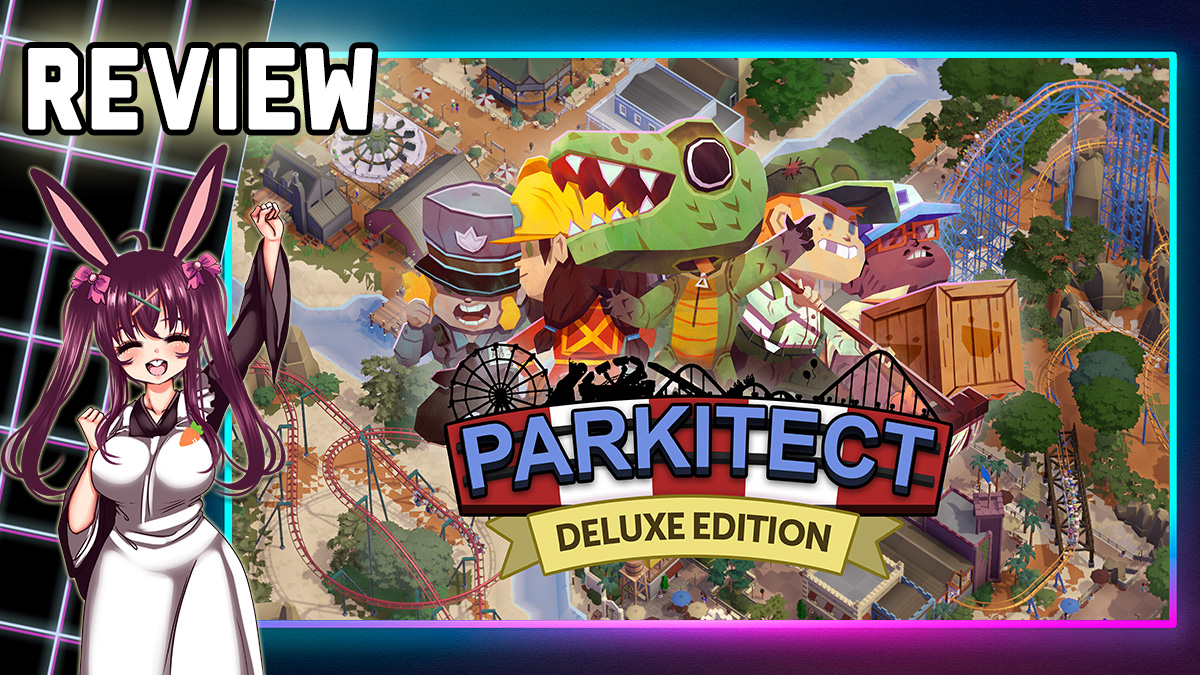
Overview – developed by Texel Raptor and published by BlitWorks Games, Parkitect: Deluxe Edition is a special console release of the theme park management sim that was originally released on PC. As the owner and operator of your own establishment, build rides, design the layouts and hire staff so you can thrive in the cutthroat world of theme park management. This release of the game is available on PlayStation and Xbox, with a link to each version at the bottom of this review.
Disclaimer: before I get into the review, I would like to thank BlitWorks Games for providing the copy of Parkitect: Deluxe Edition that was used for this piece, via the Keymailer service. The provision of this software has not influenced the contents of this review, all thoughts and opinions contained within are my own.
Now with the introductions out of the way, let’s get into the review. I will be skipping the story segment as there is little in terms of a plot for this release, going straight into discussing the gameplay and mechanics of Parkitect.
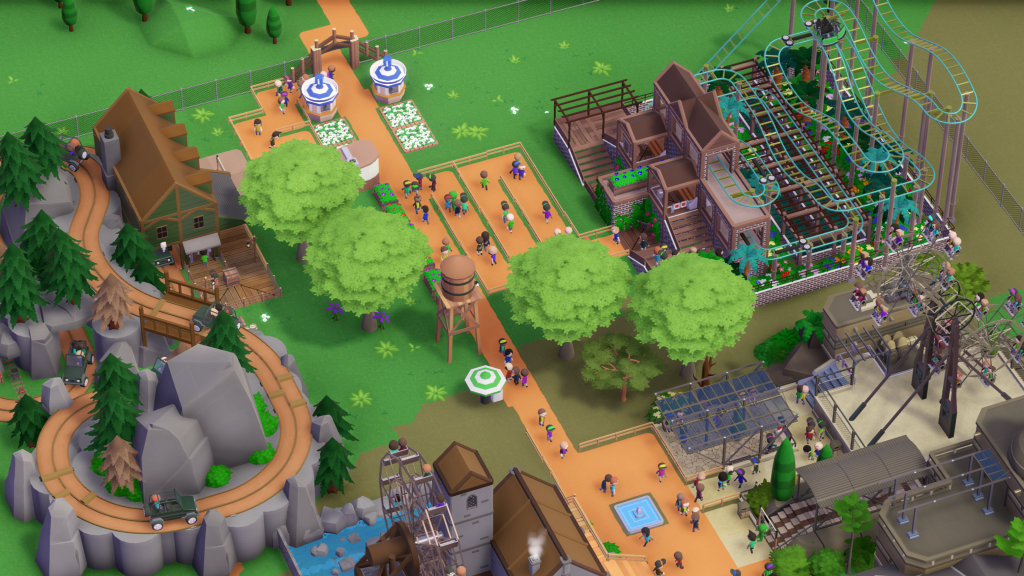
Gameplay – Parkitect is a theme park management simulation in the vein of RollerCoaster Tycoon and other titles in the genre, with the objective being to build a successful attraction. There are two game modes for this release, with a Campaign and Sandbox mode, which players can select from the main menu. The Campaign mode has a total of 37 different stages for players to play through, with all of the scenarios from the base game and the Taste of Adventure expansion.
In the Campaign, players are given a predetermined area, with a fixed starting fund and objectives to complete. The objectives for the different scenario parks are split into main and optional goals. The main goals are the only ones that need to be cleared to progress, with the optional goals for those who want a challenge. The types of goals that players can take include having no loan debt, selling a set a number of tickets and a target for simultaneous park guests.
While building and maintaining the park, time passes on a month by month basis, starting from January of year one. As each month passes, the expenses of the park will be deducted from the funds that the player has remaining. At the start of a campaign scenario and in sandbox mode, the park starts off with an entrance, a small plaza and usually a staff area. It is up to the player to decide what rides, facilities and decorative features are added to the park.
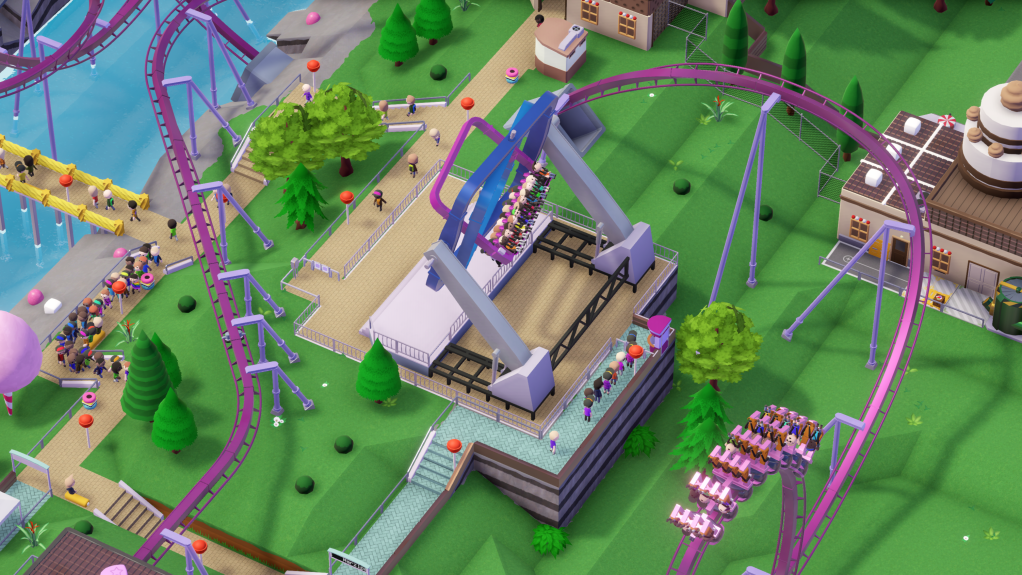
Each of the scenario parks, will have a set of rides and attractions that can be implemented, starting off simple like a Ferris Wheel, Mini Coaster and Carousel. These will be alongside more thrilling rides, larger roller coasters and even water rides. But rides aren’t the only things that need to be built for a profitable park, as there are shops and other facilities that players can build. The options vary from burger and hotdog stands to balloon stalls, ATM machines and even toilets.
But a theme park doesn’t keep itself running by itself, so staff are needed to keep the park running efficiently and most importantly, keeping guests happy. For a sustainable park you will need to employ several different staff, with five different types of staff members that are needed for a park. These are haulers to supply shops, Janitors to clean up messes, Mechanics to fix rides and decorations, security to stop vandals and entertainers to keep guests happy.
The staff will wander the park, fulfilling their roles as they are needed but they can be assigned to specific areas to keep them effective. In order to keep the staff happy and keep the park running, the player will need to provide them with their own facilities. These include staff rooms, depots and training rooms. If the player neglects the needs of their staff, they will become tired and be unable to perform their duties, leading to negative reactions from the guests.

Adding facilities to the park is just the start, as the player needs to add walkways to the park for staff and guests to find their way around. The player is able to lay guest paths all across the park, which the guests will roam during their visit. Then there are the queue lines, which are added to the entrances of rides. Last are the employee paths, which will be used by staff to travel throughout the park to reach the jobs they have to do, keeping them away from the guests.
Next we have decorations, with various options that can be laid down to make the park and attractions look unique. The options that can be used include trees, canopy shelters, screens and even effects. The different decorations will affect the ratings that the guests give the park, improving the overall rating of the park. The guests of the park will react negatively if they see staff areas of the park, so adding furnishings to hide these will also help improve the visitors.
Now we move onto the coaster builder, which will allows for custom rollercoasters to be built, with each of the coasters having different options. Each of the coasters have limits to their height, and the details that can be added to them. Some coasters can be inverted, have loops and even launch systems to be able to get the coaster going at high speeds. The best way to figure out the coaster that guests enjoy most is through experimentation, building and testing different coaster builds.
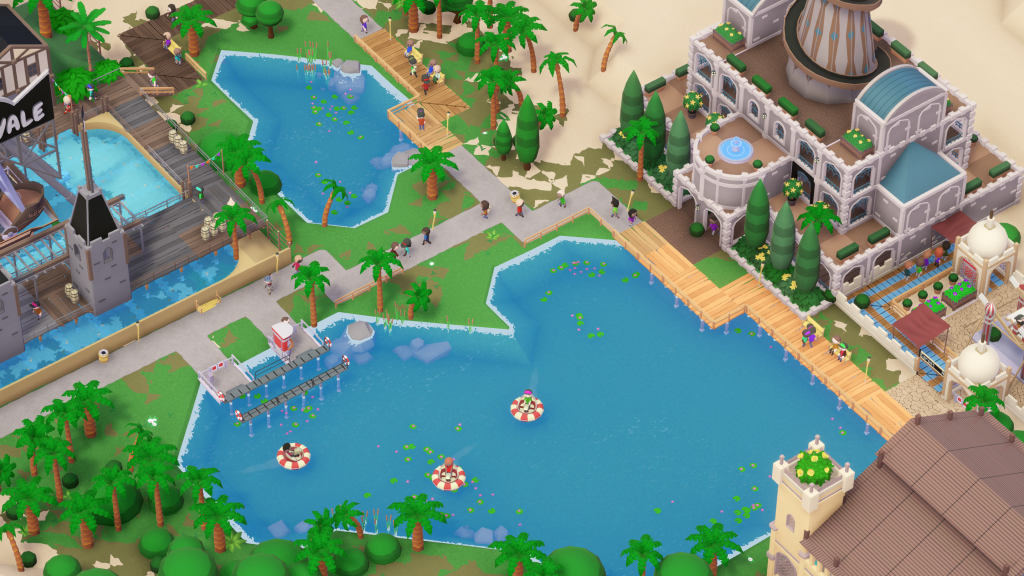
There is also a blueprint system included, allowing players to save their favorite creations to be used in ever park. The game even includes pre-made ride templates, with decorations and layouts, with some inspired by real world coasters. This can speed up the building process and save time, so players can start getting their guests spending as fast as possible. The coasters, along with other rides can be modified, changing number of cars and chain lift speed and more.
The height of rides, paths and even the ground itself can be changed, with different elevations and terraforming options available. This system can also be used to make the most of the space available, with the possibility for paths/tracks to go underground and even into bodies of water. This can make it easier for staff to move around the park, with underground paths as shortcuts over long paths around the park. This gives the creative options more flexibility for players.
The creation of rides, decorations and facilities in the park is important, but great care must be taken to make sure that the park is still profitable. As each month passes, the expenses for the active attractions, hired staff and supplies will be deducted from the money that players have. If the revenue coming in is less than the expenses, the park will risk bankruptcy. An onscreen warning of how long there is left to get out of debt, as failure to do so will result in park closure.

This is where the financial system and satisfaction stats of guests will come into play. The player can more often than not alter the costs of the park for guests, with the cost of entry, rides and services (even the toilets) having the ability to charge guests. This can be an easy way to cover the expenses of the park, preventing going into debt and having to close the park. There is also a loan system that can be used, giving emergency funds if the player needs fast money.
However, this isn’t free funding as all of the money from loans needs to be paid back. You can allow the loan to be repaid each month, or pay off lump sums when enough money has been earned. There are a range of loans that can be taken, with a multitude of amounts and payment plans on offer. Loans can be risky as debt will rapidly increase if payment cannot be made, speeding up park closure. There are park goals that require the player to have no loan debt to succeed too.
Last to discuss is the Sandbox mode. Here the player can create the park of their dreams, with the ability to select any of the parks from Campaign that have been completed. There are also preset templates, with Small, Medium and large empty parks, along with themes that can be used as a base. The player is able to turn money, research and goals off, allowing for maximum creativity without restrictions with all of the rides and blueprints available to use.

There is so much more that could be discussed, but those elements are best discovered and experimented with first-hand. So with the gameplay covered, it is time to move onto the other aspects of this release, starting with the controls.
Controls – sadly, the controls are one of the lowlights of this title, as it can be difficult to properly control the camera and use precision to select items. The coaster building controls can be a bit tricky, having to stop building to adjust the camera sometimes. This is one of the issues when trying to translate mouse and keyboard to a controller. Luckily, everything else works fairly well, with a handy controls guide that can be shown by pressing the touch pad.
Difficulty – is a little difficult to describe the difficulty of this game, some of the challenges can be achieved fairly quickly, whereas others require some careful planning and consideration. The biggest challenge can be in learning how best to maximize what is available, making the most of the area and what prices to set. However, if you don’t want to focus on the campaign, there is plenty of fun to be had with Sandbox mode and it can be used a great practice tool.
Presentation – visually this is very similar to the older tycoon games, with old school style to the graphical presentation. This works well in the favor of Parkitect, as it invokes a sense of nostalgia and familiarity with the stylized look. The coasters and rides are nicely detailed, with some real world designs and the use of blueprints with prebuilt decorations. The music and effects for the game are fitting, with a bright and happy soundtrack that works perfectly.

Final Thoughts – I have played some park management sims in the past, with Theme Park being my favorite. So when I got the chance to play this, it was easy to take the offer and my first impressions weren’t the best. The tutorial worked well enough, but the rigidity of it was a little stifling and I had a much better experience by simply experimenting and figuring things out. This is a fairly solid and charming indie park sim, with near infinite gameplay value.
But I will say it isn’t without its faults. The camera can be a little combative at times, there were errors that crashed the game and some mechanics aren’t fully explained in a way that is easily understood. But that being said, it is worth picking up if you are into games like Rollercoaster Tycoon, as there is a lot of opportunities to be creative with the coaster builder. The game is a little bit rough around the edges, but that is one of the common flaws of games that go from PC to console.
In the end, I give Parkitect: Deluxe Edition a final score of 3.5/5. This is a fun and enjoyable Theme Park management simulator, featuring attractions inspired by real world thrill rides, plenty of challenging scenarios and near endless replay value. The game is rough around the edges, but it doesn’t harm the overall gameplay experience. If you want to check this release out for yourself, a link to each version of the game will be below.
Link to PlayStation version (HERE)
Link to Xbox version (HERE)
 W.Kohaku Media