
Overview – developed and published by PQube Games in collaboration with Art Co, Kotodama: The 7 Mysteries of Fujisawa is a hybrid of Puzzle and Visual Novel, where a new kid gets wrapped up in the mysteries of a High School. As the new Kid, Uncover the mysteries of the school, along with the hearts of the cast of characters. This title is available on PlayStation, Nintendo Switch and Steam, with a link to each version of the game at the bottom of this review.
Disclaimer: before I get into the review, I would like to thank PQube for providing the PS4 copy of Kotodama: The 7 Mysteries of Fujisawa that was used for this piece, via the Keymailer service. The provision of this software has not influenced the contents of this review, all thoughts and opinions contained within are my own.
Mature Content Disclaimer: Please note, this game contains material that is not suitable for all audiences. The game features Partial Nudity and Sexual Content, so if you are uncomfortable with this, or under the age to access it, please check out the other content on this site. All characters depicted in this title are 18 years or older.

Now with the introductions out of the way, let’s get into the review, starting with the story. I will be referring to this game as simply Kotodama, for the sake of brevity.
Story – as a new transfer student, they have joined Fujisawa Academy midway through the semester. But they are not alone, as they are accompanied by a fox demon, who grants the new kid mysterious powers. On the first day, while looking for their homeroom, they encounter another student, who mentions something about a curse at the school before running away. This meeting sets in a series of events with seven mysteries tied to the school at the center.
Gameplay – Kotodama is a hybrid of visual novel and Puzzle gameplay, with the story playing out in chapters. During a chapter, the player will encounter a varied cast of characters, with the story taking place across the different locations of the academy. Using the traditional visual novel style of progression, the player will be presented with dialogue options. These choices have an impact on the story, with various endings to achieve.
During each chapter, there will be a mystery that the Occult club wants to solve. These mysteries are tied to the different characters the player will meet, as each character has some darkness in their heart. To uncover this darkness, as well the mysteries of the academy, the player uses a special power, provided by the fox demon companion. This power allows the player to enter the targets mind, uncovering the truth that they are hiding.

When this occurs, the player enters into puzzle battles using the power of Kotodama. These are where the puzzle aspect comes into play. The puzzle sections play out in match three action, but there is a bit of a twist to the gameplay. Instead of switching the gems on screen with those next to them, the players send the gems to the top of the screen. This causes the rest of the gems above to drop down, allowing players to create matches.
When the player matches three or more icons, either horizontally or vertically, they will be destroyed and the energy will attack the character. As the player attacks the target, they will fill up the happy meter on screen. The gems are split into color coded attributes, with each character having a preferred type. When the player matches the preferred gems, they will fill the happy meter faster, while also giving the player stars.
The stars are a key component to success, as collecting 4 will add a skill use for the player, allowing them to use one of the abilities on the right side of the screen. These are important, as the player has a limited number of turns they can make. But with the special skills, the player has the chance to earn more moves with each successful use. However, the skills come with a risk attached, as they can agitate the target causing them to attack the player.

When the target attacks the player, they will make gems unusable, reduce the Happy meter and more. These make the puzzles tougher, with the potential to fail by using up all of the moves. The Happy meter is split into four segments, with the stage being completed when all four segments are filled. When a segment is completed, the player will gain more moves and the target will lose a piece of clothing, as they get closer to the naked truth.
If the player runs out of moves during a puzzle stage, they will get a game over, sending them back to the title screen. When this occurs, the player must make their way back to the point they failed. Luckily, there is a skip button that will allow the player to pass the dialogue they have already seen. There is also the option to save at any point during story segments, which can minimize the loss of progress when failing a puzzle battle.
After successfully completing the stage, the narrative will progress, with the mystery of that chapter being uncovered. But this is not all the gameplay loop has to offer. There is a simple navigation system, where the player can go to different areas of the campus, allowing for a less linear story progression. This doesn’t make any significant changes, but it may lead to different dialogue options, which can be explored on later play routes.
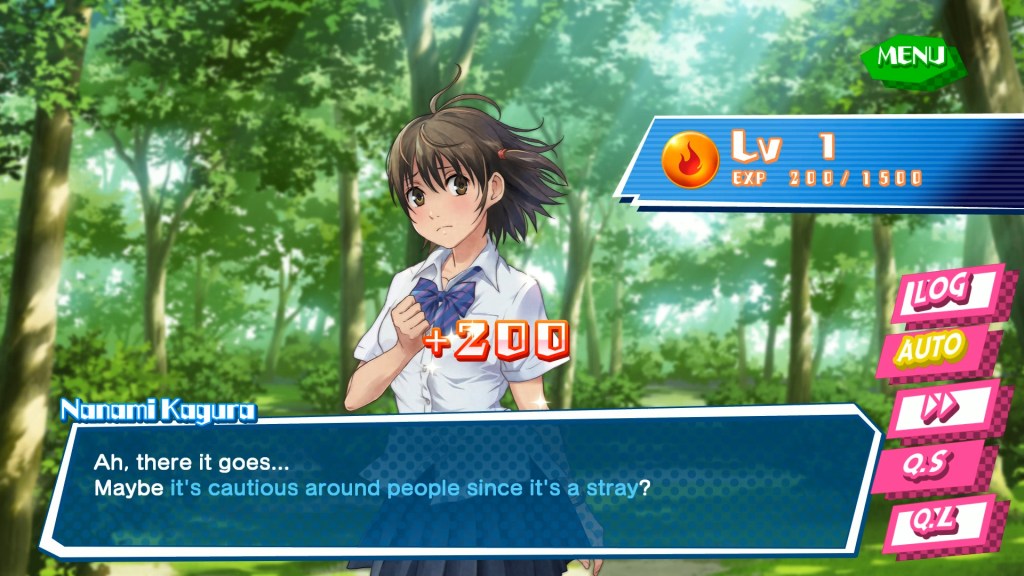
There is also a rather simple levelling system, where the power of the Kotodama Gems will gain increased strength. This is accomplished by collecting color coded words, which are added to a magical book. When enough words of a set color are collected, the level of the associated gem will be increased. By strengthening the words, the investigation puzzles will become a little easier, but still pose a challenge.
If the player wants to practice, they will be able to go to the dormitory and use the power of Fantasize. This is a type of free play mode, where the player can freely play the puzzle stages. This lets the player polish their skills, set new scores and even unlock new underwear to be revealed. As puzzles are cleared, the target character will be added to this mode, so they can be challenged freely. This mode can also be accessed from the main menu.
Last to discuss is the additional side content of this release. There is a gallery for the player to view the different images that have been unlocked, this may take multiple attempts to fully fill out. Then there is the Tips section, which holds information on the different characters and story details. Finally, we have Quaker, which is a parody of social networks giving extra bits of story to the player, accessible from a pop up on screen or the menu.
Now with the gameplay covered, it is time to cover the other aspects of this release, starting with the controls.
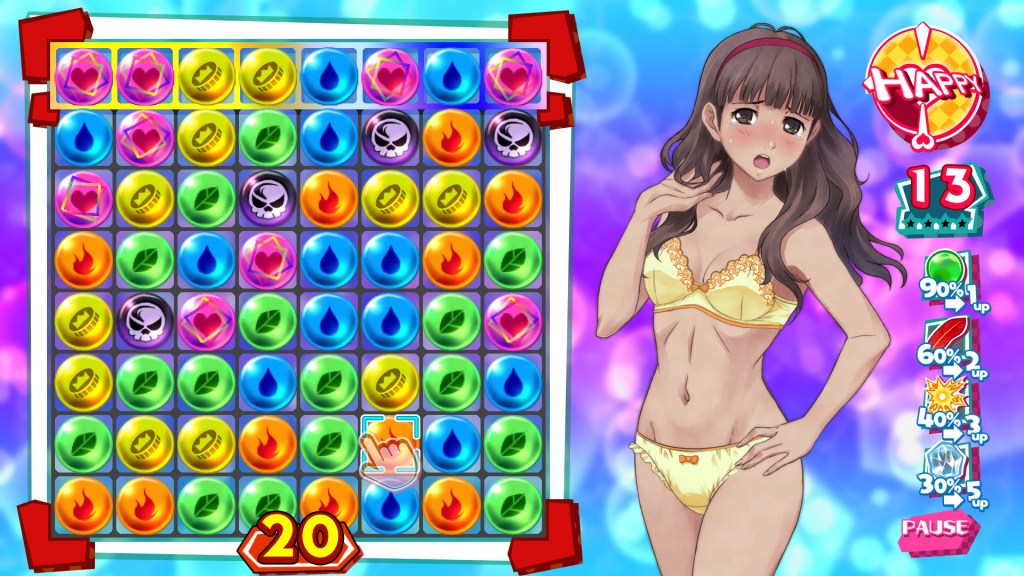
Controls – there is a nice and easy control system for this release, as there is little in terms of complex gameplay. The inputs required will be shown on screen for the player, allowing for quick and easy reference at any time. During the puzzles, the player uses the D-Pad for moving the cursor within the field. The thumbstick is used to move the cursor to the skill actions and apply them to the target. The Nintendo Switch version also supports touch screen controls.
Difficulty – in terms of challenge, for over half of the game there is no challenge, due to the majority of the game experience being a visual novel. But during the puzzle battles, there is a fair amount of difficulty, due to the limited number of moves and possibility to get bad luck. This makes saving important before the puzzles, as it will reduce any time lost from failure. There is a Hard option that can be unlocked for puzzles when conditions are met.
Presentation – from a visual perspective, this is a pleasing title, as it has some art that is very pleasing to the eye. This is from the anime style of art that is used, alongside well designed backgrounds and a good use of color. There is little animation during the puzzles, but it doesn’t impact the game. The music is nice and simple, with some pleasant melodies, there is also a full Japanese voice over for all characters, except the player.

Final Thoughts – I am a rather casual enjoyer of the visual novel genre, due to the unfortunate amount of shovelware on the market. This also applies to the match 3 style of puzzle games, as there is a lot of low quality content out there. However, this game managed to offer a pleasing experience, with both of the genres it uses. The story was engaging and I enjoyed the narrative, with the gameplay adding to the experience by breaking up long stretches of text.
I had picked this game up a long time ago for the Nintendo Switch, and only recently got round to playing it. I was very happy with the experience, with the quality of the gameplay on both PlayStation 4 and Nintendo Switch. There is a lot of gameplay content on offer, with the story routes, endings and free play puzzle options. I am comfortable recommending this game to visual novel fans and puzzle enjoyers, as it offers a lot of content in a modest package.
In the end, I give Kotodama: The 7 Mysteries of Fujisawa a final score of 4.5/5. This is a fun and enjoyable mix of visual novel and puzzle gameplay, with a story that is engaging and well written, with multiple routes, endings and a lot of replay value for players to enjoy. If you want to check this game out for yourself, a link to each version of the game will be below.
Link to PlayStation version (HERE)
Link to Nintendo Switch version (HERE)
Link to Steam version (HERE)
 W.Kohaku Media