
Overview – developed by Zenovia Interactive and published by Retroware, Neon Inferno is a blend of Run n’ Gun action and gallery shooter, taking place in a neon soaked cyberpunk New York. In 2055, NYC is split into territories where battles for domination take place, between several major factions including the Yakuza and NYPD. This title is to be released on all console platforms and Steam, with a link to each version of the game at the bottom of this review.
Disclaimer: before I get into the review, I would like to thank Retroware for providing the copy of Neon Inferno that was used for this piece. The provision of this software has not influenced the contents of this review, all thoughts and opinions contained within are my own.
Now with the introductions out of the way, let’s get into the review, starting with the story. I will be discussing the core gameplay experience, omitting some details as I don’t want to spoil the experience for players, while also being unable to test the co-op gameplay.

Story – in the year 2055, NYC has become a dystopian warzone, with conflicts that are spread across the city. Within the neon soaked cityscape, there is a battle for control between warring factions. The Family, a notorious crime syndicate deploy their two most important assassins, Angelo Morano and Mariana Vitti, as they seek to eliminate their rivals. To dominate the city, the assassins must take on the Yakuza, the NYPD and those who arm them.
Gameplay – Neon Inferno is a mix of Run n’ Gun action and gallery shooter, similar to games like Wild Guns and Contra. There are three main game modes for players to enjoy, with the story mode being where the majority of the action takes place. With six missions for players to challenge, which have three distinct difficulty settings. After selecting the save slot, character and difficulty, the game will start and the player will be thrown right into the action.
The player will play through a tutorial, showing all of the mechanics for gameplay, with the foreground and back ground shooting, melee combat and general movement. Once the tutorial is cleared, the first mission starts. During missions, the player will need to battle their way through the stage, fighting enemies in mostly side scrolling action. As the player makes their way through a stage, they will need to blast their foes away.

When fighting enemies in the foreground, the player will be able to shoot in 8 directions, with the base weapon having an unlimited number of shots that the player can use. There will also be enemies in the background of the stages, which use the background crosshair to shoot, with a standard and fast option. Then there is the melee attack, which uses a green blade to strike enemies and deflect enemy attacks, sending shots back to them.
As the player uses the blade to deflect and block attacks, they will gain adrenaline which can charge up into five levels. This is very important, as the adrenaline is used to activate Bullet Time. By holding down the melee button when successfully deflecting green shots, the player will be able to aim their redirected shots. When using bullet time, the attacks can be aimed in the foreground and even sent into background, dealing increased damage to enemy forces.
During the missions, the player will be able to jump, double jump and crouch to avoid the attacks of the enemy. But the player will also be able to use the dodge roll, which can help the player bypass attacks and some environmental hazards. The dodge will make the player invulnerable for a small amount of time, which is very useful during more hectic sections. It will also be required to climb ropes, hold rails and hang from platforms during the missions.

Each of the missions are made up of several segments, where players will need to keep maintain their focus as there is danger everywhere. Not only will the player need to deal with the standard ground forces, which can be taken out in a single shot, there will also be heavy/armored forces to deal with. These enemies are more robust, requiring a lot of damage to take down. A health bar appears above them when they are damaged.
Then there are the vehicles, which include heavily armored tanks, helicopters and more to deal with. Some of these mechanised forces will drop bombs or fire shots before leaving, making them more of a nuisance rather than a genuine threat. However, when many of them appear, they become deadly to the player. Thankfully, through effective use of the dodge mechanic, it is possible to make it past these enemies with minimal injury to the player.
Within some of the missions, there will be auto scrolling sections with most of them using vehicles, including a motorcycle and a train car. During the bike areas, the player will need to dodge enemy fire, while also moving between lanes to avoid civilians. These sections are intense and challenging, with enemies appearing from all directions to attack the player. Thankfully, there will be warnings to show when hazards are appearing.

At the end of the mission, and during some of them, the player will engage in battle with challenging bosses. During these encounters, a bar will appear on the screen showing their name and total health. The bosses that the player needs to fight include giant military vehicles, a human weapon and even a Yakuza mob boss in an mech suit. Many of the boss fights have multiple phases, with the battle changing upon clearing the first segment.
When the mission is cleared, the player will be taken to a results screen, where they will be given a monetary reward based on their performance. There will be a base amount for the mission, with bonuses and penalties that will be applied. The bonus is usually for the clear time, but the penalties vary, with the most punishing being the collateral damage penalty. If a civilian is killed, either by the player or enemies, heavy penalties will be applied for each death.
There is also a rating system where players will be awarded a star rank, alongside a title depending on their performance. For the Novice and Medium difficulty, the player will only be able to earn a maximum of three stars for a mission. This means the player will need to play through the game on Hard if they want to earn 5 star rankings in story mode. The player will be able to earn up to 5 stars in Arcade mode (discussed further below).
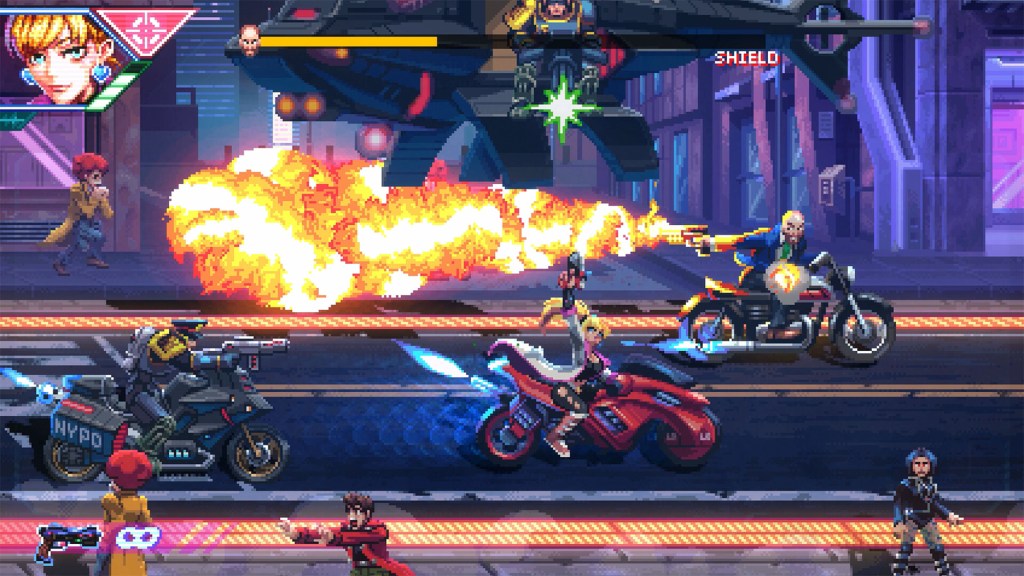
Between missions, the player will be able to visit a shop, where weapon power-ups can be purchased using funds earned from missions. These vary in cost, offering temporary power-ups to weapons and a shield for the mission. Only one can be selected before going into the next step. After visiting the shop, the player will go into the mission briefing, where the Don will give the player their mission, providing details and objective.
During the main body of the game, there is a non-linear approach to the missions, where the player will be able to select the objective they want to take on. Before the player makes their decision, there is an option to get details on the mission. This will provide background on the character, where they need to go and what the target is. It doesn’t appear that the sequence the player chooses has any impact on the game experience.
Throughout the game, there will be cutscenes with interactions between the characters, which help to push the narrative forward. These cinematics are shown in a dynamic way, adding to the experience of the story. There will also be in game scenes, which often occur before a boss battle happens. All of these give the story beats more impact, deepening the story and making the dystopia of the neon soaked NYC feel alive.

Away from the main Story mode, there is Arcade Mode, which offers a brutally tough challenge those who want to push their skills to the limits. In this mode, the player will have one credit to try and get as far as possible. Unlike the story mode, there will be no checkpoints, meaning death will be a significant setback for the player. Then we have the final game mode, which is the mission replay mode, to try and improve rankings.
In the mission replay mode, all of the cleared stages can be challenged again, letting players try to improve their ranking on the missions. When selecting a mission, players can choose to play the entire mission from the start, or a single section of it at the cost of being ranked. After selecting their choice, they will also be able to select the difficulty from the three choices in story and arcade difficulty. This makes mission replay a very valuable practice tool.
Now with the gameplay covered, it is time to discuss the other aspects of this release, starting with the controls.
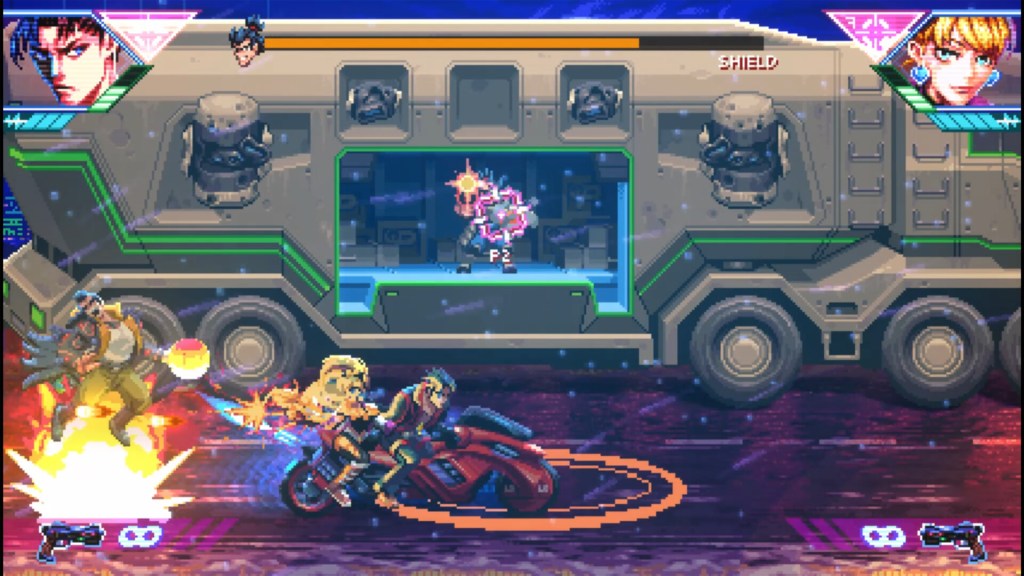
Controls – Neon Inferno is best played with a controller, but there is the option for keyboard to be used. It is highly recommended to use a controller, as there are several buttons that need to be pressed at the same time. In general the controls are laid out in an easy to use manner, but can feel a little clumsy and awkward when first starting out. For those who need to make adjustments, there is the ability to remap the inputs for the game.
Difficulty – this is a very challenging game, requiring a lot of pattern memorisation, as well as trial and error. This is due to the frequency of enemies, the different types of attacks they use, as well as the very tricky boss fights. Thankfully there are difficulty settings that adjust the gameplay. Novice (easy), has greatly increased health and modified enemies, Medium is balanced for all players and Hard features brutal enemy patterns, with the least health available.
Presentation – Neon Inferno has visuals that are reminiscent of the 32-Bit era of gaming, featuring large bold sprites and vibrant use of color, especially with the different cityscapes. The environments, set pieces and general experience look beautiful, which are further enhanced by the excellent cinematic sprite art. Then we get the sound, which is excellently crafted, adding atmosphere to the action on screen and the dystopia it takes place in.

Final Thoughts – for the longest time, I have been a fan of games like Metal Slug, Contra and Wild Guns, which made Neon Inferno very appealing to me. When I got my hands on the game, I had some teething problems during the early stages, but as I got deeper into the game, everything fell into place. The game mechanics are a lot of fun, with smooth gameplay that is reactive, fast paced and a challenge that is tough but fair.
The story is well written, which is accompanied by imagery that reminds me of titles from the PC-98 system, with the highly detailed cinematic sprite arts. I very much enjoyed the narrative, pacing and flow of the game, especially with the non-linear approach with most of it. There were no issues with the experience, aside from a couple hiccups when learning the controls. I am happy to recommend this game, as it weaves two game styles together seamlessly.
In the end, I give Neon Inferno a final score of 5/5. This is an excellent action shooter, blending the Run n’ Gun and Shooting Gallery styles together perfectly, with the cyberpunk setting, vibrant visuals and atmospheric soundtrack all working in harmony. If you want to check this title out for yourself, a link to each version of the game will be below where possible, as well as link to the official site.
Link to Steam version (HERE)
Link to Nintendo Switch version (HERE)
Link to PlayStation version (HERE)
Link to Xbox version (HERE)
Link to Official Site (HERE)
 W.Kohaku Media
This is a well-made review, and I have to say the game looks quite interesting. I love the art style, and the game looks pretty fun. Never played any of these games, Metal Slug, Contra. I did play Contra on the DS, but I was bad at it. I will check this game out when I can. :3
LikeLiked by 1 person