
Overview – originally developed by Taito and M2, with publishing handled by ININ Games, Ray’z Arcade Chronology is a collection of shooters from the 90s. Play through all three entries of the RAY arcade series, with special enhanced variants of the 3D entries of the series. This release is available on the Nintendo Switch and PlayStation systems, as well as special physical versions from Stritly Limited game (while stocks last) with a link to each version of the game at the bottom of this review.
Disclaimer: before I get into the review, I would like to thank PR Hound for providing the copy of Ray’z Arcade Chronology that was used for this piece. The provision of this software has not influenced the contents of this review, all thoughts and opinions contained within are my own.
Now with the introductions out of the way, let’s get into the review. As this is a compilation title, I will be covering the individual titles in this release, providing some plot details where available and discussing the gameplay systems in release order.

RAYFORCE – 1994
Plot – In a distant future humanity constructs a massive neuro-network supercomputer called Con-Human, with the purpose to maintain the environment of the earth. This is to ensure the continued existence of earth and its inhabitants. However, this system does not last, as the mind of a cloned human becomes linked to Con-Human, leading to it becoming sentient and corrupting its mind. This leads to the machine attempting to exterminate that it was made to protect.
After a prolonged war with humanity, Con-Human was able to wipe out almost the entire population, leading the survivors to flee into space. After defeating the human resistance, Con-Human has altered the very earth itself, transforming it into an extension of his body which it plans to use to eliminate the rest of humanity. To prevent this, the remaining humans go on the offensive, planning to fight the genocidal machine even though it will destroy the earth.
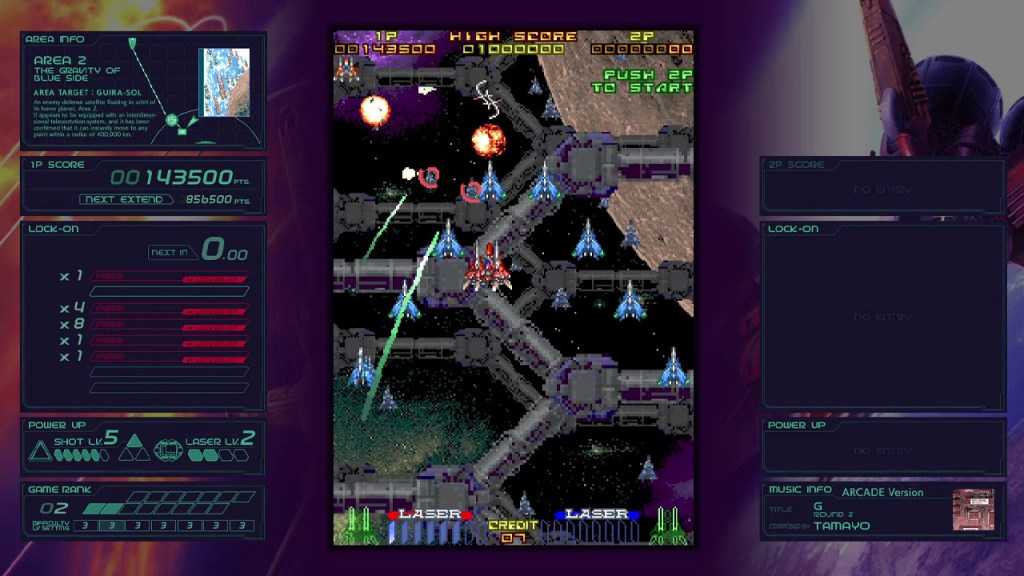
Gameplay – RayForce is a pixel art scrolling vertical shooter consisting of 7 stages for the player to take on, each with a large scale boss battle for the player to take on. The player must shoot down wave after wave of enemies, dodge bullets and collect power ups as they make their way through the stages. The enemies that the player will face will have a range of attack patterns, while appearing in two separate layers of the screen.

The layer system of the game is the key selling point of RayForce, as it utilizes a very special weapon system which revolutionised shooters of the time. Like most vertical shooters, the player is armed with a standard shot that they fire directly up, this can be improved and strengthened by collecting power-ups. However, there is a special weapon that players can use in RayForce, the “LOCK ON LASER” which can target several enemies in the layer below to attack them.
These systems work together to create a system that is challenging, as the player will need to be aware of both levels of the screen. This is due to the way that enemies can move between layers, leading to players needing to quickly change the weapon they are using. The lock-on weapon is also important to getting a high score, as the weapon can target up to 8 enemies (when full levelled up), leading to huge combo scores.
There are local and online leaderboards for this game, where players can test their skills and try to reach the top spot, depending on the conditions set. There is also simultaneous co-op play in this release, where two players can work together to take on the machines and eliminate Con-Human together. When a player runs out of lives, they can jump right back in when continuing. Finally, there is a replay system where players can save a video of their best runs (available in all games).
RAYSTORM – 1996
Plot – in the year 2119, travelling into space has become a reality, with the world working together to expand humanity throughout the solar system. During this expansion, the government of earth establishes the Star Federation, which are responsible for maintaining peace and order in the colonies. However, by 2219, humanity has quickly expanded the colonies all the way to Orion, which has made it difficult for the federation to maintain control.
As the federation lost control, they implemented martial law which oppressed the inhabitants of the colonies, leading to the formation of rebellion. On the planet Secilia, the rebels establish the Secilia Foundation, beginning their fight for freedom. After countless battles, they defeat the Star Federation and Secilia plan to destroy the earth. This leads to a desperate struggle for the survival of the earth, as the R-GRAY ship is launched as part of OPERATION: RAYSTORM.
Gameplay – just like its predecessor, RayStorm is a vertical scrolling shooter where the player will battle against waves of enemies, as well as large scale bosses at the end of each stage. The game is broken up into 7 stages again, with a special 8th stage against the final boss. The majority of the gameplay in this title remains the same, except for a few changes to the core mechanics that make this title unique from the first.

The new systems of this title are the changes to the Lock-on Laser system, which can be used in both layers of the playfield. This allows the player to target enemies below and infront of them, increasing the potential for big combos and approaches to the stage. There is also a new special attack that will deal significant damage to the enemies on screen. This needs to be charged after use, by successfully downing enemies.
There is also a new ship type that the player can do, with a different set of weapons that function differently to the standard set. These are a twin beam that replaces the standard spread shot, alongside a lightning style laser and a special attack that launches a huge explosion at the front of the ship. There is also two control options, offering a simplified way to play and these new systems offer a new approach for players each time they take on this challenge.
Just like the previous entry in the series, this title offers two player co-op gameplay with both players working together, as well as the inclusion of leaderboards that players can submit scores to. What makes this title, as well as its successor RayCrisis different from the RayForce title is the changes to the visuals. This title introduces polygon graphics, which replace the pixel art of the original title as well as a wider screen ratio rather than the narrow screen.

RAYCRISIS – 1998
Plot – as a prequel to RayForce, this is set during the events that led to the rise and rebellion of the Con-Human supercomputer. During the creation of Con-Human, a scientist attempts to bond the mind of a cloned human with the machine, leading to the system gaining sentience. After this, the computer begins its attack on humanity, laying siege to the earth as it attempts to exterminate the imperfect beings that created it.
In an attempt to bring the system back under control, a mecha-neurologist connects to Con-Human and attacks the machine from within using computer viruses. These viruses are called Waveriders, planted directly into the cybernetics link of Con-Human, in the mission Operation RAYCRISIS. This battle with the now sentient machine is the only way to bring it down, stopping the computers destructive plans and attempting to prevent it from causing any more damage.
Gameplay – RayCrisis follows the same core gameplay formula as the previously discussed games, however, this title has mechanics that make it unique from the rest. Introduced I this entry is the codename system, where players are able to enter their initials or a series of 4 characters/numbers to remember their records. This allows for players to experience another new feature to the series, the randomised map set.
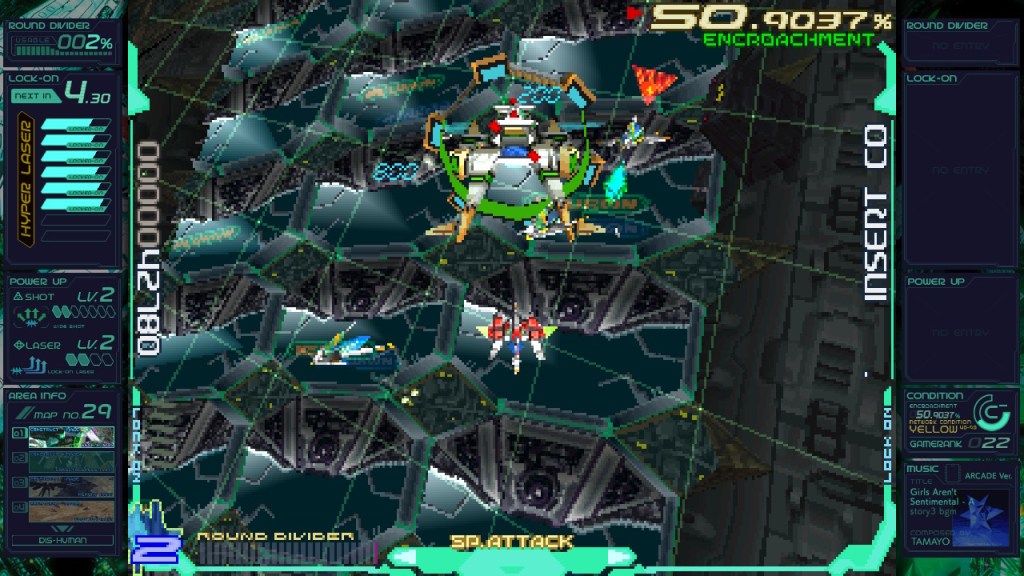
When starting a new game for the first time, the player will go through the five stages of the game, battling waves of enemies and bosses. Then at the end of the stages and the battle with the final boss, the player is then given a ranking based on performance, with the details attached to that codename. Upon starting the game again, if the player enters the same code at the start, the player will be given a choice of new stages to play or the previous set.
As well as the new stage system, there is a dynamic difficulty mechanic tied to the Encroachment system, which is affected by the performance of the player. During play, the meter will increase as enemies fly past the player and as time passes, but the player will be able to lower the percentage on screen by quickly dispatching foes. If the meter is lower, enemies will become more aggressive, but if the meter is maxed the player is sent to the final boss.
This ties into the endings of the game, as there is a total of three possible endings that the player may get. There is a standard ending from playing the game normally, a bad ending if the Encroachment meter is maxed out and a secret ending if specific conditions are met. These different endings add to the replay value of this title, pushing players to do their best to try and get the special secret ending in a run.

The weapon systems of this game have been altered too, with a new bomb attack called the Round Driver, as well as the Hyper Laser if one part of the enemy is targeted with all shots. These special weapons give massive point boosts to the player score and can help with lowering the encroachment rate. There is also a special third ship that can be unlocked for players to experiment with, either by meeting special conditions or via a secret code.
And finally, just like the other games, the player is able to put their scores on a worldwide leaderboard, challenging other players scores in an attempt to reach the top spot. This release also pushes the 3D aspects of the game further, with a wider variety of on screen effects and varied locations that can be pulled from. But with all the advancements that the game made, it feels the slowest out of the three titles in this pack.
Now with all of the games discussed, it is time to cover the other aspects of this release, starting with the controls.
Controls – as these are arcade games, the controls for the games are very straight forward, with only two buttons needed for the majority of the games. The inputs for all games are simple with shoot and laser as the default settings, with options to have bombs as inputs in RayCrisis and RayStorm. The menu, credit and start buttons are also mapped to the controller in accessible ways, but players can modify the buttons to fit their controller of choice.

Difficulty – these shooters verge into bullet hell territory, with a lot of enemy shot patterns that can make it very difficult to make it through the game without getting shut down. However, there are difficulty settings in all games for players to tailor the experience to their skill levels, with multiple options to help players make it through. This is likely the best shooting collection for players who want to get into the genre.
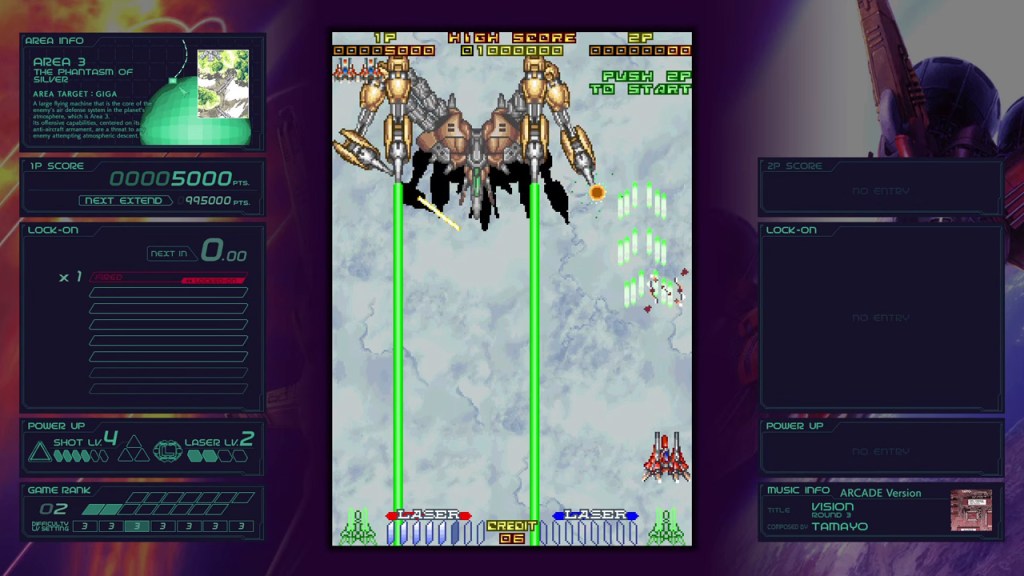
Presentation – as a set of arcade titles from the 90s, the visuals may seem primitive to some, but the graphical look to each of the games is still pleasing to the eye. The original graphics of these games still look good, with several options for filters and different aspect ratios, alongside new HD versions of RayStorm and RayCrisis in this pack. There is some slowdown in the 3D games, but this was present in the original versions of those titles, so it isn’t a fault of the system.
The sound design of these games is excellent with sound effects that have a lot of weight and impact to them, accompanied by a soundtrack composed by ZUNTATA, Taito’s in house band. The music that is featured in these releases is the original soundtrack that was included with the arcade versions, alongside a new arranged set of tracks for the games. There is also the inclusion of “arcade ambience” background sound that gives the feeling of playing in an actual arcade.
Final Thoughts – I am a fan of the Ray series of vertical shooters, having played the home versions of RayForce on the Sega Saturn and RayStorm on the PlayStation many years ago. So getting my hands on this collection was a real nostalgia trip, but it was also a new experience since I hadn’t played RayCrisis before. So for me it was a little bit of a mixed bag, as I knew what to expect from the first two but not the third.
I had a great time playing RayForce and RayStorm, but not so much with RayCrisis, as the changes to the gameplay systems, shorter play time and overall feel of the game were different to the others. This was rather jarring as there is no real way to know what to expect with each run of the game, which made it harder to make any real progress in terms of skill compared to the others. But, it will offer a great challenge to those who enjoy the random style of play.
I am happy to recommend this collection to all fans of the series, as it is likely the best way to enjoy the games, outside of owning the actual arcade hardware it was made for. Having the complete trilogy of Ray shooters in a single pack is one thing, but the bonus HD remasters of the 3D games, the arranged soundtrack, online leaderboards and even a replay system makes this the ultimate release for fans. However, I feel the price point is rather high for arcade games.
In the end, I give Ray’z Arcade Chronology a final score of 4/5. This is the definitive collection for fans of the Ray series of vertical shooters, with the original games presented as they were in arcades, with bonus HD titles and new arranged music that makes this an awesome, but pricey package. If you want to check this release out for yourself, each version of the game will be available below.
Link to Nintendo Switch version (HERE)
Link to PlayStation version (HERE)
Link to Physical release (HERE)
 W.Kohaku Media