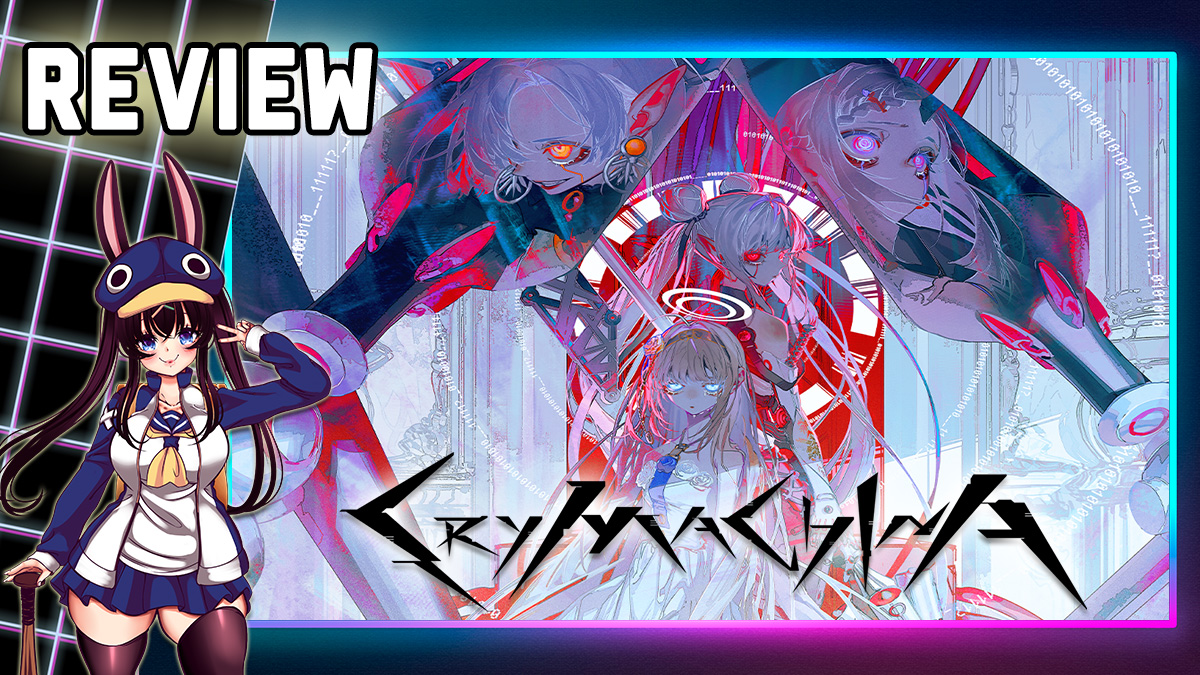
Overview – developed by FuRyu and Aquaria with publishing handled by NIS America, CRYMACHINA is an action RPG set in a post-apocalyptic future, where humanity has gone extinct. As a team of mechanical girls, fight for survival and to understand what it means to be human. This title is available for the Nintendo Switch, PlayStation 4/5 and Microsoft Windows, with a link to each version of the game at the bottom of this review.
Disclaimer: before I get into the review, I would like to thank NIS America for providing the copy of CRYMACHINA that was used for this piece. The provision of this software has not influenced the contents of this review, all thoughts and opinions contained within are my own.
Now with the introductions out of the way, let’s get into the review, starting off with the story. Please be aware that I will nly be covering the core components of the experience to prevent spoilers. This title is the successor to FuRyu’s previous action RPG Crystar, which I have reviewed (HERE) so please check it out if you haven’t already.
Story – Set in a distant future, long after mankind has gone extinct, there is a vast structure drifting through space known as Eden. Within Eden, self-evolving mechanized life forms called Dei ex Machina operate with a single goal, the restoration of Humanity. However, due to unknown events, Propator, the first Deus ex Machina, was lost and now balance of Eden is in turmoil, leading to war between the remaining machines.
To cease this upheaval a group of girls have been resurrected, with their minds placed in mechanical bodies called E.V.E. guided by Enoa, the Eighth Deus ex Machina. To achieve this goal, they seek to become recognised as “Real Humans” by the Dei ex Machina, attempting to stop the violence and survive. Can these girls bring the chaos to an end, help the machines and save Eden from this perilous situation.
Gameplay – CRYMACHINA is an action RPG, which utilises both dungeon crawling and action brawler gameplay, with a touch of the classic visual novel storytelling. In this release, the player will take on challenging mechanical foes and deadly bosses, through intense hack and slash battles. The gameplay loop is split between the action and the story, with the narrative segments progressing the game in between action stages.

Before the player can jump into the action, they must select an available destination from the network list. As the game progresses, there will be more areas for the player to select from, widening the available zones for players to explore. The majority of the stages that the player can access are separated into three distinct areas, the gateway, checkpoint and central core. But there are secret areas that can be discovered by the player.
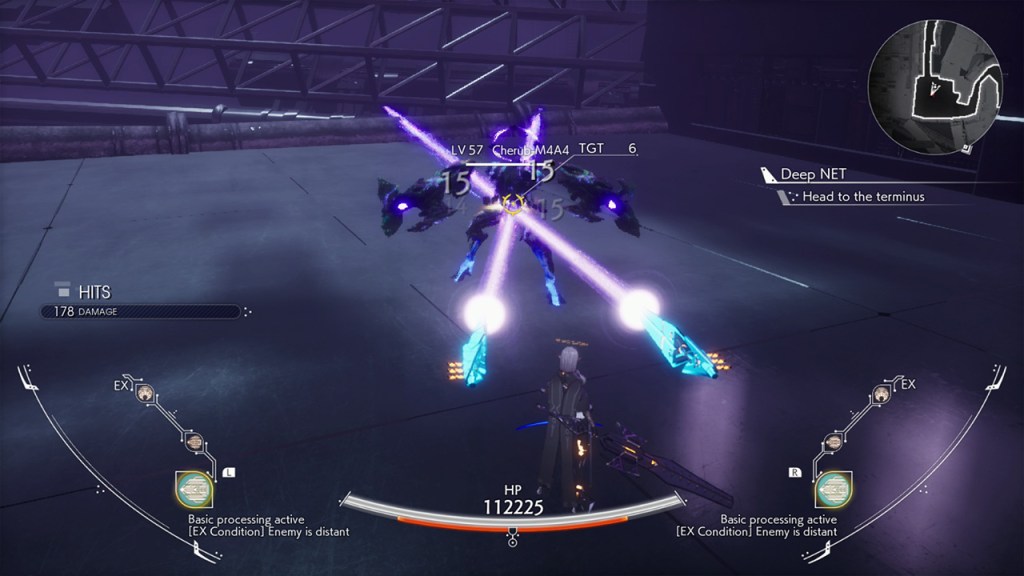
Each of the mission stages will see the player exploring different parts of Eden, battling mechanical foes and bosses at the end of each area. The common enemies that the player will encounter while traveling each of the zones are known as Cherubim, robotic enemies that appear in a range of types with different attacks for each. The girls with their E.V.E. bodies can fight back with a range of attacks, each of them having a unique move set.
Here is a breakdown of the core attacks that players can use during battle with their mechanical foes;
- Basic Attacks – each of the party members can use light combo attacks, attacking enemies in rapid fashion. Then we have the heavy attacks, these are used to launch enemies when the player has damaged them enough to put them in a weakened state. The heavy attack can also be charged up, dealing additional damage to the target enemy.
- Auxiliaries – these special weapons float behind the character with abilities based on their type, with the capability to enhance them with items called Sentiments. Each of the auxiliary weapons can be mixed and matched, but some are better suited to one character over the others. But be aware that overuse can cause them to Overheat.
- Ranged Attack – each of the party members have their own ranged attack, which has two different functions that can be used in battle. The main function is the single attack, where the player taps the fire button to attack enemies. Then there is the charge attack which deals increased damage, which can wear down enemies faster.
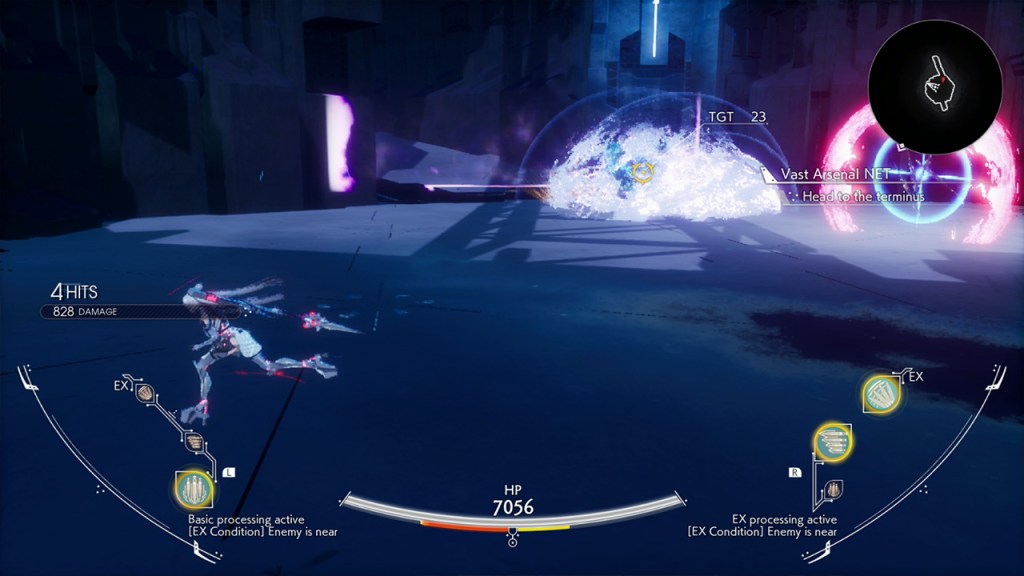
- Finishing Assault – when the enemy is weakened, the player can attacks to knock them down, putting them in a downed state. During this period, the player can deal additional damage to their foes by using the Finishing Assault, a special power attack that will deal massive damage to enemies.
- Enoa Support – the Deus ex Machina Enoa, supports the party in battle, providing four different functions for the player to utilize during missions. These are Emergency Repair, which allows the player to heal. Remote Assault, letting the player deal damage to a specific target with the chance to weaken them. Awaken, which puts the player in a special powered up state for a limited time and Return to base, which exits the mission.
- Defensive skills – all of the E.V.E. are equipped with the ability to dodge and parry, with bonuses that can be applied based on the unique qualities of the party members. If the player is able to time their dodge or parry correctly, they may be able to initiate a counter attack, which can lead to severe damage to enemies.
Throughout the game, players will earn ExP (pronounced E-cross-P) which function as the experience system for this release. As the player defeats enemies, the active character will gain varied amounts based on the challenge that the enemy provides. If the foe is many levels above, they will gain more ExP and if they are many levels below they will get reduced or even zero ExP. This resource is accumulated into a pool that is used in the home base (discussed further below).
At the end of each stage, the player will encounter bosses that they must fight to progress, these include powerful Demi-Cherubim, other E.V.E. and even Deus ex Machina. These battles can be very intense and will often push the player to their limits, with some of the encounters being extremely tough, multi-phase affairs. When these battles are completed, the player will get a clear time, a count of the damage taken, total ExP accumulated and more.

There will also be items that players can collect during the adventure, with equipment that can strengthen the player. These will be found on what looks like corpses, with some of them requiring puzzles to complete to obtain. The items that appear are randomised, with the strength of them depending on the area that they are located. These power-ups are used as a reward to encourage exploration and repeated play of the stages.
Outside of the action stages, the player will visit the Imitation Garden, a special virtual world that acts as the home base for the player. Here the player will interact with the characters and learn more about them, gain more insight into their stories and so much more. Here are the features that can be accessed in the Imitation Garden;
- Enoa – the Eighth Deus ex Machina, Enoa, offers a range of facilities for players to use which are important to the success of the mission. Enoa operates the Data Transport Terminal, which is used to access the action stages. She also has the ability of Code Analysis, which will allow the player to check data collected from bosses to unlock new power-ups and earn EGO.
- E.V.E. Tuning – Enoa also provides the ability to level up the E.V.E. frames for each of the playable characters, which will increase their base stats and make them stronger. To level up the character, the player must use ExP points earned during battles. There are limits to the level that can be reached, which increase depending on the progress of the story.
- Combat Support Programs – the player is also able to strengthen the support abilities of Enoa, using EGO that has been accumulated during play. EGO can be earned in a variety of ways, with the most common being the Tea Party and Code Analysis. When powering Enoa up, players are can increase the number of support uses, as well as the efficacy of her skills.

- Communication – here you access the Tea Party, which are visual novel style scenes where players can learn more about the characters and world. There are two types of scene that can be accessed, split between mandatory for story progression and optional for extra side content. Players can also change costumes in this menu, with free and paid DLC costumes.
- Combat Analysis – players can check their achievements, battle record and check the tutorials that are shown throughout the experience. This is the best way to refresh yourself with the mechanics if you need to remind yourself how they work.
- Materials – in this section, players can look at the information gathered from Personality Data dropped by bosses, as well as profiles of the characters that have been encountered. There is also an archive for the information drops collected during play, with secrets to discover, along with a music player that lets players enjoy the soundtrack away from stages.
All of these elements combine to create an experience where the action gameplay is tied directly to the story, which breaks up the flow in a positive way. The action and narrative split system works well, fleshing out the characters with new details in a way that feels natural. The breaks in the action also allow players to improve their E.V.E. and equipment, letting players equip new equipment and use their resources to level up.
The weapons and armours can be equipped during the stages, but it is recommended to add new gear beforehand to make the most of it. If a player has equipment that is of a lower level, is duplicated or doesn’t work well, then they can be dismantled to gain EGO, which is used to upgrade the E.V.E. frames and Enoa’s abilities. There are many uses for the resources gained during play, with experimentation being the best way to approach them.

There are many secrets to discover, with the optional story segments, secret areas and more that this game has. The overall experience has a good balance of story and gameplay, but for those who just want action, the narrative segments can be skipped. There is also a special “Casual Mode” for players who want to focus on the story, allowing for the more difficult sections of the game to be cleared easier.
Now with the gameplay covered, avoiding any spoilers, it is time to move onto the other aspects of this release, starting with the controls.
Controls – this release has a control system that is easy to pick up, but very hard to master, with the main actions on the face and d-pad, with the dodge and Auxiliaries tied to the shoulders. The movement works very well, with the camera and character controlled via the thumbsticks. During play, there are no issues with input lag, however, the travel distance of a Joy-Con sticks can make it difficult to quickly change directions at times.
Difficulty – there is a fairly moderate difficulty curve with this title, as the player is eased into the gameplay experience. But, there is difficulty spike mid-way through the game that may be very challenging for some players, but after it does settle down again. This can be adjusted via the Casual mode, which makes the game easier at the cost of reduced rewards, allowing for the more inexperienced players to get through the adventure.

Presentation – the artstyle that is used for this game is beautiful, with a very stylised look to the character portraits that are used during the story. This contrasts well with the environments, character models and enemies that are encountered, which round out the whole world. There is a dark and oppressive atmosphere to Eden itself, with the use of darker shades in comparison to the warm colors that can be found in the Imitation Garden.
The cutscenes that are featured throughout are executed well, which fit the mood that they are trying to portray. There is also an amazing opening animation after the introductory section, with a fantastic theme that sets the overall tone for the experience. The soundtrack for this title is a treat to listen to, featuring compositions that breathe life into the cold world of Eden, along with Japanese voiced dialogue throughout that enhances the presentation.

Final Thoughts – when I played the previous ARPG outing Crystar I had a great time with it, which made the anticipation for this one much greater. When I got my hands on this game, I was not sure what to expect, but I can happily say I was not disappointed. The story was fantastic which kept me engaged for the entire experience, with moments that pulled an emotional reaction from me, all augmented by a fantastic soundtrack from composer Sakuzyo.
The action works very well, with a system that is very simple to pick up, but has the depth of challenge that can really push players. It may feel repetitive to some, but there is enough diversity with the playable characters and Auxiliary weapons that keep the action fresh. I am happy to recommend this game to everyone that enjoys Action RPG titles, or is looking for a good narrative to enjoy. However, the areas of increased difficulty may be off-putting for some players.
In the end, I give CRYMACHINA a final score of 4.5/5. This is a fantastic action RPG title, as well as the perfect follow-up to Crystar, with combat that is easy to pick up but hard to master, a cast of characters that I became invested in and a narrative that elicited an emotional reaction from me. If you want to check this title out for yourself, a link to each version of the game will be below.
Link to Nintendo Switch version (HERE)
Link to PlayStation version (HERE)
Link to Steam version (HERE)
 W.Kohaku Media