
Overview – developed by Renegade Sector Games and published by Eastasiasoft, Diorama Dungeoncrawl: Master of the Living Castle is a low-poly action adventure set in a medieval fantasy world. Take on the powerful enemies that stand in the way of our hero, wielding their hammer of power to fight the hordes of evil. This title is available on all major console platforms, with a link to each version of the game at the bottom of this review.
Disclaimer: before I get into the review, I would like to thank Eastasiasoft for providing the copy of Diorama Dungeoncrawl: Master of the Living Castle that was used for this piece. The provision of this software has not influenced the contents of this review, all thoughts and opinions contained within are my own.
Now with the introductions out of the way, let’s get into the review. There is not much of an in depth narrative for this title, so I will be going straight into covering the gameplay. Please note, I will be referring to this title as Diorama Dungeoncrawl, for the sake of brevity.
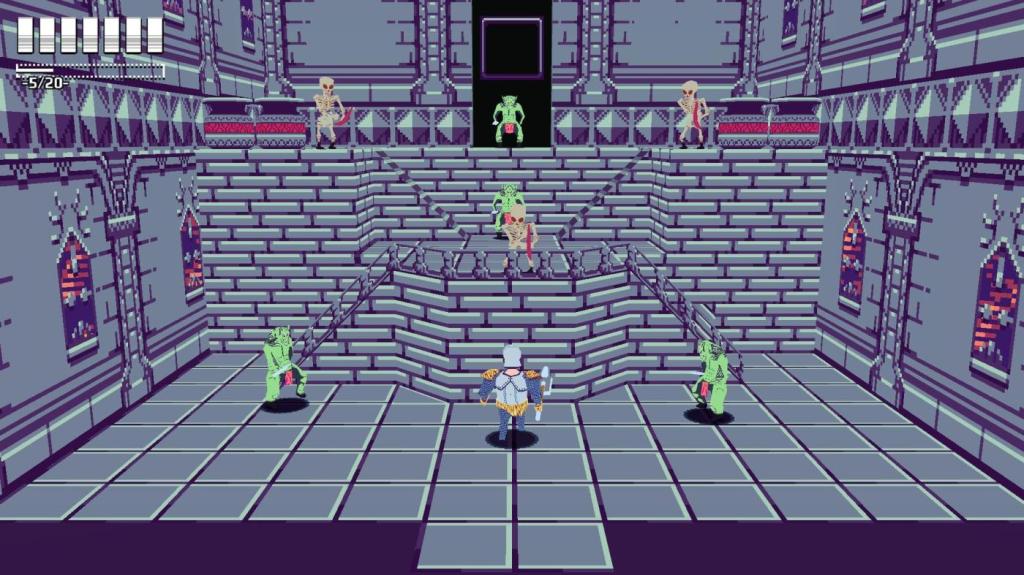
Gameplay – Diorama Dungeoncrawl is a 3D roaming brawler, inspired by the hack and slash action titles of the past. The player takes the role of a nameless knight, who is on a quest to take down the necromancer that lives in the Living Castle. To achieve this, the player must guide them through different areas, fighting deadly enemy forces that guard the castle. There will also be traps and hazards that must be navigated to survive.
The player has only one attack as standard, which is swinging their powerful hammer, but there are some additional power attacks that can be used. If the player holds down the attack button, they will unleash a powerful strike, with special magic that can be picked up. However, these attacks use up energy which is limited, but can be replenished to some degree by breaking pots found in the different stages of the game.
The pots that can be broken will contain energy pick-ups, magic attacks and health ups in the form of meat on the bone. These items can be very useful, prolonging the life of the player and helping them to defeat tough enemies. The magic power attacks include a projectile, a shockwave attack and a strike that sends a trail of flame forward. Unfortunately, these power-ups are limited to specific points, meaning that they will be lost of the player dies.

The stages themselves are made up of rooms, with enemies, hazards and pitfalls to get in the way of the player. The gameplay loof for these stages is fairly simple, get through the different rooms, reach the boss and defeat them in battle. But in order to stop the player, there will be moments where there is a gate that blocks the way forward. To bypass these gates, the player will need to defeat all of the foes in their way to proceed.
At set points during stages, there will be boss battles against powerful enemies, which will lock the player in an arena for the fight. These bosses are very dangerous and can take the player down in seconds. This is due to the unfortunate way that the game handles hit detection, as the hit box for enemy attacks can be very inconsistent. This applies to the standard enemies too, along with knockback that will send the player flying.
This knockback is made significantly worse due to the level designs, with the player often being thrown into pits or knocked off platforms. This makes the game more difficult than it needs to be, as it is not only an action brawler style game, but also a platformer. The platforming segments work well for the most part, but they can be extremely frustrating. This frustration is compounded by one of the biggest issues in this game, the depth perception.

Throughout the game, there is elevated platforming that can be very difficult, due to the way that the camera is positioned. With the persistent viewpoint, there can be some issues with seeing where moving platforms are, where they end and where the different walls are. This difficulty has the potential to cause many players to miss jumps, fall into pits or simply walk of the edge, which is made worse by enemy projectiles and other attacks.
In an attempt to compensate for the difficulty of the different areas, there are checkpoints at set points during stages. These points will heal the player and save their progress, allowing them to continue from this point when starting the game up. But there are some areas that would benefit from a save/check point, yet simply do not have one and this makes it feel like a grind at times. The game isn’t the longest, but can get tedious and repetitive.
Now with the gameplay covered, I want to move onto the other aspects of this release, starting with the controls.

Controls – the title uses a very simple two button input system, with buttons for the jump and attack. The attack button can be held down for the special attack, which delays the input and slows it down a little. The most unfortunate part of the controllers is the lack of D-pad support, as all movement is tied to the left thumbstick. The standard inputs are responsive and work well, which are fairly comfortable to use, but feel stiff and slow at times.
Difficulty – this is a very difficult game, sometimes to the detriment of the experience. This is due to the knockback, the way that the enemy attacks function and the unfortunate design faults. At times, it feels like the game has been made to be overly diffiuclt on purpose, which isn’t necessarily a bad thing in general, but it does drag this title down. The save points do alleviate this a little, but they don’t save this from being a frustrating and punishing title.
Presentation – visually, the game feels like something that may have been made in the 90s, with very clean and polished low-poly models. The world design is quite nice, with colors that make the environments feel fantastical. There is no issue with frame rate for the majority of play time, but some of the effects do cause the odd stutter here and there. The soundtrack adds a retro feel to the game, with music that use the classic synth/Midi sound.

Final Thoughts – I had previously played titles by Renegade Sector, which have been a mixed bag. Sadly this title was more of the same, with a promising premise that sadly didn’t live up to the potential. There are issues throughout this game that negatively impact the game, with the issues with hit boxes, depth perception and what feels like an unfair difficulty curve. It doesn’t make for a fun experience, feeling like a chore over time.
I am unsure if I am able to recommend this to anyone, as there are too many problems that I feel will cause a lot of frustration for even casual players. From a visual perspective, the game is well executed, with a look that is reminiscent of the titles that inspired it. However, there are so many negative elements to the gameplay, with knockback that feels unbalanced, enemy attacks that are difficult to judge the distance of and bosses that are just unfair.
In the end, I give Diorama Dungeoncrawl: Master of the Living Dungeon a final score of 2/5. This is a retro styled title that had a lot of promise, with the potential to be a fun throwback to the past and the games that inspired it, but sadly the issues it suffers from sap what fun can be had. If you do want to check this game out for yourself, a link to each version of the game will be below.
Link to Nintendo Switch version (HERE)
Link to PlayStation version (HERE)
Link to Xbox version (HERE)
 W.Kohaku Media