Overview – developed by Ten Pennyfingers and Shady Corner games, with porting and publishing handled by Eastasiasoft, Dreamcutter is an action platformer set in a dreamscape filled with nightmares. As Haley, wield the power of the Dreamcutter, a powerful otherworldly scythe that can cleave through the nightmares that cloud her mind. This version of the game is available exclusively for the Nintendo Switch, with a link to it and the original steam release at the bottom of this review.
Disclaimer: before I get into the review, I would like to thank Eastasiasoft for providing this version of Dreamcutter. The provision of this software has not influenced the contents of this review, all thoughts and opinions contained within are my own. Please note, I was involved with some post release development of the PC version, with my name in the credits of that release.
Mature Content Disclaimer: this title is intended for adults only, featuring strong language and content of a sexual nature with some explicit imagery included. If you are under the age of 18 or are uncomfortable with sexual content, please click off this review and check out the other coverage presented on this site.
Now with the introductions out of the way, let’s get into the review, starting with the story of Dreamcutter. Note, I previously covered the steam release of Dreamcutter, with a link to that review (HERE).
Story – College student Haley has been struggling to sleep, plagued by nightmares of monsters and strange places. While in class, she falls asleep and becomes trapped in a dreamscape, unable to escape the nightmare that is unfolding around her. As she seeks to escape, she finds a mysterious weapon, the Dreamcutter, a scythe that is capable of destroying the nightmares. With this new power in her hands, Haley sets out on a quest to defeat her inner demons and gain freedom.
Gameplay – Dreamcutter is an action platformer, with challenging platforming and combo focused combat, wrapped in a visual novel style narrative. The player controls Haley, the college girl who wields the Dreamcutter, granting her the power to fight the monsters in her dreams. When starting the game, the player is given the option of Story Mode or Arcade. The Story mode is the standard gameplay mode, with cutscenes and boss reward events (discussed further below).

During story mode, the player will encounter narrative scenes of characters talking which is presented like a visual novel. These scenes convey the story well, with instances where players are able to select between dialogue options. The dialogue choices that players can make will give different outcomes, but have little influence on the ending of the story. Then we have Arcade mode, where the action plays out the same, however, the only events that occur are the reward scenes.
During the introductory segment of the game, the player will be given a tutorial where all of the core mechanics and moves are detailed for the player. once this opening has been cleared, the player will be sent to the hub world called Sanctuary, where the player can access the 5 worlds of Haley’s mind. The 5 worlds are made up of a set of stages and a boss battle, with the challenge increasing as the player progresses through the dreamscape.
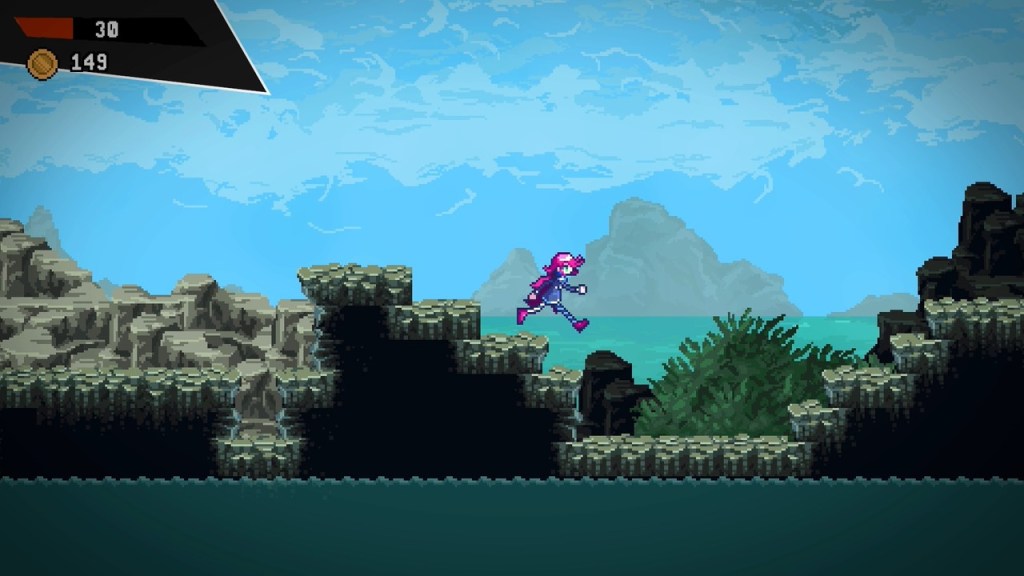
Within the stages, the player must cleave their way through the nightmare creatures, while also using the Dreamcutter to help traverse the terrain of stages. The Dreamcutter serves many uses, as not only can the player swing it to damage enemies, but Haley can throw the scythe, dealing damage as well as using it to launch her upwards when stuck in walls. There are also terrain elements that can be hit by the player, allowing gaps and pitfalls to be covered with ease.

The last part of the Dreamcutter toolkit is the spin glide, which allows the player to spin the scythe and slow their descent or ride air currents. All of these tools will allow the player to pass all of the hazards as well as explore the stages, uncovering the many secrets that are hidden through the game. These skills will also be useful for those who want to try and beat the game as fast as possible, especially as the Arcade mode comes with a timer built in.
While battling the monsters in stages, a combo will occur with a rank from D to A, increasing the more hits that the player adds to the chain. However, there is a meter that will go down over time if hits haven’t been landed on enemies, ending the combo when it is empty. When the combo ends, the player will be given a coin bonus based on their performance, which is added to the total along with the coins that are on the stage and are dropped by enemies.
At the end of the stage, the player will encounter a Nightmare orb that must be destroyed at the end of each level. When the player attacks the orb, waves of enemies will be spawned endlessly, with the player needing to hit the orb until it breaks, clearing the level. When all of the main stages have been cleared, the boss stage will be opened up for the player to challenge, with each of them having their own unique challenges that will push players to their limits.

When the boss battle is cleared, the player will be rewarded with a special intimacy scene, depicting characters in sexual situations. These scenes have been altered from the original, with creative modifications made to the artwork in order to fit the allowed content standards. But these aren’t the only saucy rewards that players can unlock. In the main hub of Sanctuary, there is a shop that players can access, using coins earned in stages.
The coins that players collect can be used to buy upgrades for Haley, increasing her health, damage and more that will come in handy during the adventure. Alongside the upgrades, there are also bonus challenges that the player can unlock, with special rewards for completing the objectives. All of these challenge rewards and the intimate event scenes are added to the gallery. The bonus images are provided by a range of artists. The shop and its contents add more replay value to the game, giving players a reason to return to stages and earn coins.
Now with the gameplay covered, it is time to cover the other aspects of this game, starting with the controls.

Controls – the control method for this release fits the Nintendo Switch controller well, with all of the key inputs matched to the face buttons. During the tutorials and at set points of the adventure, there are button inputs that will pop up on screen showing the player what they need to do. All of the inputs have low input lag, making the transition to the Switch quite well. The game plays comfortably in both handheld and docked, regardless of the controller that is being used.
Difficulty – there is a fairly moderate difficulty curve to this title, where the challenge will build the further the player gets. This is noticeable during the later parts of the game, with new hazards and stronger enemies that appear as a roadblock for players. To offset some of the challenge, there are checkpoints that will let the player resume if they are defeated. The player can also spend time gaining coins to buy new upgrades, increasing the chances of success.
Presentation – visually, the game has a classic pixel platformer look to it, consisting of vibrant sprite work, rendered backgrounds and gorgeous CG arts. The sound for this release is excellent, with a range of compositions that complement the environments that they are featured in, alongside some voice work by HaruLunaVO. These elements come together to create an experience that feels familiar and fresh. There are some performance issues, with frame stutters but there have been patches to deal with this.

Final Thoughts – having played, performed QA testing and reviewed the steam release of this game, I was very excited to get this on the Nintendo Switch. Unfortunately I do have to say that it is a bit of a mixed bag, due to the performance issues that occurred. These problems aren’t present in the Steam version and appear to be a byproduct of the porting process. There has been a patch, but it is unknown if there will be more patches in the future.
Now aside from the issues, the game feels right on the Nintendo Switch with the fast paced action, challenging platforming and the capability for speedrunning. There is a lot of fun to be had with this release, but there are improvements that can be made by the porting team. I am unable to give this a recommendation currently, but once the game is more stable, then this will be a definite purchase for fans of action platform titles.
In the end, I am not sure if I can give Dreamcutter a score due to my involvement with the PC release. I will say that this is an excellent game, but is unfortunately marred by some technical issues. Overall the game is still fun to play, but the stuttering can be frustrating for players and potentially spoil the experience. If you do want to check this game out for yourself, a link to both the Steam and Switch version of the game is below.
Link to Nintendo Switch version (HERE)
Link to Steam version (HERE)
 W.Kohaku Media