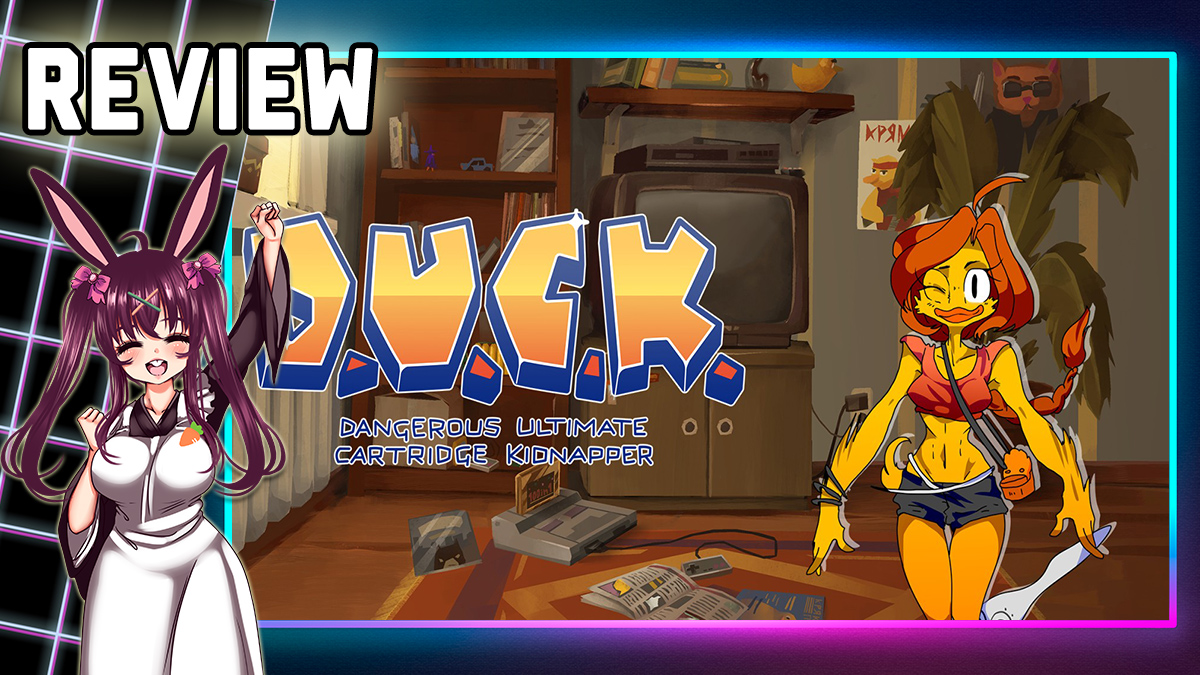
Overview – developed by Duck Team and published by Valkyrie Interactive, DUCK: Dangerous Ultimate Cartridge Kidnapper is a microgame collection, with 100 distinct and very short challenges. As a group of ducklings, overcome the curse of the evil spirit D.U.C.K and beat the 100 in 1, or become trapped in the game. This title is available for PlayStation and Nintendo Switch, with a link to each version of the game at the bottom of this review.
Disclaimer: before I get into the review, I would like to thank Valkyrie Interactive for providing the copy of DUCK: Dangerous Ultimate Cartridge Kidnapper used for this piece, via the Keymailer service. The provision of this software has not influenced the contents of this review, all thoughts and opinions contained within are my own.
Now with the introductions out of the way, let’s get into the review, starting with the story. I will be focusing on the single player experience, with some light detail on the multiplayer components of the game. I will be referring to the game as a shortened title of DUCK for the sake of brevity.
Story – while out together, a group of ducklings find a mysterious 100 in 1 game cartridge in a bush, excited by this discovery, they rush to play it and grab their friend to join them. After cleaning the cartridge and putting it in, they are suddenly confronted by D.U.C.K, an evil spirit who has trapped them in their room. The only way to escape is to beat the challenges of the 100 in 1 cartridge, but if they fail, they will become part of the game trapped forever.
Gameplay – DUCK is a microgame challenge collection, similar to the WarioWare series of games, where the player challenges extremely short games across a variety of categories. There are several game modes for this release, with the most important being story mode. In this mode, the player works their way through the 5 main chapters, playing as each of the ducklings. Each chapter has an opening and ending dialogue with D.U.C.K.
Before starting a chapter, the player will need to select the difficulty they want. There are four difficulty settings to choose from. These are split into Easy, Normal, Hard and Original, which will affect the microgames that appear. In the Easy setting, the player will play 10 challenges, normal will have 15, with both Hard and Original having 20 microgame challenges. At the end of a set of stages, the player will challenge the boss stage.
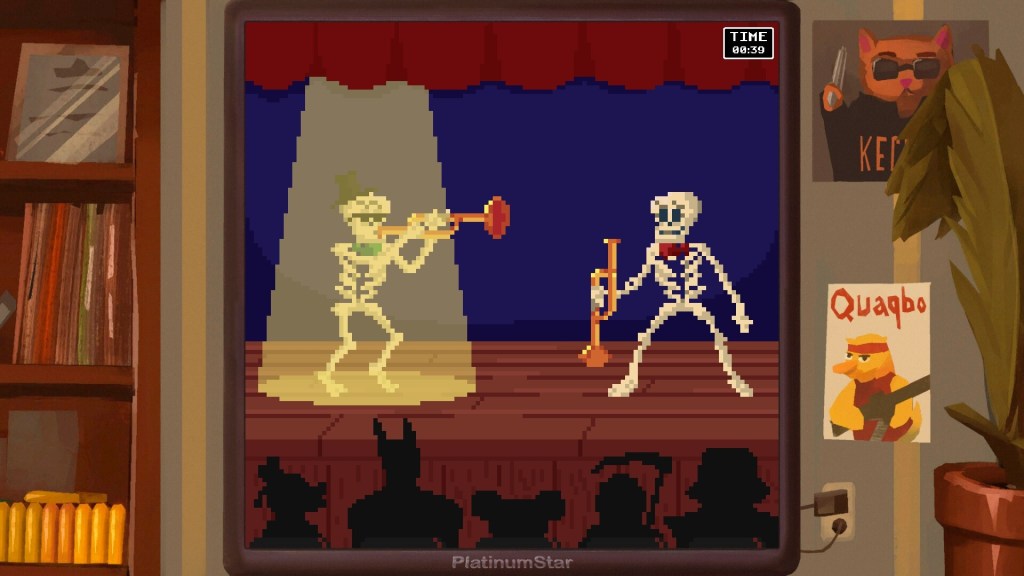
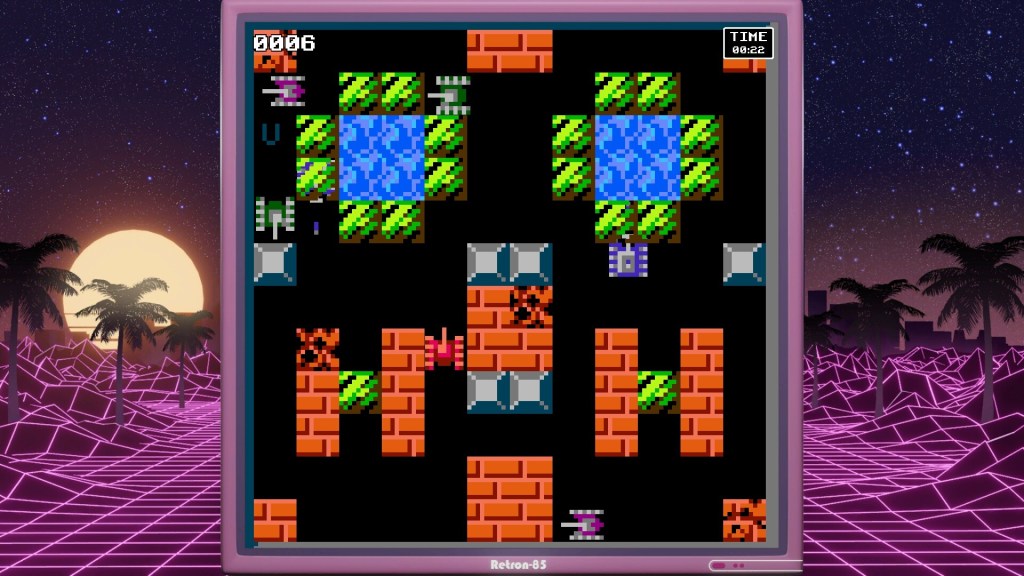
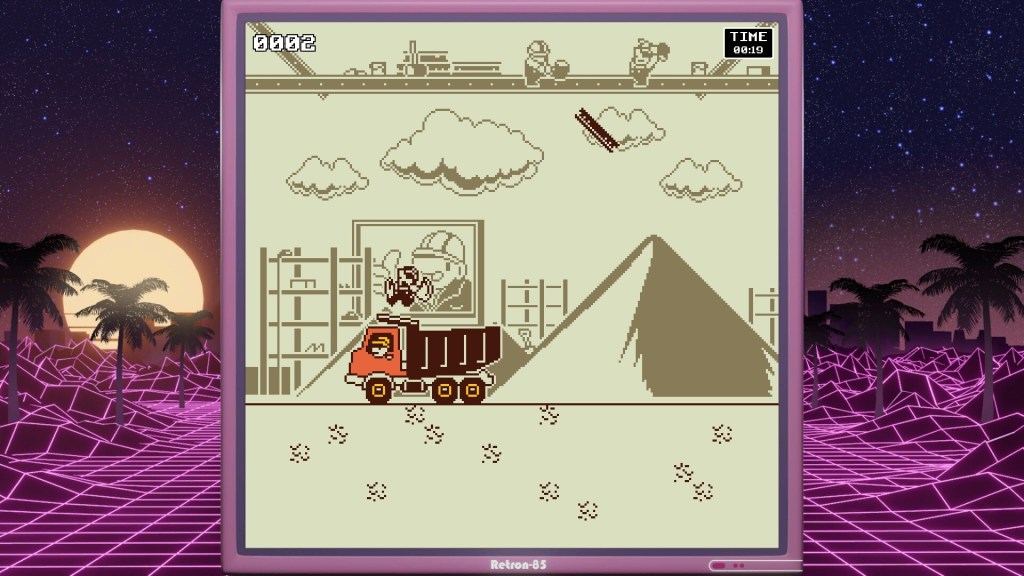
The microgames are inspired by games from a variety of genres, with platforming, shooting, racing and more. These games are inspired by classics from the history of gaming, with references to games like Bomberman, Battle City, Wild Gunman as well as the Game and Watch. There are also many references to popular culture, television and even memes, which both add to the experience, but also make it feel dated at times.
In these challenges, the objective may be as simple as getting to the goal, or dropping boxes so that they line up without falling over. Then there are challenges that require the player to meet conditions, like getting a target score or defeating a set number of enemies. These can also have a time limit tied to them, with players clear an objective or get to a goal in time. But some require the player to meet the target and get to a goal.
The time limits for the stages vary wildly, with some being as short as 20 seconds and others up to 2 minutes, which adds a level of chaotic uncertainty when playing through the challenges. If the player succeeds at the challenge, they will be able to move onto the next microgame. However, in the Easy, Normal and Hard challenges, if the player fails, they have the choice to try again or lose a duck (life). If the player is in Original mode, stages cannot be retried.
When all of the microgames for the chapter are cleared, the boss stage can be challenged. These are significantly longer and more challenging, which really ramp up in difficulty. They are much more complicated, instead of the simple objectives like lining things up or getting to a goal, players will need to do more. Boss stages include a 3D maze, where keys need to be found to escape, or survive waves of alien insects while blasting them.
If the player fails the boss stage, they will be given the opportunity to try again, using up one of their precious lives to try again. However, if the player is playing in a mode other than Original, they will be able to use the lives that they have saved to skip the boss. This will bypass the challenge and allow them to move on, but the cost will vary depending on the difficulty, with 3 needed for Easy, 4 for Normal and 5 for Hard.
In the event the player fails and runs out of lives, they will get a game over and be trapped forever. When all of the character chapters are cleared, the player will enter the final battle with D.U.C.K. where they must play through one last set of stages. This is the ultimate challenge, regardless of the difficulty chosen, any failure will cause a life to be lost. After 5 microgames, the final boss stage occurs, pitting the ducklings against the villainous spirit.

When the final battle is cleared, the epilogue will open up wrapping up the story mode. Previously cleared stages can be retried, as clearing them on set difficulty options will give special ducks. These go from Bronze to Gold, being awarded depending on the level of difficulty cleared. There are also special secrets that can be obtained, which are tied to different mini games, like getting a perfect score on the memory match microgame.
Any of the cleared microgames can be added to the challenge mode, where players can practice games and improve general skills. There will also be the special survival challenge mode, whete players will try to get the highest score possible. Last is the party mode, where players will be able to play together, challenging each other to get the best scores possible. These are played in hotseat mode, so players only need a single controller to play.
Now with the gameplay covered, it is time to discuss the other aspects of DUCK, starting with the controls.
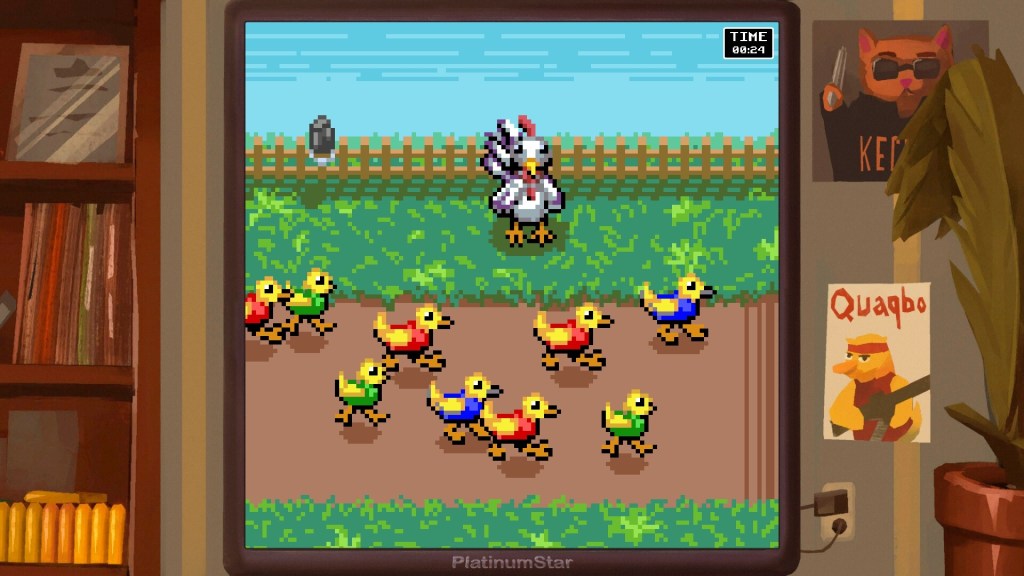
Controls – DUCK takes heavy inspiration from the classics of the 8-bit and arcade era, with a simple 2 button input system that is easy to pick up. Each of the microgames will provide the player with a brief tutorial, telling players what the buttons do before each game starts. This can be very handy, as the buttons and their usage will change from stage to stage, allowing players to be refreshed each time. There are also alternate inputs that can be used.
Difficulty – the difficulty for this game is a little weird, as there are moments where the challenges feel just right, but others that feel unfair in their difficulty. When playing the higher difficulties, the targets for scores and objectives are tighter, making them tougher to beat which can be frustrating given the tight time limits. The hardest challenges are the boss stages, which are much more involved than the regular microgames, increasing the difficulty.
Presentation – visually DUCK is dripping in nostalgia bait, with many of the elements designed to look like classic games from the 80s and 90s. Then there are the elements like games based on internet memes, which are highly detailed in their representations. There is also a lot of 2D artwork in this release, which adds more life to the world. The sound is done well, with digitised voices and music, which add to the retro feel of the game.

Final Thoughts – I am an enjoyer of the WarioWare series of games, with microgames being a fun and satisfying way to enjoy gaming in bursts. So when I got the opportunity to play this, I was excited to play this. But sadly, I had some mixed feelings about the game, as some of the microgames were more enjoyable as others. I did enjoy the gameplay, with many of the references being entertaining, especially the old memes from across the internet.
Sadly there are some issues with the game, with some of the inputs feeling delayed, missing the timing and causing failures during play. There were also some awkward troubles with momentum, where it felt like button presses weren’t being registered. I also found that the boss stages were awkward and drawn out, which made them less fun to play. But in general, as a party game, then this might just be for you and a group of friends.
In the end, I give DUCK: Dangerous Ultimate Cartridge Kidnapper a final score of 3.5/5. This is a fun spin on the microgame style of play, with some entertaining throwbacks to classic games, as well as internet culture, but sadly the general experience was a real mixed bag. If you want to check this game out for yourself, a link the each version of the game will be below.
Link to PlayStation version (HERE)
Link to Nintendo Switch version (HERE)
 W.Kohaku Media