
Overview – developed Luke Sanderson and Published by JanduSoft, Turnip Mountain is a physics-based climbing adventure, where players must find a way to reach the top of the mountain. The player controls a turnip with arms, who has been knocked from the top of the mountain as they gaze at their favourite star, using their arms independently to climb back up. This title is available for all platforms, with a link to each version of the game at the bottom of this review.
Disclaimer: before I get into the review, I would like to thank JanduSoft for providing the copy of Turnip Mountain used for this piece, via the Keymailer service. The provision of this software has not influenced the contents of this review, all thoughts and opinions contained within are my own.
Now with the introductions out of the way, let’s get into the review, starting with the story. I will be covering the main elements of the gameplay that I was able to experience, but will provide some details about content present that I was unable to try out.

Story – Once upon a time, atop a lonely mountain there lived a turnip. This turnip was gazing upon its favourite star, enjoying the peace that the secluded spot offers. However, fate has other plans as a sudden earthquake knocked the turnip from its spot, sending it hurtling down the mountain. Upon reaching the base of the mountain, the turnip extended the arms it kept inside itself, ready to climb to the peak and regain its position to see that star once more.
Gameplay – Turnip Mountain is a mix of platforming and physics-based climbing game, where the player takes control of the turnip. In this adventure, the player must climb the different segments of the mountain, with several different themed environments. These different zones of the mountain have their own themes, with mushrooms, factories and water elements to them. Each of the areas has a name linked to their theme.
Starting at the base of the mountain, the objective is to climb each of the smaller peaks of the mountain, aiming to reach the very top of the mountain. To achieve this goal, players will need to use turnips arms independently of each other. This is done by having players use thumbsticks, or dual mouse controls to move each arm. Doing this allows the player to grab textured parts of walls, pulling themselves up and moving around the screen.
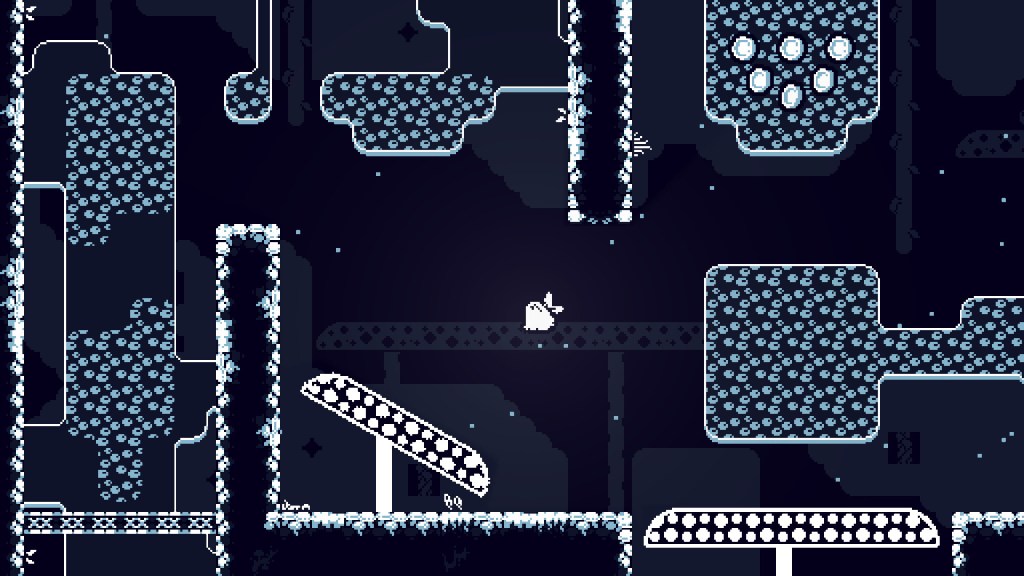
Each of the stages is split into segments, where the player will need to climb up, using their hands to grab onto surfaces to reach the next section. For the most part, it is possible to take it slow and move around the screen, scaling the surfaces hand over hand. However, as players make it further up the mountain the complexity of the areas will increase. With the introduction of moving surfaces, chains and mushroom shaped bounce pads.
These additional challenges will have the player needing to learn more advanced techniques, like super jumps. The super jump requires using both hands in tandem to slingshot the turnip, being able to move at a high speed in all directions. Players must also get to grips with the turnip roll, which pulls the arms in and allows the player to roll and bounce. By holding a direction while falling, the turnip can also perform a spin bounce upon landing.
In some of the stages, the player will also need to hold onto swinging vines, allowing players to cross gaps and reach the next grip. There will also be environmental elements to deal with, including areas without texture that need to be seeded to give them grips. Navigation of the different areas requires mastery of the movement, as the player will die if they fall in a pit or make contact with spikes. There will be many hazards to try and avoid in this adventure.

If the player does die, they will be sent back to the start of the segment, resetting the progress that is made and causing players to lose time. There is no definitive fail state for the game, allowing players to keep trying as many times as needed to clear the stage. To move to the next section, the player will need to reach the transfer boundary, with stages having different routes and shortcuts that players can make use of.
Within the stages, there will be arrows to guide the player, as well as some areas having ghosts to give players hints on how to perform tasks. Once the player reaches the end of a stage, they will find a flag that must be raised to clear the peak that they are climbing. After completing the stage, a cutscene will play out to push the story along before the next stage opens up. Players can return to previous stages to improve their times, or grab items.
Speaking of items, there are coins in the level which act as both a guide and a secondary objective. These are scattered throughout the areas of the level, being added to the player total when they are picked up. These coins are used for a special Gacha style mechanic, unlocking special cosmetics that can be applied to the turnip. Players can also collect paint brushes, which will unlock new color palettes that will change the visuals during play.
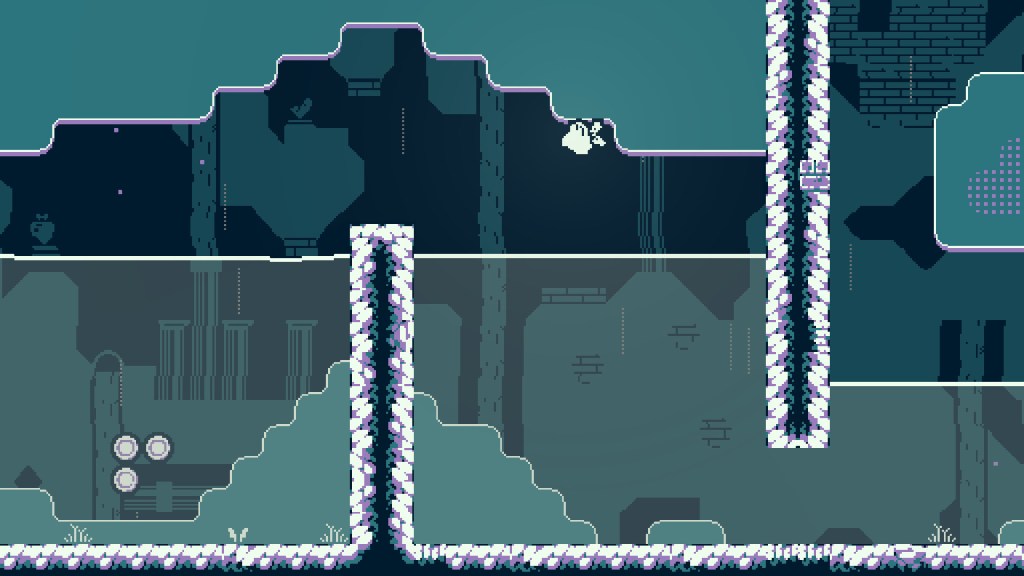
Last to discuss is the 2 player mode, which allows for co-operative play through the game. This can be done in a few ways, with players being able to use a controller each, dual mouse control or a controller and mouse together. This can be enabled and turned off at any time between stages, adding flexibility to co-op play. The two player mode works rather well, but has the potential to cause some fallout when playing with another.
Now with the gameplay covered, it is time to discuss the other aspects of this release, starting with the controls.
Controls – Turnip Mountain has an interesting control scheme, using dual mouse and twin thumbstick controls to control the arms during play. This can be a little awkward for some players to get used to, as players also need to use the triggers or mouse buttons to grip surfaces. It does take a little time to get used to, with the unique control method, but the general control experience is fun and works well once players adapt.
Difficulty – there is a moderate difficulty curve to the game, with the challenge increasing in complexity the further up the mountain players get. There is a level of trial and error to Turnip Mountain, as some of the segments can feel like puzzles, which need some practical thinking. The tutorial/ghost system helps a lot when getting used to play, with the infinite retry system also taking the sting out of failure during tricky sections.

Presentation – Visually Turnip Mountain is very leasing to the eye, with a good use of monochrome color palettes for the environments and sprites. This gives the game a very classic retro look, while making it feel vibrant and unique. Music and sound is done well, with a wonderful soundtrack from composer IsabelleChiming, giving it a whimsical feel. The cutscenes are a nice touch to round it all out, adding to the charm of the experience.
Final Thoughts – the first time I saw Turnip Mountain, I was reminded of the classic arcade game Crazy Climber, which utilizes a gameplay style similar to this. So when the chance to check this game out came up, I was very interested in checking it out. This title has a quirky unique charm to it, with a unique gameplay loop and control scheme that worked rather well, but may lead to frustration. All wrapped in a retro, yet modern presentation that elevates the experience.
I really enjoyed my time with this game, as it offered a fun twist on the climbing genre of platformer. Turnip Mountain takes gameplay that is often attributed to rage games, making it more fun and relaxed while also offering a challenge for those who want to go fast. The co-op mode is also an interesting addition, making for a fun (or not so fun) way for couples to bond. So I would recommend this game to those looking for something unique and fun.
In the end, I give Turnip Mountain a final score of 4.5/5. This climbing action adventure takes what is often applied to rage games, making it fun and enjoyable with unique control styles, vibrant monochrome pixel art visuals and a delightful soundtrack to tie it all together. If you want to check this out for yourself, a link to each version of the game will be below.
Link to Steam Version (HERE)
Link to Nintendo Switch version (HERE)
Link to PlayStation version (HERE)
Link to Xbox version (HERE)

