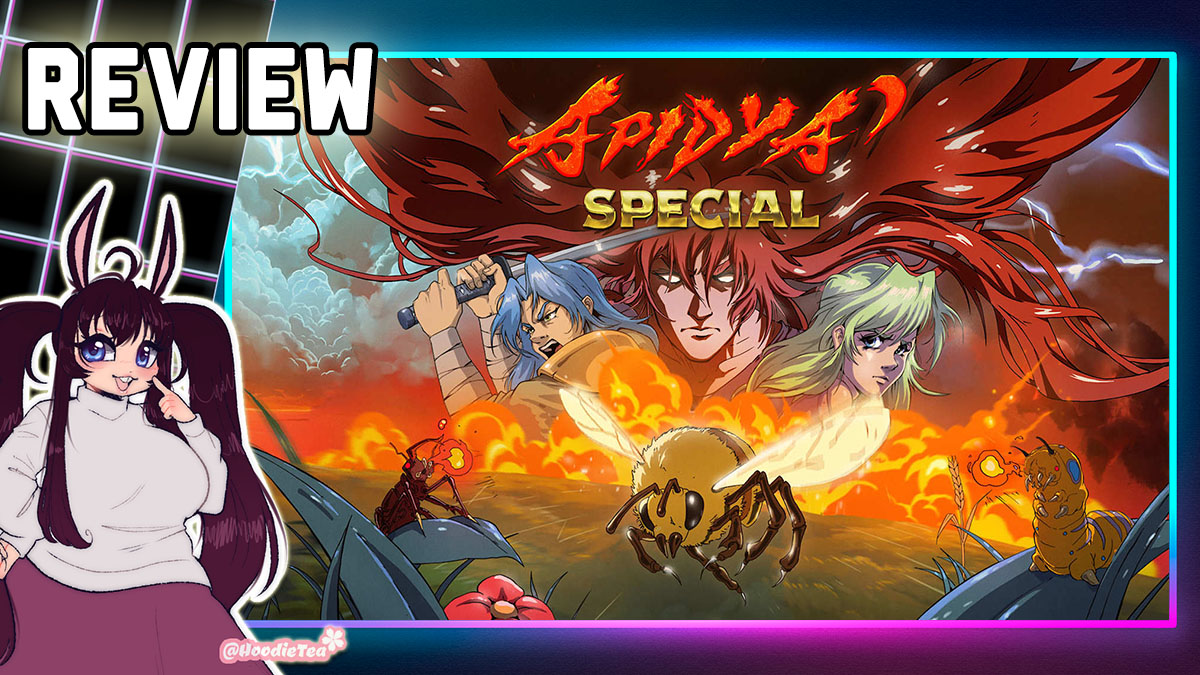
Overview – originally developed by Kaiko, ported by Team Apidya and published by ININ Games, Apidya’ Special is a remake of the classic Amiga shooter from 1992, brought back in 24-bit style. Take to a micro world as Ikuro, who uses magic to become a Bee trooper, taking on insects, fish and mutated abominations in side scrolling action. This title is available on PlayStation 5, Xbox Series, Steam and Nintendo Switch, with a link to each version of the game at the bottom of this review.
Disclaimer: before I get into the review, I would like to thank PR Hound for providing the copy of Apidya’ Special that was used for this piece. The provision of this software has not influenced the contents of this review, all thoughts and opinions contained within are my own.
Now with the introductions out of the way, let’s get into the review, starting with the story. I will be covering the single player gameplay experience, as I was unable to fully test the multiplayer aspects of this release. However, I will give some details where possible.
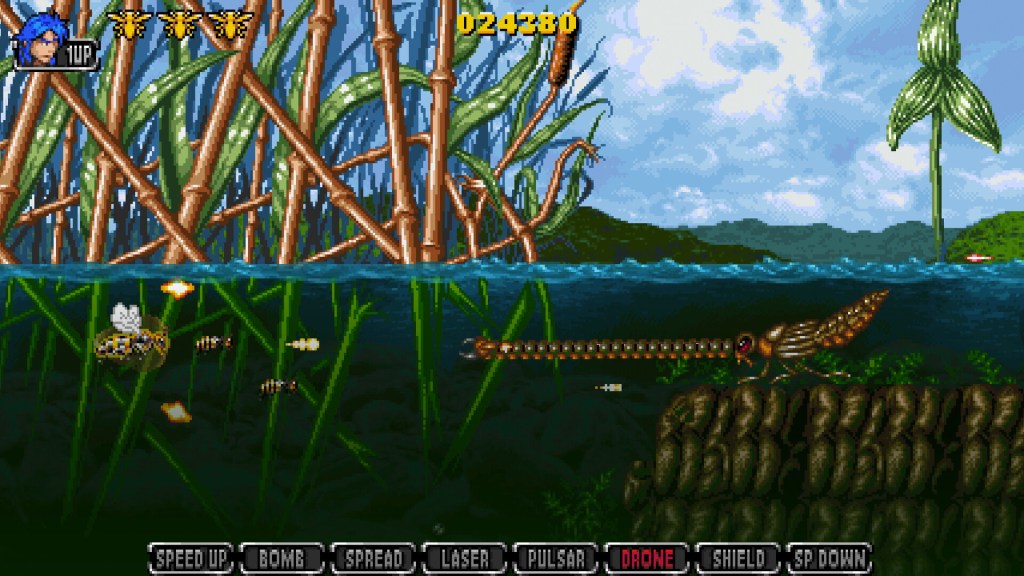
Story – Ikuro’s wife Yuri has been cursed by the dark magician Hexaa, who is residing in her stronghold, guarded by an army of organic and mechanical minions. Ikuro uses his magic to become a bee, setting off on a mission to save his beloved. Ikuro must destroy the army of Hexaa, battling them across a variety of locations, including a meadow and sewer in a micro world. Destroy the evil lord of black magic, save Yuri and get revenge.
Gameplay – Apidya’ Special is a horizontal side scrolling shooter, where players take the role of Ikuro, who has become a bee capable of battle. In a micro world, take on the armies of Hexaa across several distinct landscapes. Take flight in battle with Insects, fish, mutants and bio-mechanical enemies, taking them down with a variety of weaponry. The player can use a rapid fire blaster, which will blast in spurts, as well as a charge attack that fires a large stinger.
As players shoot down enemies, they will be able to collect red flowers which add points to a power-up bar. This system is functionally identical to Gradius, with several power-ups for the player to gain. These consist of speed change, the drop bombs/missiles, three different weapon types and support unlocks. Each time the player picks up a red flower, an option on the power-up bar will be lit up, only going away when it is activated.
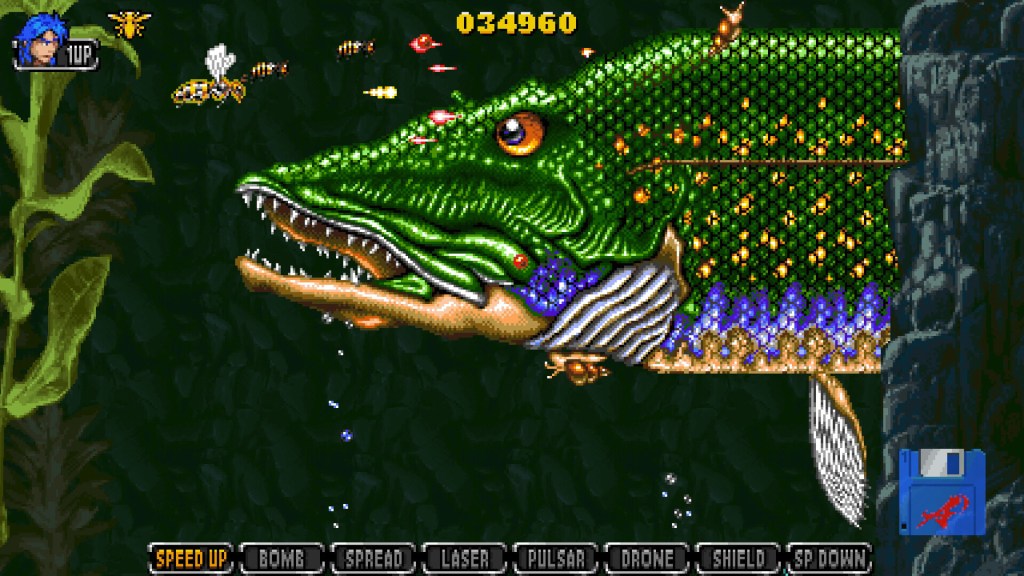
The weapon options that players have are the Spread Shot, Laser and Pulsar, with each of them functioning distinctly from the others. When activating a weapon upgrade, the player will get additional power boosts up to three times, with the increases being carried between weapons. The bomb doesn’t have a set upgrade path, with two options that will alternate when activated, with a single drop bomb and a torpedo that follows the terrain.
Then we have the support items, which are separated into two different options for players. The first is the Shield, which will protect the player from a limited number of shots, allowing them to avoid getting shot down. Alongside the Shield are the Drones, which are support units, similar to the Option satellites of other scrolling shooters. The player can equip two of these assistants, using them to attack enemies and block shots as they follow the player.
Each of the scenes for the game are split into stages, with the player working through hazard filled environments. The first few stages are rather easy to navigate, but the further the player gets, the more challenging it will become. This is due to the introduction of alternate paths, as well as hazards in the environment that will destroy the player if contact is made. Sadly this can be difficult at times, as some elements of the stages can look like they are in the background.
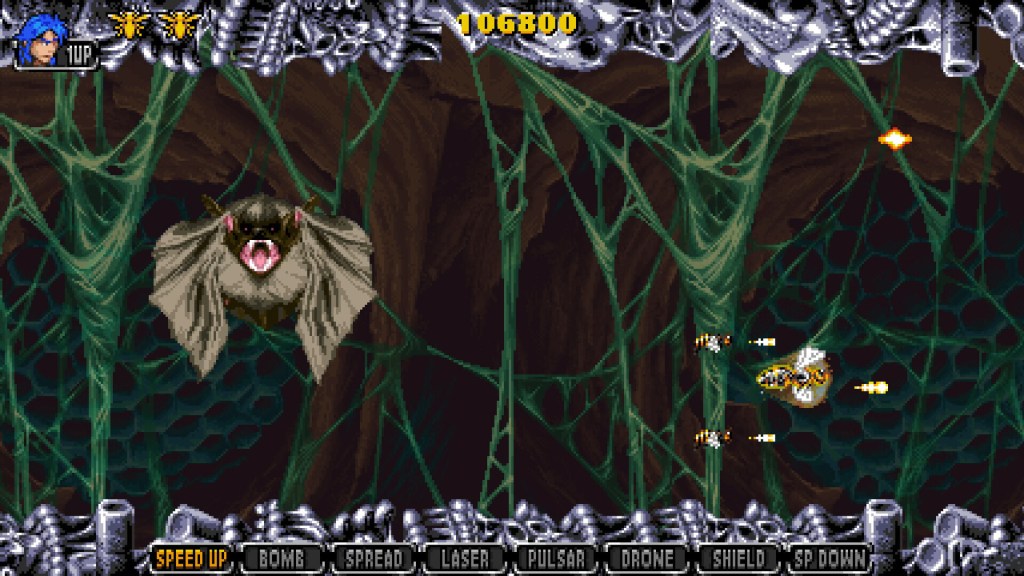
At the end of each stage for the first four scenes, a mini boss will appear to fight the player, with enemies including a large caterpillar, a mole and even maggots from a Rat carcass. There will also be the chance for special bonus stages to be activated if special conditions are met. For the finale of a scene, the player will be transported to an arena to battle the final boss. In the final Scene, the player must fight a series of mini bosses before battling the true villain.
As this is a remake, there have been various quality of life changes made to the game. The first is the graphical changes, with all of the original assets being redrawn, going from the original Amiga version into enhanced 24-bit style visuals. Players can also change the way the action flows, with the ability to maintain weapons when getting shot down. There is also the option to turn off the stage reset upon death, which allows players to jump right back in.
Players can change the speed of the game, with the option for PAL and NTSC performance. The PAL option has the game running at 50FPS to emulate 50Hz, with NTSC running at full 60FPS, which is the same as 60Hz displays of the time. All of these settings can adjust the way the game feels, with slower speeds and mechanic changes easing the game. But if players want an authentic experience, these settings can be set to off before and during play.
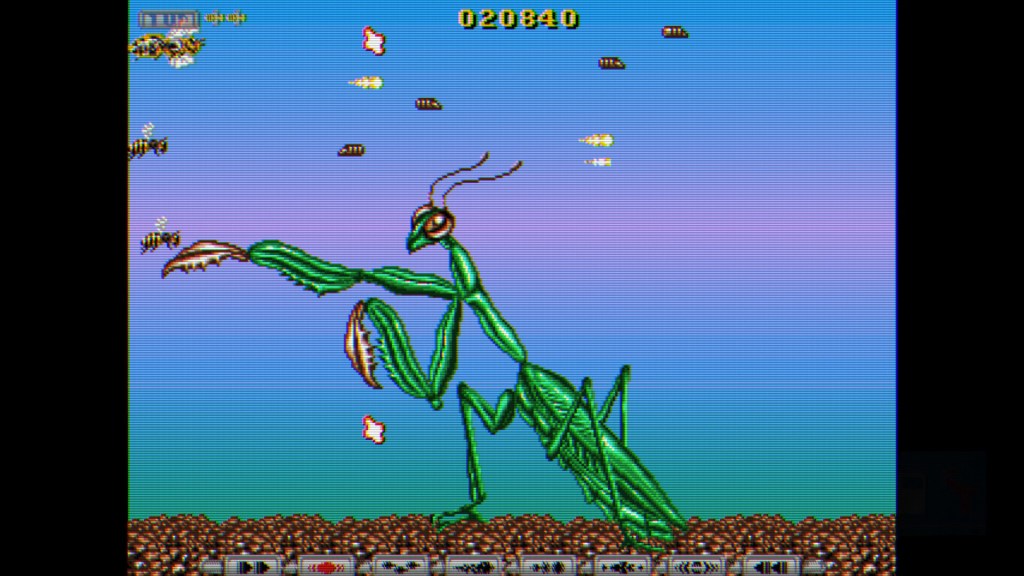
Introduced in this version of the game, players can also save the game, allowing them to come back to the action when they want. There are three slots for players to use, letting players have three different runs of the game at any time. There are also CRT filter settings that give the look of classic displays, with scanlines and glow that give the game that retro feel. It is also possible to switch between remade graphics/sound and the original assets at any time.
Last to discuss is the multiplayer content for this release. There is a Co-op mode that is highlighted in the store, allowing the player to join and assist by controlling a drone. However, I was unable to test this feature of the game and there was no mention of it on the menu. This is frustrating as the game doesn’t explain how to use this feature, even though it is used as a selling point of the experience. The original also had an alternate play option which seems to be missing.
Now with the gameplay covered, it is time to discuss the other aspects of this release, starting with the controls.
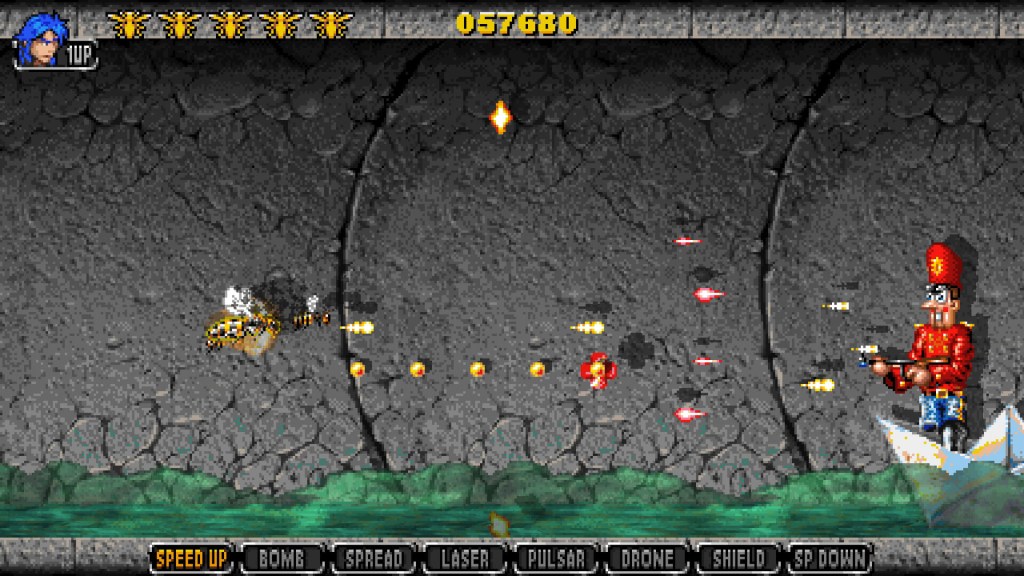
Controls – Apidya’ Special is designed to use controller specifically, with an arcade style set up that uses three buttons for general play. There is support for a range of controllers, with the ability to run use Steam Input for expanded compatibility. This allows players to use retro style controllers, as well as arcade sticks for that classic SHMUP feel. There is some keyboard support, but this can be awkward as the inputs are spread across the keyboard.
Difficulty – there are several difficulty settings available for this release, with four different options for players. The settings that players can select from are Practice, Easy, Normal and Hard, with the enemy behaviour and challenge changing based on the settings. In the Practice mode, the experience is cut down, with less stages to play through to get to the end. The difficulty can also be changed by adjusting the stage reset and weapon loss on death.
Presentation – In this release, the original visuals have been mostly redrawn, with enhanced backgrounds and new parallax scrolling. The majority of the original sprites are present, with many of the larger boss sprites being reworked into the new style. There is also a whole new soundtrack, with reworked music from the original composer and new voice work added to the game. This makes the game feel new, while also offering the original for those who want to experience it.
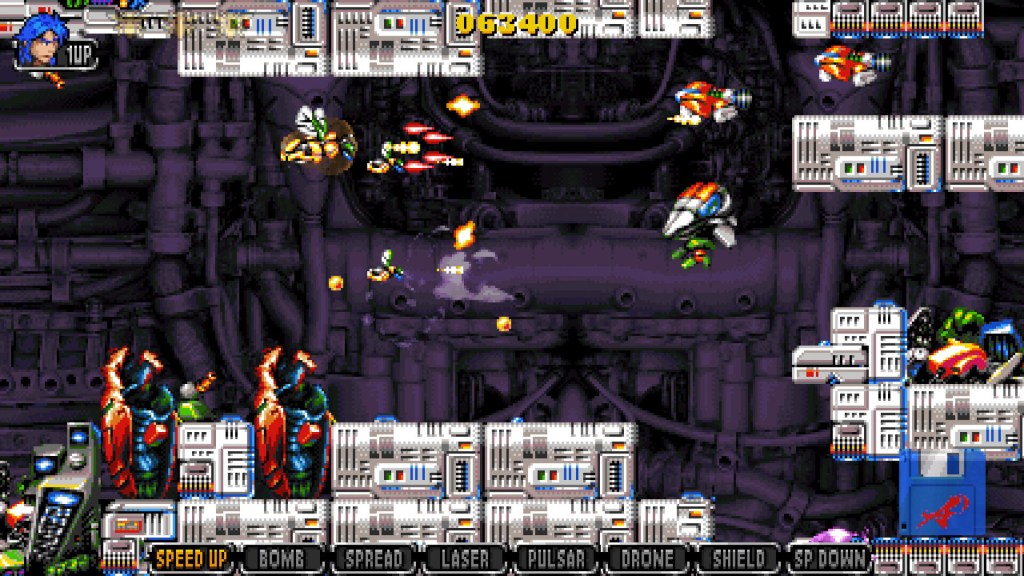
Final Thoughts – I was not aware of the original game, as I was not a big player of the Amiga back in the day, only dabbling with a few games. So seeing this game interested me, as I enjoy discovering old and obscure titles. Apidya’ Special was an interesting experience, as it had that familiar feel of classic Japanese SHMUPS, with a European flair. I had a lot of fun with this, and seeing touches like The Little Tin Soldier was a nice touch during play.
Unfortunately, due to the period that the game was made, the game can be brutally tough with elements that can feel unfair. This can be frustrating for players, especially with the weapon loss and stage resets upon death. The frustrations can be lessened a little with the quality of life adjustments, but it can still put off some players. But for those looking for a challenge, I can recommend this game to fans of retro SHMUPS and scrolling shooters.
In the end, I give Apidya’ Special a final score of 3.5/5. This is a solid and challenging scrolling shooter, with brand new visuals and sound, quality of life adjustments and additions, reviving a game that has fallen into obscurity, but it is rough around the edges. If you want to check this game out for yourself, links to each version of the game are below.
Link to Steam version (HERE)
Link to Nintendo Switch version (HERE)
Link to PlayStation 5 version (HERE)
Link to Xbox Series version (HERE)

