
Overview – developed by Nekete Games and published by RAWRLAB Games, Yosei Wars is an arcade style platforming game, developed for the Game Boy and brought to console via the GB Wrapper. As the fairy Hanoka, set out on a mission to rescue kidnapped tooth faries, who have been kidnapped by the junk food monsters. This title is available for Steam and Nintendo Switch, with a link to each version at the bottom of this review.
Disclaimer: before I get into the review, I would like to thank RAWRLAB Games for providing the copies of Yosei Wars that was used for this piece. The provision of this software has not influenced the contents of this review, all thoughts and opinions contained within are my own.
Now with the introductions out of the way, let’s get into the review, starting with the story. Please note, as this is a GB Wrapper game, the rom for the game will be included with the Steam version. This can be loaded onto a flash cart or Everdrive, so I will be covering the original hardware as its own segment.
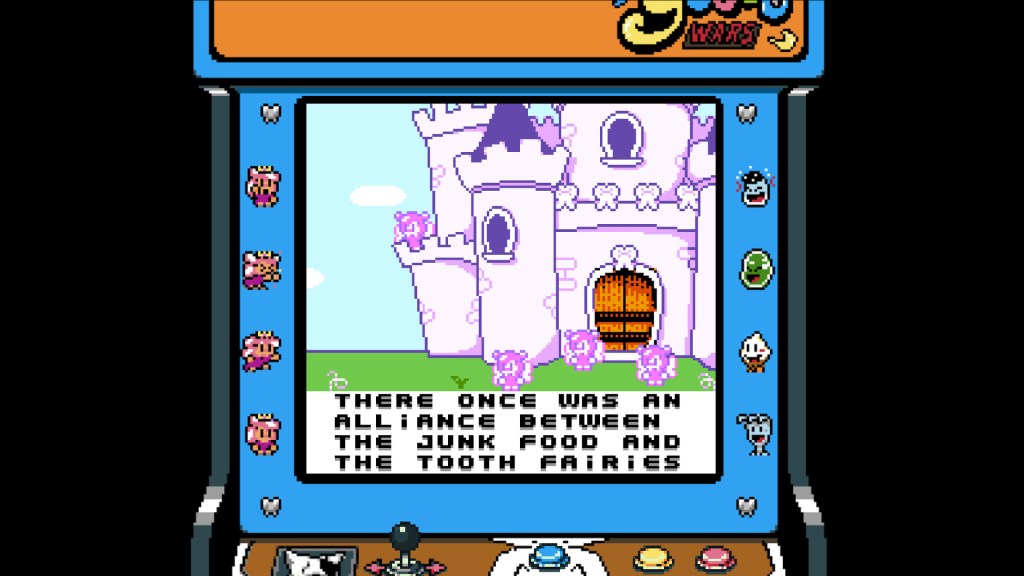
Story – Long ago an alliance was forged, with the Junk Food Monsters and Tooth Fairies coming to an agreement. The Junk Food Monsters would cause teeth to fall out, with the Tooth Fairies collecting them. However, the monsters attacked the Fairies, capturing them all. The Fairies prayed to the god of teeth, but their pleas went unanswered. An explosion sent a shockwave across the land, with the Fairies disappearing. Now Hanoka, the last Fairy sets out to save them all.
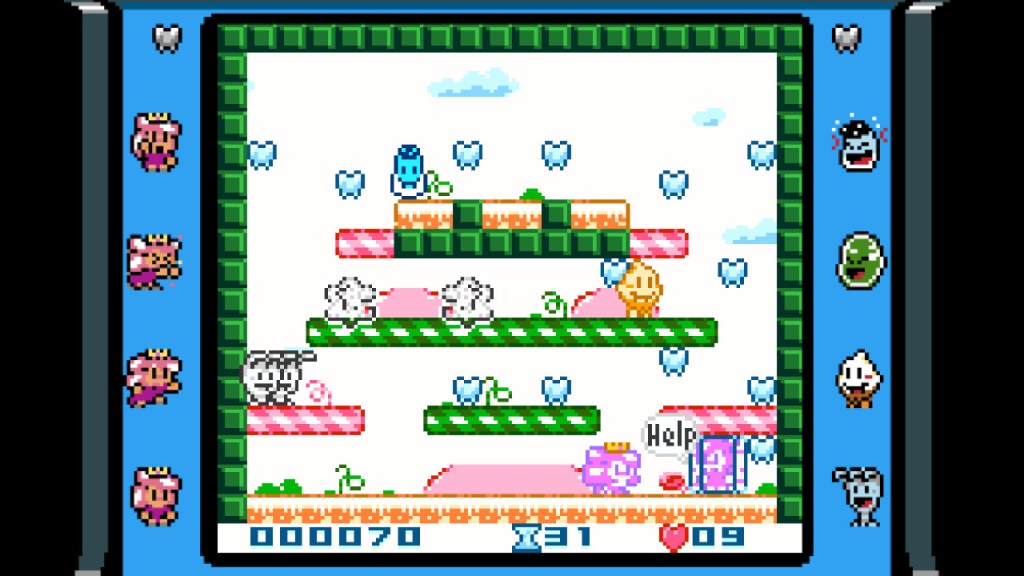
Gameplay – Yosei Wars is a platform action game, inspired by games like Snow Bros, Bubble Bobble and Rod Land. The premise of this game is to save the Tooth Faries who have been kidnapped and trapped across 36 stages. In order to save the imprisoned sprites, the player needs to collect all of the teeth scattered across the stage. This may seem like an easy task, but there will be many hazards that will try to stop Hanoka from achieving her goal.
Inside each of the stages, there will be monsters that will wander on the stages, which are various junk foods and utensils. These monsters and enemies will kill Hanoka if contact is made, sending the player back to the start point of the stage. The most common monsters are the ice cream cones, who will walk back and forth on the platform. But there will also be forks that will rush the player, salt shakers that send out deadly clouds and more to contend with.
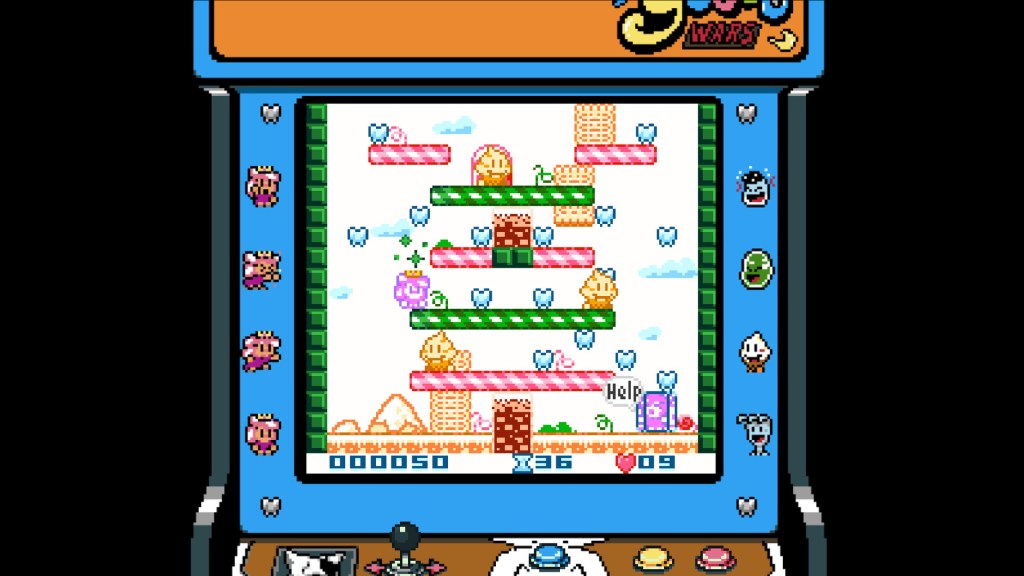
Alongside the enemies, there will also be spikes that will hurt Hanoka, killing her if any contact is made. To help the player get through the stages, they will be able to jump through specific platforms, use ladders and even use special monsters to cross gaps. But it is important not to dilly dally, as there is a time limit that players will need to be mindful. If the time limit expires, a life will be lost and the timer resets.
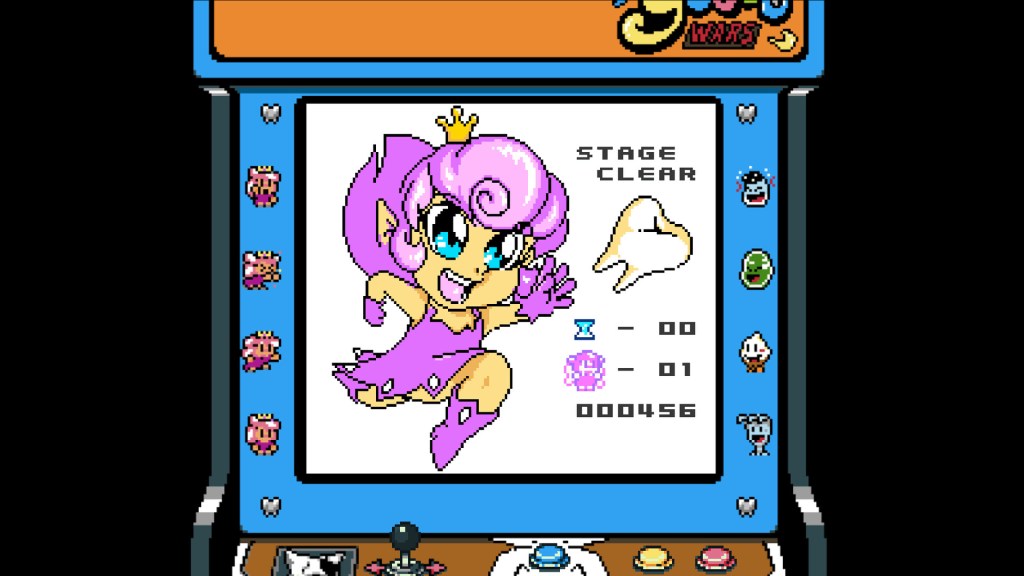
When the final tooth of a stage is collected, a special transition occurs. This means that Hanoka has activated her special Tooth Fairy powers, giving her the ability to fight back against the monsters. In Tooth Fairy mode, she will be able to fire special tooth bullets, which will kill enemies and break the fairy cage. If the player makes contact with the freed fairy, they will be added to the total and the stage is cleared, but if Hanoka dies, the fairy will be lost.
After set stage checkpoints, the player will encounter a boss monster. These stages function in a different way to the standard levels, changing the gameplay in an interesting way. At the start of the stage Hanoka has her power, this allows her to fight the boss, damaging them by hitting their weakpoint. These stages are tough, as the boss needs multiple hits to defeat, so the player will have three extra hits before death.
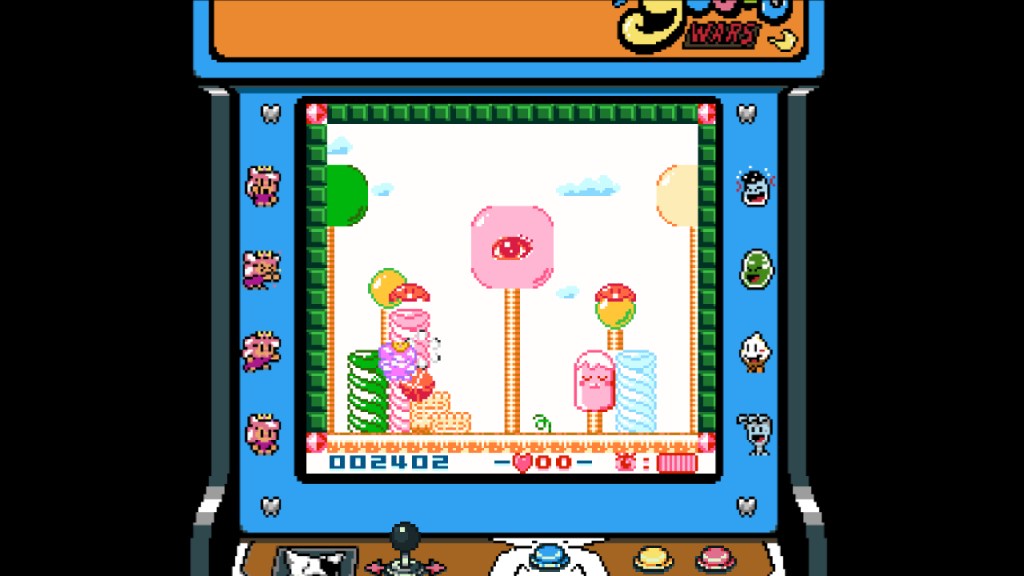
There are a total of 36 levels and 6 Bosses to defeat. Players have 10 lives as standard, with the ability to alter them in the settings. In the event that the player loses all of their lives, they will be prompted to continue. This does come at the cost of points earned during play, however, the default score penalty is set at 0 points. The penalty can also be modified in the settings, adding an extra layer of challenge to the game.
Outside of the main game, there are various extras that are bundled into this release. These include an art gallery, music player and bestiary, allowing players to check out the sights and sounds of the game. Also included are the various prototypes for the game, showing the progress of the game over the years. There is also a special monochrome variant of the game, which emulates the “green and green” look that the original DMG Game Boy had.
Now with the gameplay covered, it is time to discuss the other aspects of this release, starting with the controls.
Controls – there is a very simple and easy to use control system for this release, using only two buttons for all inputs. There is the Jump and Attack button, which are responsive and intuitive. The movement controls work really well, with the option for both D-pad and thumbstick input. All of the inputs work well and are comfortable on Nintendo Switch, various PC compatible controllers and the Steam Deck. This makes it very accessible to all players.
Difficulty – there is not a great amount of difficulty to this game on the standard setting, but for those who are looking for a greater challenge, there are additional settings. The easiest way to alter the game is to modify the difficulty, with Easy, Normal, Hard and Maniac. Then there are the life settings, with as few as 1 and as many as 30. The penalty for death can also be changed, making this a highly modular gameplay experience.
Presentation – this game feels straight out of the mid 90s, with a great use of color, sprite work and effects of the classic Game Boy era. All of the onscreen assets look very good, with no issues with clashing of color and everything is highly visable. The sound is done very well, with chiptune compositions that are bright and boss themes that add tension. Then there is the extra art, icons and screen elements that tie all of the game together.
Original Hardware – as the Steam version of the game has the Rom files included, there is the ability to load them onto a flash cart. All versions of the game can be played on Game Boy Color and Game Boy Advance, with the DMG and prototypes also working on the first model. The game and variants are fully compatible with original Hardware, with no issues or lag. This makes it a great option to take the game on the go, perfect for those without a Switch or Steam Deck.
Final Thoughts – I am fond of the Game Boy homebrew scene, having played some of the smaller games as well as offerings from RAWRLAB, Like Maron’s Day (reviewed HERE). This is a fun and enjoyable platformer, which feel like it would have fit perfectly during the original run of the system. All of the different game elements are crafted well, with responsive and challenging gameplay, that can be enjoyed by everyone.
I spent a fair amount of time playing the main official version of the game, alongside the monochrome and prototypes of the game. There is a lot of bang for your buck with this, as it allows players to experience more than just the main game. It is also an accessible game that players of all skill levels can enjoy. So I am happy to recommend this game, as it is a lot of fun inside of a rather modest and affordable price, especially with the amount of replay value.
In the end, I give Yosei Wars a final score of 5/5. This is an excellent homebrew package, offering a lot of arcade style platforming in a colourful package, alongside the different prototypes and extra content in an affordable package. If you want to check this game out for yourself, a link to each version is below.
Link to Nintendo Switch version (HERE)
Link to Steam version (HERE)

