Retro Revivals – Sunset Riders (Arcade Archives)

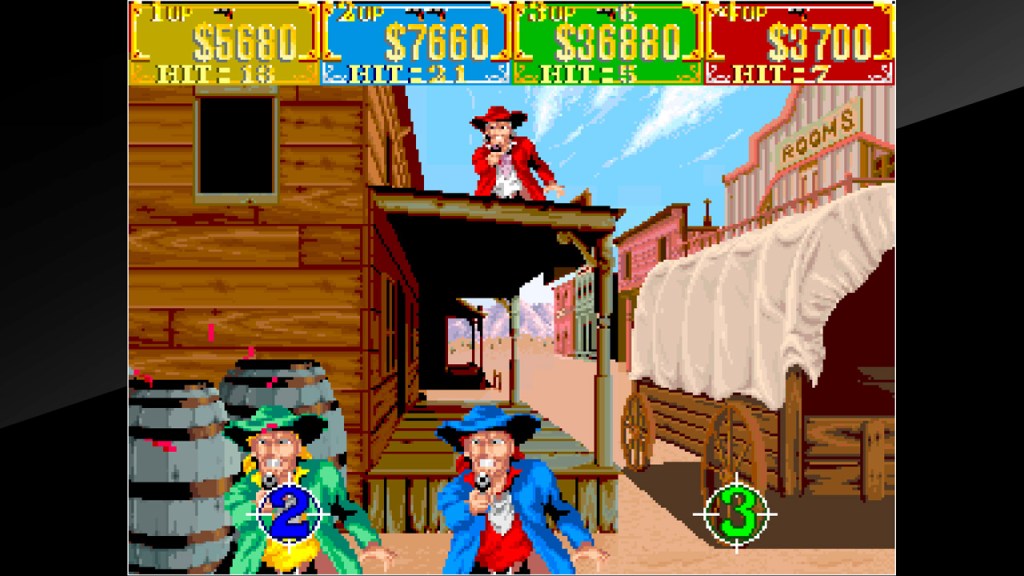
Hello, and welcome to Retro Revival a new regular feature, where I will be discussing retro titles that have been given a new lease of life on modern platforms. The titles featured in this series will range from HD remasters, emulated ports and titles that are included in collections. To start off this new feature, I will be covering the arcade title Sunset Riders, a western run and gun action title from Konami, powered by Hamster’s Arcade Archives.

Disclaimer: the games discussed in this feature have been purchased by me, so the opinions given within are all my own. There has been no sponsorship of the content within this feature. Links to the different versions of the game will be provided at the bottom of this feature where possible.

So with the introductions out of the way, let’s get started with the premier instalment of the new Retro Revival feature. This will follow a similar formula to other features, discussing the game and then some personal thoughts on them.

About the game

Sunset Riders is a side-scrolling run and gun action game, set in a version of the American Old West, inspired by the tales of Outlaws and Bounty Hunters. In this arcade release, the player can select one of four gunslingers, who are on a mission to take down a rogue’s gallery of bandits and outlaws. This title can be played in two variants, a 2 player or 4 player mode is available, with a choice between the original Japanese and international versions.

There are four bounty hunters in this release, split into two specific play styles. The first is the gunslingers, Billy and Steve, who are armed with rapid fire six shooters for quick shots. Then there are the shotgunners, Bob and Cormano, who use powerful spread guns to dispatch enemies. This gives a good amount of variety when playing the game alone, or with others as there is a lot of content on offer in this title.

The game itself is made up of 8 stages with a boss battle in each of them. These stages usually play out in a traditional side scrolling fare, with the ability to jump between upper and lower levels, alongside platforming challenges. Then there are the auto scrolling stages, where the player rides a horse moving back and forth. There are even stages where the player has to cross a moving train, and a battle inside a saloon.

As the player makes their way through the stages, there will be gangs of outlaws that try to take the bounty hunters down. These include the traditional bandits, dynamite throwing cowgirls and fantastical depictions of Native Americans from the Spaghetti Western genre of film. These foes will attack the player with projectile and ranged weapons, appearing from windows, balconies and even jumping down from rooftops.

There will also be enemies holding sacks, who drop items when defeated. These include piles of gold, a turkey roast and the most important, power up stars. These stars give one of two benefits when first picked up, separated into gold and silver. The gold stars give ultra-rapid fire, whereas silver stars give the player a second gun, doubling the shots. All items can also be collected from Saloon girls and by entering open doors.

The power-ups will be with the character for as long as they can avoid death, as they will be reset upon being defeated. This will revert them to their standard attack, which can be a little frustrating during boss battles. Thankfully, there is an abundance of power-ups that can be found, with the number increasing as do the players. This can make it a little frantic during co-op play, as players can scramble to get the upgrades.

At the end of each stage, the boss will appear and throw out a digitized voice line, usually a quote that is inspired by outlaws in media. Then the battle begins, with each of the encounters having a unique gimmick to them. These include a hotshot gunfighter that can dodge roll, a hulking bandit on an armored horse and twins that use explosives/bombs. The unique gimmicks keep the action exciting, preventing it from getting tedious during play.

Each of the bosses has a bounty attached to them, increasing with their infamy and power. When playing single player, the bounty will be immediately given to the player. But if there is more than one, the player who deals the most damage to the boss will win the bounty, shown as a percentage on the results screen. This gives a competitive element to the co-op gameplay, as this is still a score based arcade game.

When all of the bosses have been defeated, the game will start again from the first stage for a second loop. This will occur with increased difficulty, increasing the number of enemies and dangers they possess. If the player chooses to play the Japanese version, the game will end after a second loop giving a definitive ending. However, if the player chooses to play the international version, the game will continue indefinitely after each loop.

After stage 2 and 5 during a loop, the player can challenge a bonus round, which acts as a shooting gallery, where 50 targets will pop up on screen. Players have a short window of time to shoot the outlaws, or they will disappear. The patterns are set for both stages, so after some practice it is possible to get perfect scores. When in solo or co-op mode, points will be awarded to a player based on how many targets they have managed to hit.

Since this is an arcade game, there is an in-game leaderboard that will record the score that players have earned. Then there are the online rankings, which let players across the world compete against each other for the top spot. Then we finish with the bonus challenge modes, with Caravan Mode that gives players a 5 minute time limit and Hi Score Mode, where players get one credit. The best score achieved in these modes is added to the global rankings.

Personal thoughts

I remember coming across sunset riders while on holiday as a kid, seeing the two player cabinet at a seaside arcade. This was alongside other Konami arcade machines, like the Simpsons and Teenage Mutant Ninja Turtles, which were a highlight of the summer holidays. When the Arcade Archives brand launched on the PlayStation 4 and Nintendo Switch, I had no idea that Sunset Riders would get a revival through this brand.

However, I was happily surprised when this title was added to the Hamster Arcade Archives library, making it an easy pick up. When I booted this up for the first time, I was instantly taken back to those days in the arcade. I grabbed my controller, picked my favourite bounty hunter and before I knew it a couple hours had passed. In the end, I had cleared the true ending of the Japanese version and multiple loops of the International release.

I had previously played the game via early versions of MAME, alongside the two home ports, but they had their limitations. This is the best possible way to experience Sunset Riders, as it features both versions of the game in 2 and 4 player variants, alongside dipswitch access and video filters. Then there are the extra modes, which really expand the replay value for players. This is alongside the global rankings, where players can compete across the world.

As a single player experience, this is a great game on its own, with a lot of fun to be offered for those who enjoy a good run and gun. However, when playing this game with at least one person in co-op mode, the chaos is elevated even further. The enjoyment you can have looping the game over and over, is just pure arcade fun at its core, all wrapped in vibrant spaghetti western camp. There is even a Can-Can scene in a saloon as a transition cutscene.

This is one of those games that I thought would never get released again, as Konami has a pretty bad track record of ignoring a lot of their old games. It was part of the short lived Game Room app on the Xbox 360, which was poorly promoted and shut down in 2017, making Sunset Riders inaccessible once again. I am thankful that Hamster has put the effort into their Arcade Archives label, offering many games that have not seen a re-release, a second chance to be appreciated.

If you couldn’t tell, I have a lot of love for this game, and with the popularity of games that feature a western setting, I feel that it deserves a chance to shine again. Before Call of Juarez, Red Dead Redemption and Red Dead Revolver, Sunset Riders brought the wild west bounty hunter to game screens. I cannot recommend this game enough, as it the perfect for fans of westerns and co-op action games, with a low cost of admission.

If you have enjoyed reading this feature, then please check out my other content on the site, including additional features and game reviews. There will also be more entries in this new Retro Revival feature, the Lost Gems series and a new entry in Gaming Oddities will be coming soon. I will also be working on a series of features focusing on co-op experiences. So stick around and see what catches your fancy.

Links to Arcade Archives Sunset Riders below.

Link to Nintendo Switch version (HERE)

Link to PlayStation version (HERE)

Lost Gems – Clockwork Knight (Sega Saturn)

Hello! It is that time again, with the next entry in my series discussing classic games that are no longer officially available. In this instalment, I am going to be discussing a forgotten classic for the SEGA Saturn, Clockwork Knight. This is the first part of a duology of games, with the first being a launch title for the western Saturn launch. So let’s take a look at this (at the time) revolutionary platformer in this entry of Lost Gems.

Disclaimer: while the game discussed here is no longer officially on sale, there are ways to obtain the game. This can either be through the second hand market, or through unofficial digital roms/rips. I do not condone or promote piracy, so there won’t be an links to roms or rips of the game being covered.

So with the introductions out of the way, let’s get started. I will be starting with the general game experience, then giving my personal thoughts on the title.

About the game

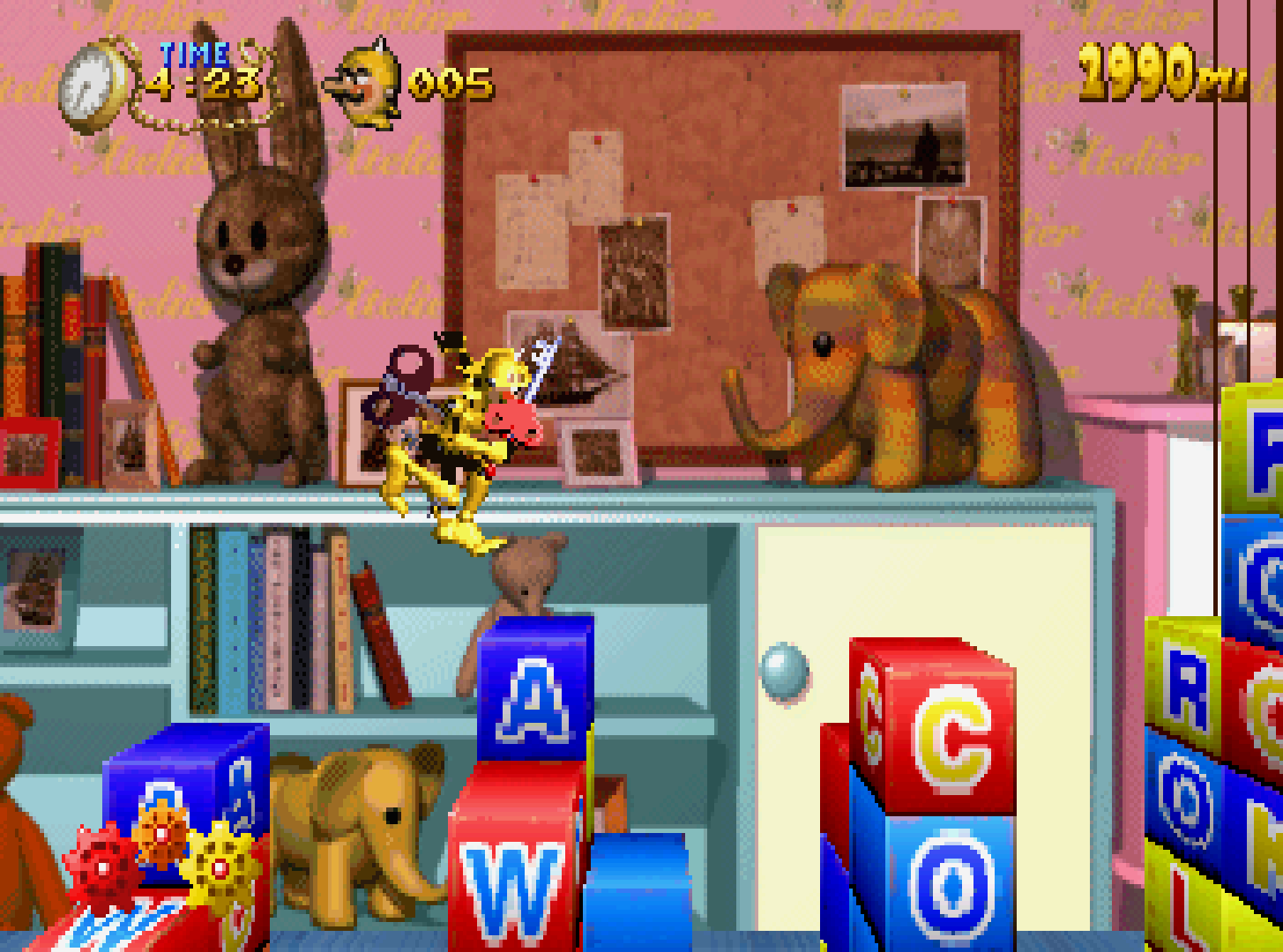
Clockwork Knight is a 2.5D platformer, using a combination of pre-rendered sprites, polygon models and stages that make good use of 3D depth. This title also featured full video cutscenes, with these videos at a much higher quality compared to early FMV offerings. These video scenes play out during the opening and ending of the game, as well as being used to push the story forward at key points. This was a big leap in game video quality at the time.

The premise of the game is simple, at midnight each night, the toys in the house are awoken by the princess Chelsea. During one night, two Clockwork Knights Ginger and Tongara de Pepperouchau (Pepper) are trying to win the love of the princess. During their contest, the lights go out and the princess is kidnapped. Now the two Knights go into action to save her, while many of the toys become hostile in order to stop her rescue.

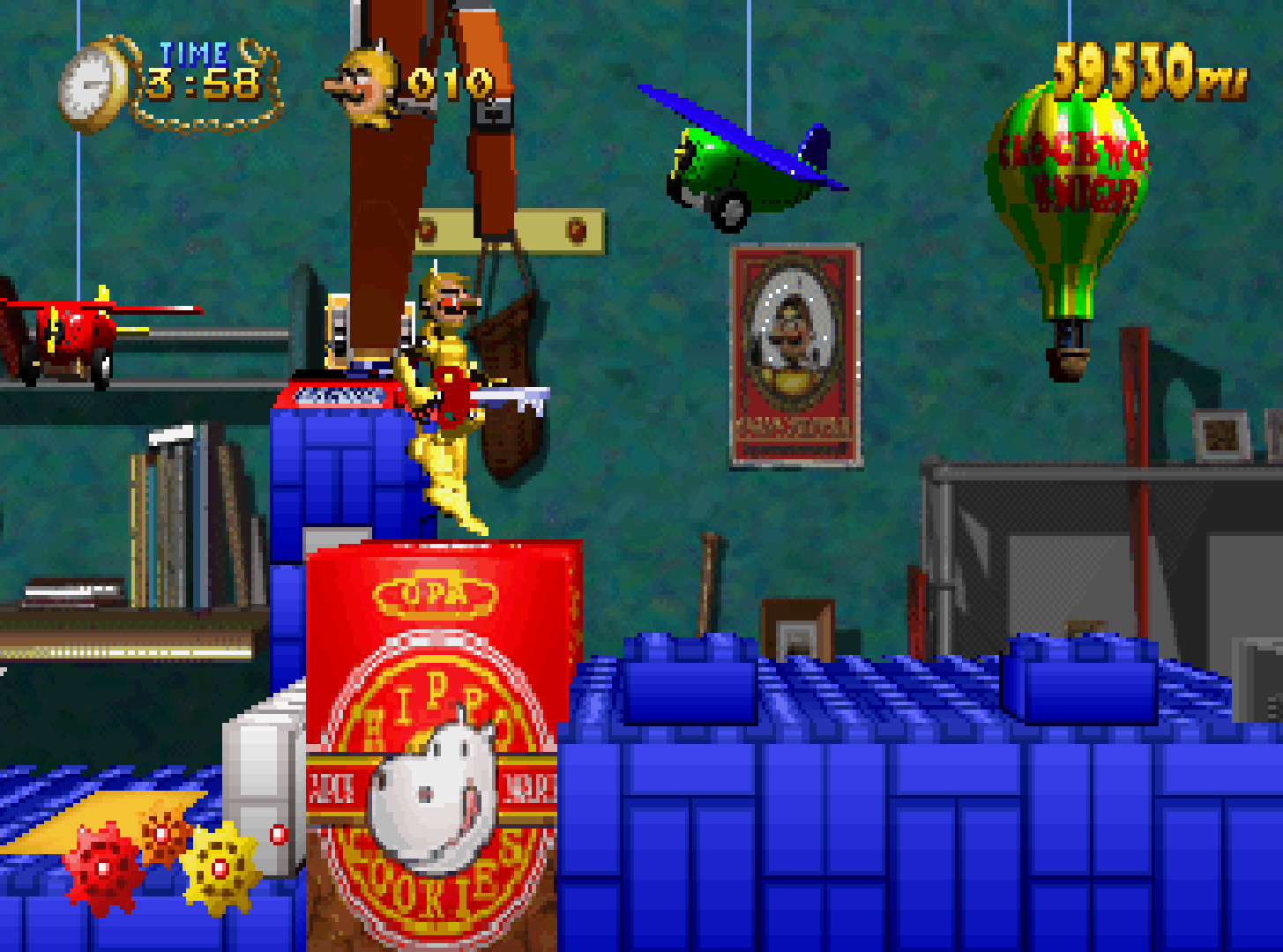
The gameplay loop for this release is easy to understand, with the player taking control of the protagonist Pepperouchau. As the titular Clockwork Knight, they must travel through various parts of the house they are in, battling the evil toys in order to save the princess. There are 4 rooms to travel through, made up of two stages and a boss each, with a final boss battle to cap the adventure off. Each room has unique gimmicks and themes that make them unique.

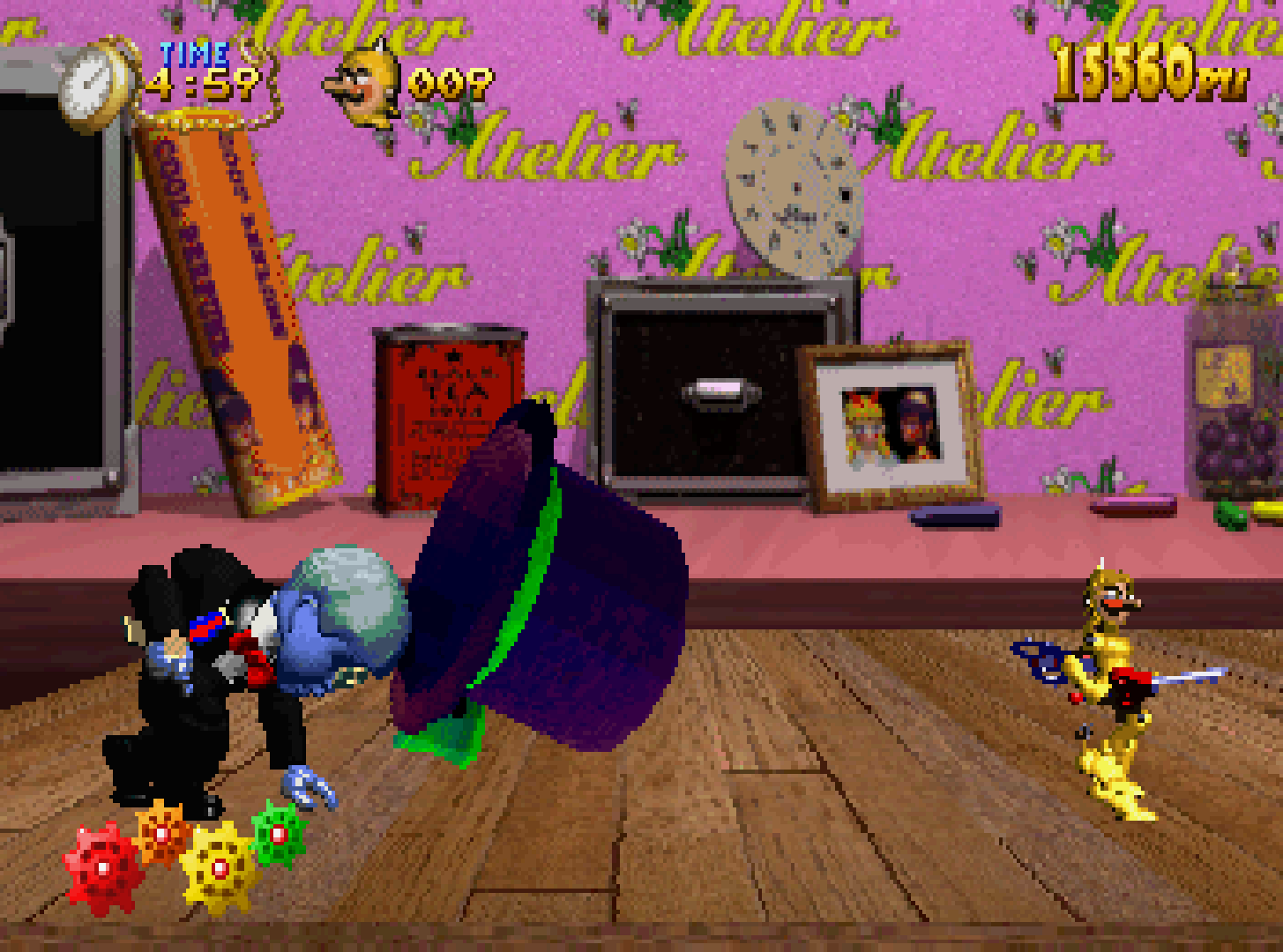
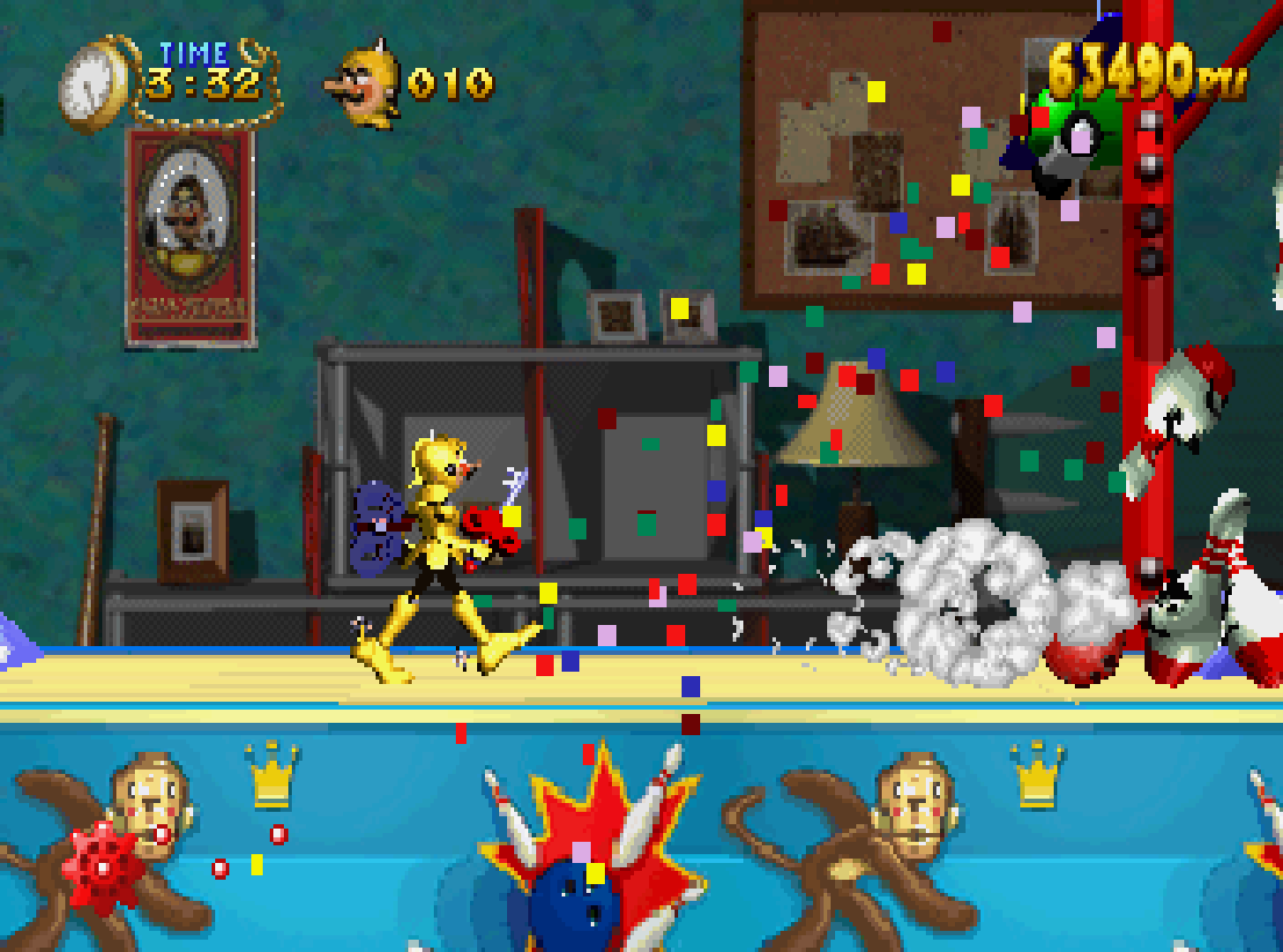
This platforming title follows the traditional action structure, where the player can move left and right, as well as jump across gaps or over enemies. There will also be hazards and obstacles that can damage the player, like enemies that will jump from the background, spikes on the ground and pitfalls. Pepper starts each life with 3 gears, losing one when damage is taken, but they can be restored and increased by collecting clockwork keys.

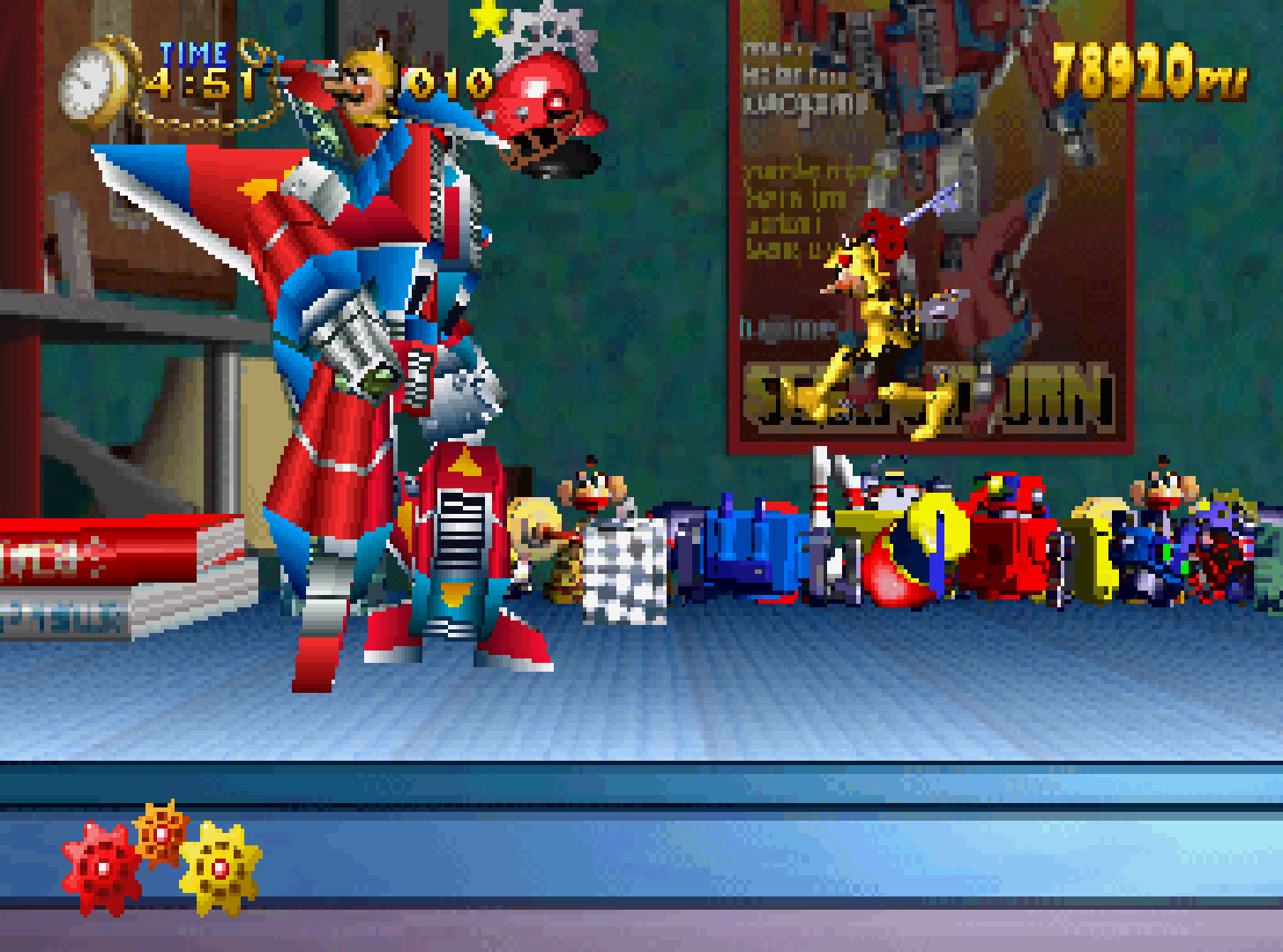
As Pepper is a Knight, he is armed with a sword in the shape of a key, which is used to battle the various enemies that appear. The player can use this weapon to attack by thrusting directly in front of him. This will stun many of the enemies, or outright destroy them. if an enemy is stunned, they can be attacked again to kill them or picked up and thrown. Players can also tap the attack button, causing his body to spin as he turns the key.

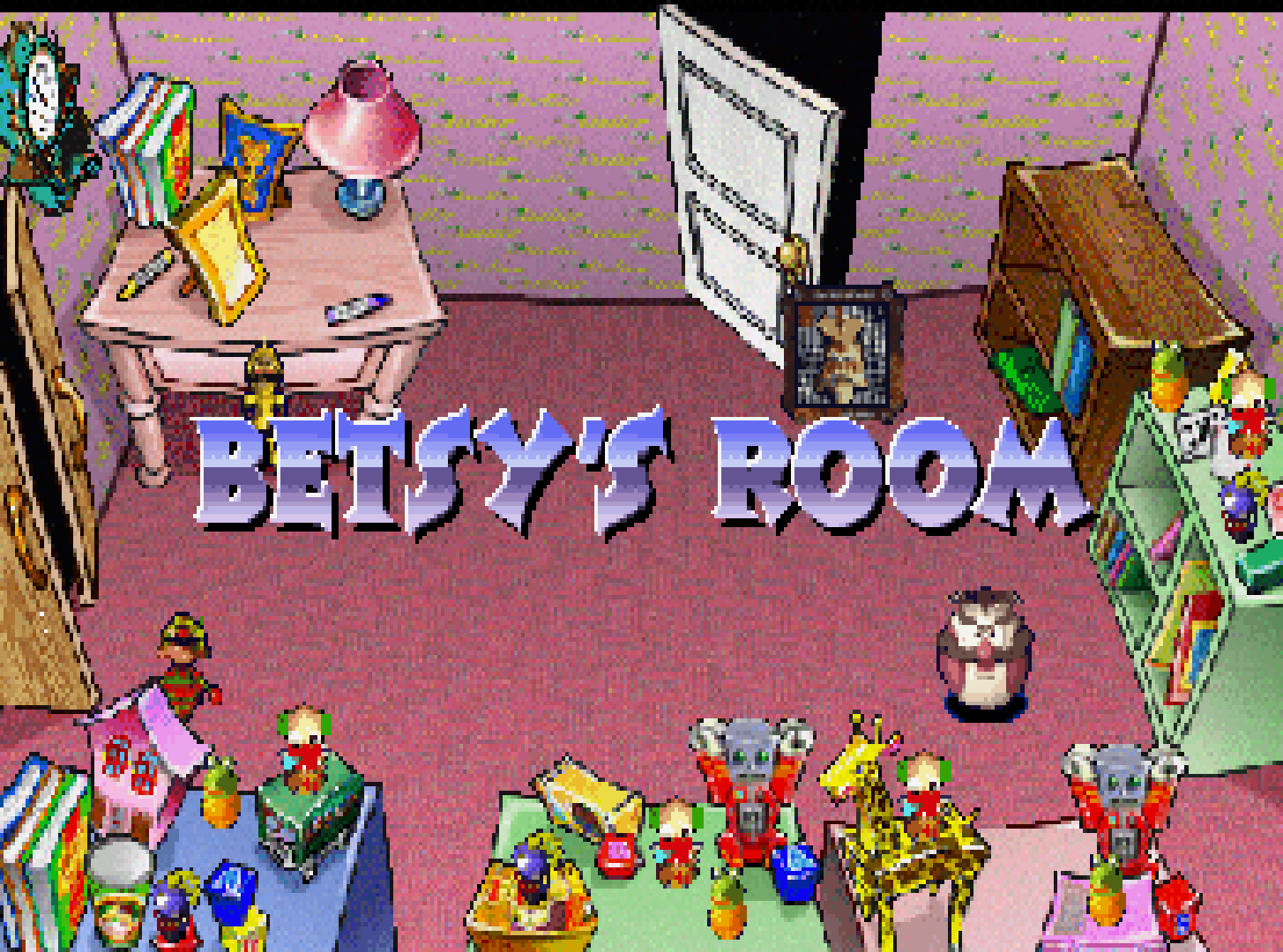
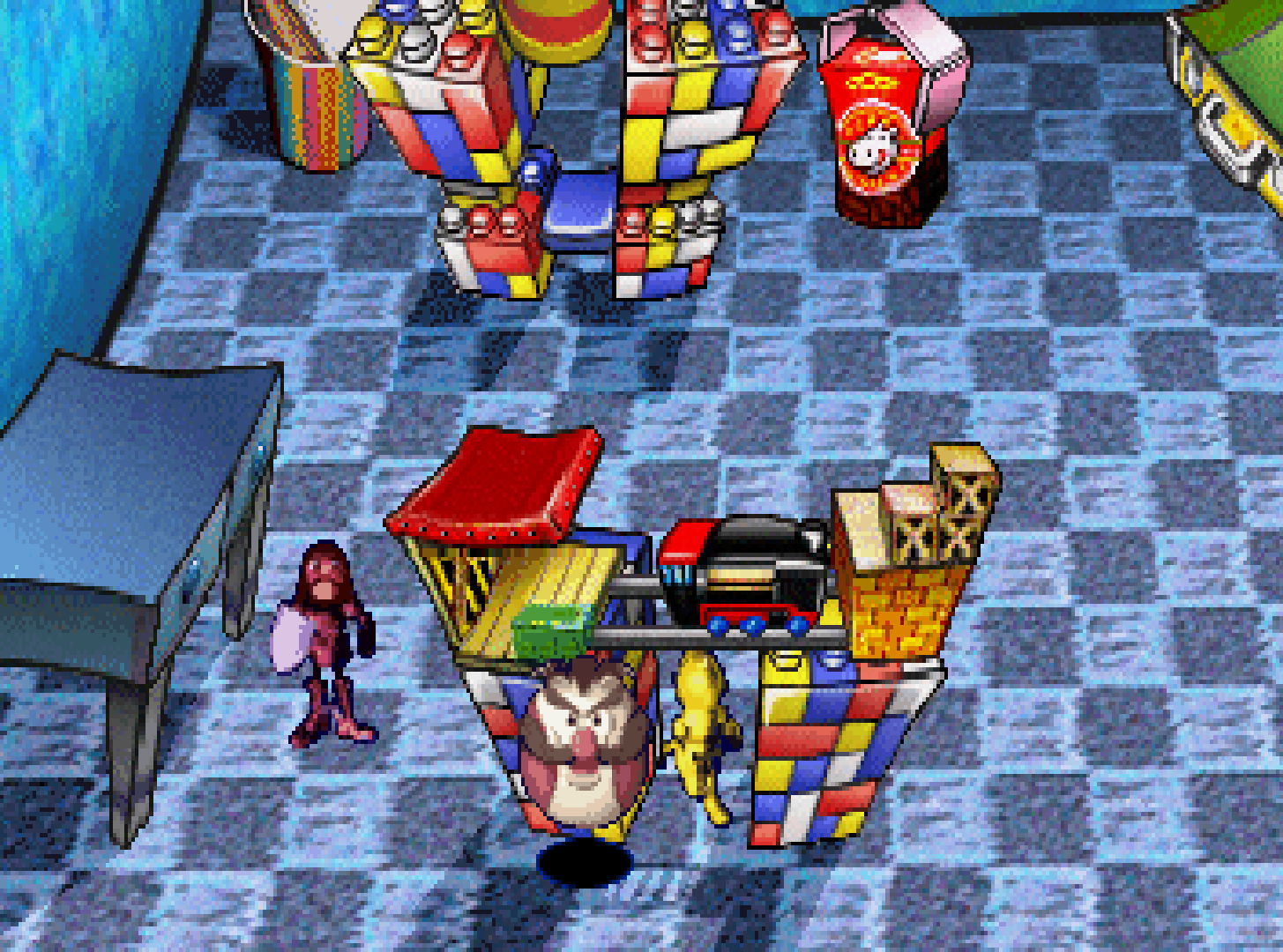
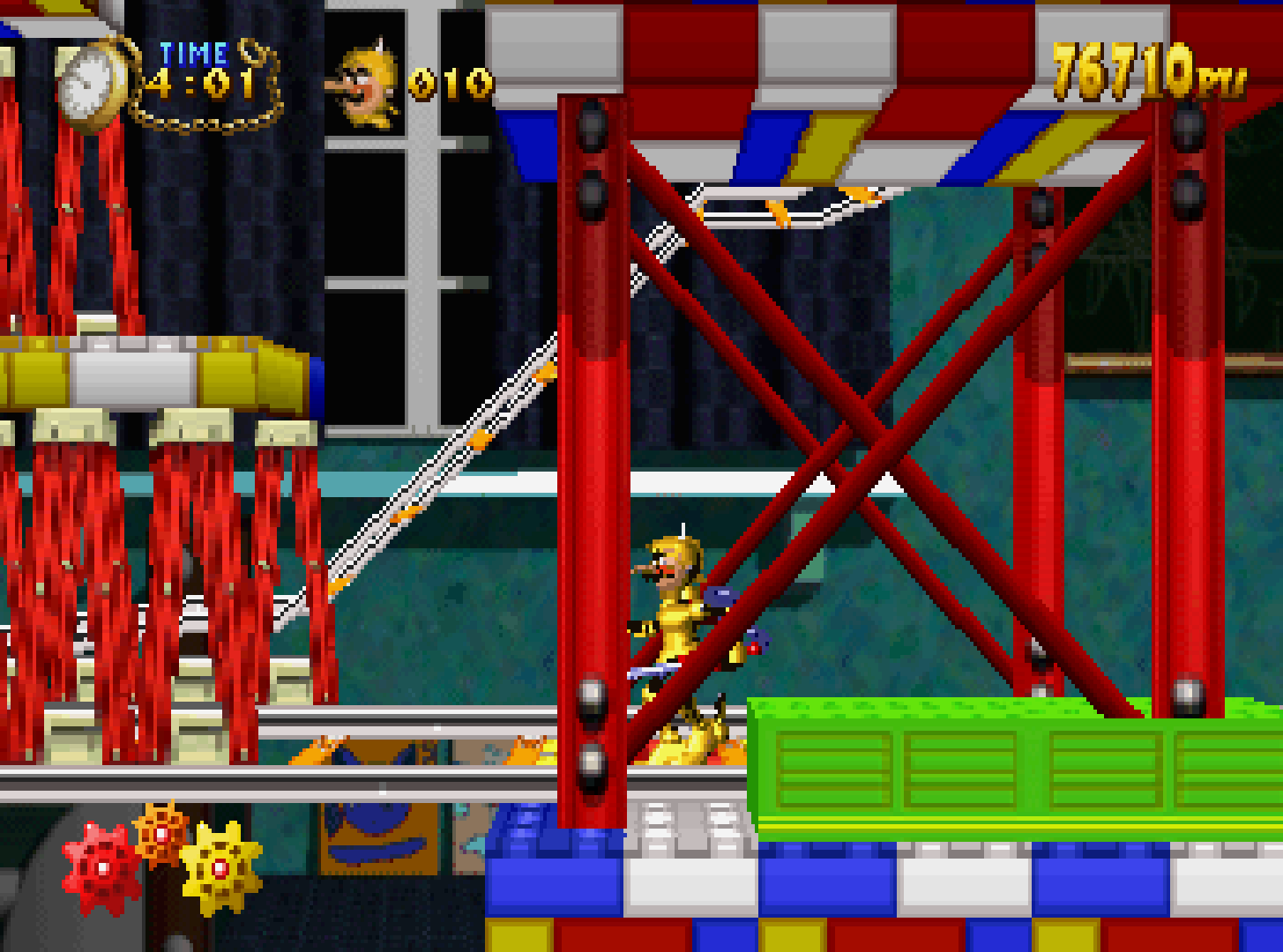
While travelling through the different stages, there will be elements that are distinct to them. Betsy’s Room is the starting zone, with dolls houses that can fall over and story books that will try to crush pepper. Then there is Kevin’s room, which has battery powered elements, like trains and mechanical cranes. The kitchen uses water, as well as low traction platforms to make them more hazardous. Last is the Attic, which contains spikes and explosive enemies.

The different stage mechanics keep the experience exciting and fresh, keeping players on their toes during the course of the game. But there is one more thing that enhances the general experience, which is the alternate path system. Like other platformers, the stages are not just a straight line to the goal. In most of the stages, the player will be able to use special boxes, which are opened with his sword and can transport him to a new area.

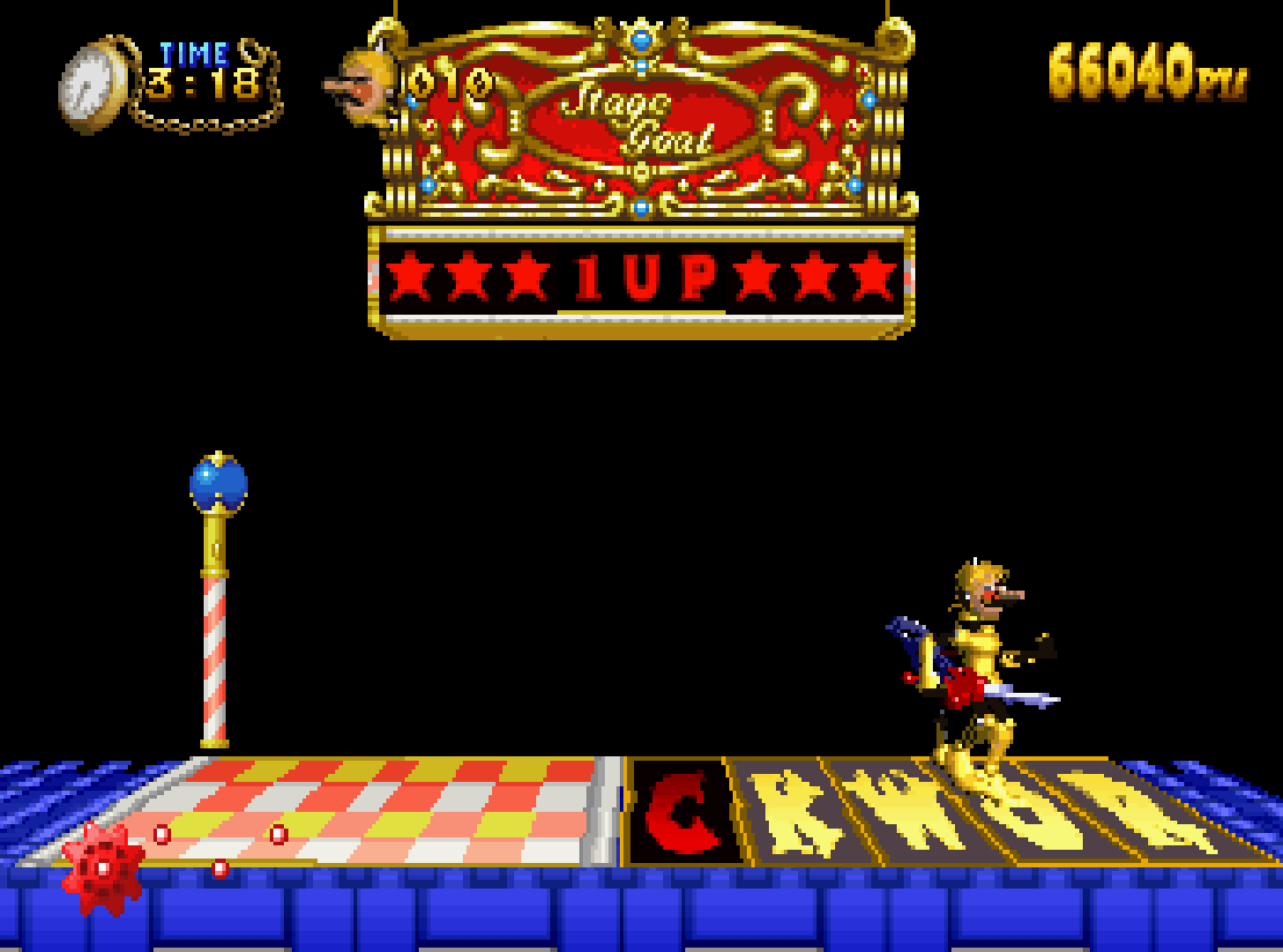
These boxes aren’t the only form of transportation in the game however, as some stages contain tunnels to move through. There are even some secret passages in stages to be discovered, expanding the replay value of the game. At the end of a stage, the player is given a challenge to fill a missing letter in the word clockwork, by jumping on a moving platform. If this is successful, the player gets an extra life to go into the following stages.

Moving onto the bosses, each of the boss battles will have their own challenges, where pepper has to hit them in a weak point. These battles will have multiple phases and patterns for players to figure out. The Bosses will have a theme that is similar to the stage that they are in, with the exception being the Attic boss, which plays out before the final true boss. After the first three boss battles, there is a special bonus round that occurs.

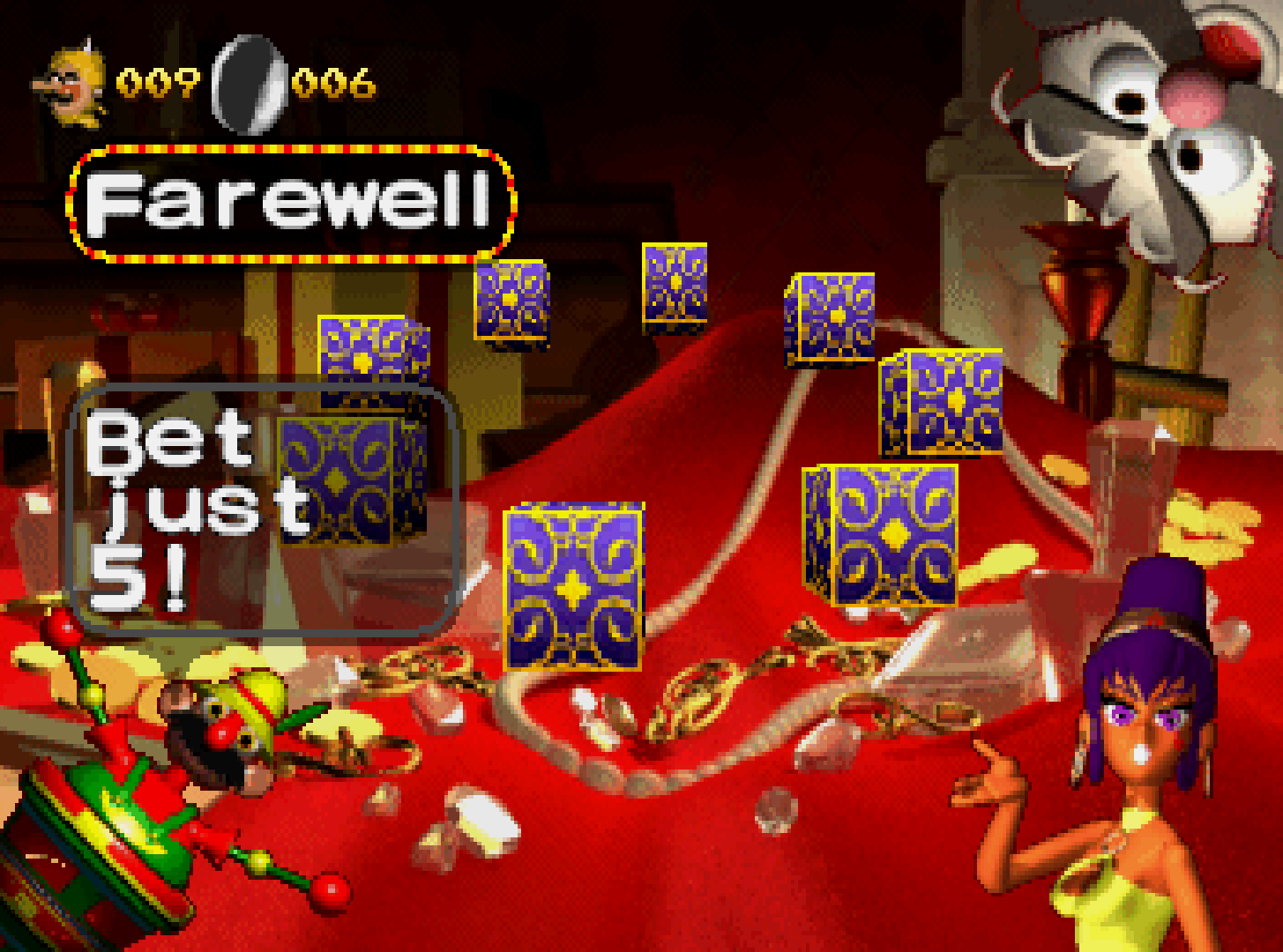
In this special bonus round, the player can wager coins they have collected during the stages. The player can wager 5, 10 or 15 coins and take on a spinning box challenge, where the player must follow the boxes as they spin to get the item they seek. But if they get a clown face, they get nothing. If the player does win, they can try to double it and go for a huge payout, but if they fail they lose it all. It is important not to waste your coins.

If the player runs out of lives, they will be sent to the continue screen, where 20 coins must be paid to keep playing. When this happens, the player will be sent back to the stage they died on.  To keep the game going, extra lives can be collected in stages and in the bonus game, these are shown as helmets with blue giving one life and red giving 3. If the player clears the game, all remaining lives are converted into points for the players score.

Speaking of Score, this is the main replay value of the game. The player will score points based on performance, with bonuses for time and damage taken at the end of the stage. To ensure the best score is obtained, with as little damage taken as possible, it is important to make good use of items that appear. These include items like footballs, springs and even an invincibility orb that will make Pepper invulnerable for a time.

Personal Thoughts

I first experienced Clockwork Knight as a kid, being blown away by the leap from the Mega Drive and SNES, to this whole new world of 3D gaming. There was something special about it and everything that made it new and fresh has stuck with me since I first played it. I will admit that it does have some small flaws, like the length of the game with only 13 stages, including the bosses. But this is for a reason, as the first game ends on a cliffhanger.

The general moment to moment action of the game is fun, with a lot of exploration, secrets and bonuses to be found during play. this game can even be run through pretty quickly, as there are secret exits, letting players pass to the boss from the second stage pretty quick. Then there are the fun boss battles, which really keep the player on their toes. These are very challenging, as you can suffer a lot if you try to rush for a quick kill.

The thing that stood out to me the most is the music and cutscenes, which were something that was pretty revolutionary for the time. The animation between scenes is really good, pushing the story forward without the need for dialogue. Then there is the music, which is wonderful to listen to, offering a selection of tracks that enhance the experience for players. Then there is the opening song which sets everything up for the adventure ahead.

I really love the experience that Clockwork Knight and the sequel provides (which will be covered in the future), as it is just a good simple platformer. This was a showcase for the SEGA Saturn, with the use of depth for the stages and backgrounds, making it feel less flat than the games that came before. It is a real shame that the game is still locked to the Saturn, as there are emulation options out there to bring the game to new systems.

I wish that SEGA would bring this series back, but not as a remake as I feel that would spoil the experience. Last year was the 30th anniversary for the game in japan, with this year being the anniversary in the west, a long time to ignore such a wonderful series. Thankfully, the games are not too expensive on the secondary market, with the game being affordably priced. This is good as games of this age on dead hardware often explode in price.

Thank you for checking this piece out. if you enjoyed it, please take a look at the other content that is available on the site, as well as the other entries in this feature. More content will be coming soon, so stay tuned for that and see what catches your eye.

Morkull Ragast’s Rage – Nintendo Switch Review

Overview – developed by Disaster Games and published by Selecta Play, Morkull Ragast’s Rage is a comedic Metroidvania with a focus on platforming and action. Morkull, the God of death, seeks to escape from the Ragast where he has been imprisoned, after discovering that he is a character in a video game. This title is available on Steam, Nintendo Switch, PlayStation 5 and Xbox Series systems, with a link to each version of the game at the bottom of this review.

Disclaimer: before I get into the review, I would like to thank the rep for Selecta Play who provided the copy of Morkull Ragast’s Rage that was used for this piece, via the Keymailer service. The provision of this software has not influenced the contents of this review, all thoughts and opinions contained within are my own.

Now with the introductions out of the way, let’s get into the review, starting with the story. I will be covering the core gameplay of this game, as there are some elements of the game that I don’t wish to spoil for players.

Story – Morkull, the God of death has found himself trapped in the Ragast, imprisoned within it. He has decided to break out of his bondage, becoming aware of his existence as a video game character. He has recruited the player to aid him in this quest, as he wishes to combat the developer and escape the confines of his programming, seeking to bring his evil to the world.

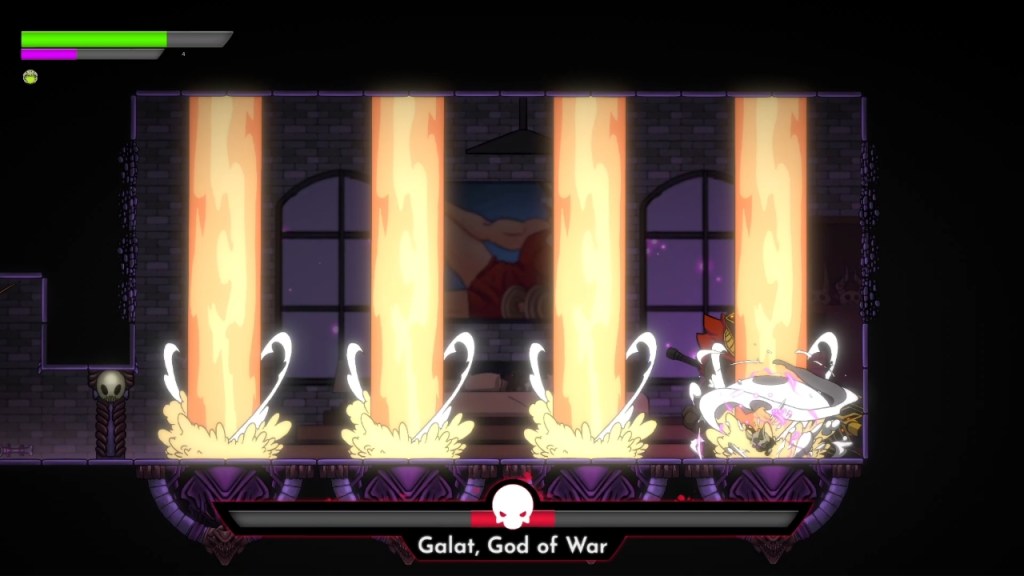
Gameplay – Morkull Ragast’s Rage is a rather simplified Metroidvania, where the player takes control of the eponymous villain and god of death. The game features a rather straight forward gameplay loop, focused on platforming and action, with a little exploration. When the player starts the game, they will be moved through a simple tutorial, teaching the player the basics of the game. This introduces the players to basic combat and platforming.

As the player gets further through the game, there will be new mechanics that get added to death god’s skill set. These include the ability to block enemy attacks and parry, this is alongside the ability to dash and cross large gaps. As the skill set increases, the player will be able to reach new areas that may have been inaccessible beforehand. This means there is a little bit of back-tracking during play, but it doesn’t impact the gameplay too much.

During exploration of the different areas of the Ragast, the player will come across various foes. There will be enemies that can attack on the ground and in the air, alongside invulnerable monsters, which can deal serious damage to Morkull. To battle the dangers of the labyrinth, the player can use two attacks, consisting of a light and heavy attack. The move-set is limited at the start, but can be upgraded during the course of the game.

Enemies will have a variety of attacks that can hurt the player, dealing significant damage to him as he is rather frail in battle. Morkull has a health bar that is shown onscreen, which will be depleted from enemies as well as traps in the dungeon. These traps include acid pools, spikes and rolling boulders. In order to recover health, the player can heal up at special points and use potions, with one to start but more can be obtained.

When enemies are defeated, the player will gain souls of varying amounts. These souls are added to the players total, with no upper limit that can be obtained. The souls can also be found in hidden areas, where they can be picked up once as a bonus. If the player dies during the course of the game, they will lose half of their total souls as punishment. The souls that have been collected serve an important purpose during play.

At set points on the map, the player will come across arches, where they will be able to talk to Morkull’s servant. This vassal of the death god provides a very important service for the player, the ability to unlock new skills. By upgrading the skill tree, the player can get new combo attacks, additional potion slots and more special skills. Morkull can also heal at these points and fast travel between them, as well as respawn at them.

As this title uses elements of the metroidvania genre, the player must open up locked gates. The gates are locked in three ways, the first and most common is via keys, which are obtained from defeating enemies. Then there are the switch gates, which can be opened by triggering a switch during exploration. The last type of gate is the encounter gate, where Morkull is locked in a battle, which must be cleared to pass the gate.

Then we have the boss battles. These are challenging battles where Morkull is trapped in an arena, fighting to the death against a powerful opponent. Entering these battles will push the story forward, giving the player new special abilities and special cutscenes. But these are not the only cutscenes that occur during the game, as Morkull will break the fourth wall and talk to the player, as well as other NPC characters in the story.

The last thing to discuss is the collectable system. During the adventure, the player will discover special items that are scattered throughout the dungeons. These are added to the collection screen, where the player will be able to view special abilities, enemies encountered and more during the adventure. This is a very useful screen, as the player will also be able to access the skill tree, alongside the expanding map on this screen.

Now with the gameplay covered, it is time to discuss the other aspects of this release, starting with the controls.

Controls – the control system for this game is laid out in a comfortable manner, with all of the most common inputs on the face, and secondary actions on the shoulders. This gives the game a straight forward and beginner friendly feel, allowing newer players trying the genre a good foundation to get started. However, during play there are moments where the inputs can be missed, which is very likely to cause frustration for players.

Difficulty – in terms of challenge, this game is balanced fairly well for the most part. But there are moments where the difficulty can spike, due in part to the non-linear nature of the game. This can cause players to enter some areas unprepared, be swarmed by enemies and killed quickly, losing souls in the process. These sudden jumps in challenge can be frustrating, but with patience and resilience, they can be overcome.

Presentation – visually Morkull Ragast’s Rage looks fantastic, with hand-drawn art and frame by frame animation. This enhances the overall feel of the game, making characters and movements feel fluid and lively. There is the occasional hiccup with performance, but it isn’t prevelant enough to be considered a detriment. The sound for this release is a good accompaniment to the visuals, with atmospheric music for exploration and heavy tracks for battle.

Final Thoughts – I do enjoy a good Metroidvania or Search Action game, with a fondness for those that do things a little different. So I went into Morkull Ragast’s Rage with some enthusiasm, with mixed results. The general game experience is fun, with the fast but simple combat offering a good challenge, combined with platforming that doesn’t feel sloppy. I also enjoyed the humor and fourth wall breaks, as they add a little more spark to the game world.

Unfortunately, the game doesn’t come without flaws. The frequency of save gates where upgrades can occur is much lower than I had hoped. This can be a significant frustration when trying to get back to one with a large amount of souls, due to the penalties for death. There were some minor bugs during play too, but these will likely be addressed in the future. In general, I can recommend this to those who are looking for a fun Metroidvania style adventure.

In the end, I give Morkull Ragast’s Rage a final score of 3.5/5. This is a charming and entertaining Metroidvania style adventure, with solid humor, satisfying combat and simple but challenging platforming. Unfortunately, it is brought down by a couple minor hiccups during play. if you want to check this game out for yourself, a link to each version of the game will be below.

Link to Nintendo Switch version (HERE)

Link to PlayStation version (HERE)

Link to Xbox version (HERE)

Link to Steam version (HERE)

Fluffy Sailors – Steam Review

Overview – developed and published by Skaldery Games, Fluffy Sailors is a nautical action roguelite game, where the player takes the role of a little mouse on a quest from the mouse queen. Engage in challenging sea battles, with an interesting mechanic to battle, by using the fluffy crew on the ship as cannon balls. This title is available exclusively for the Steam platform, with a link to the game at the bottom of this review.

Disclaimer: before I get into the review, I would like to thank the rep who provided the copy of Fluffy Sailors that was used for this piece, via the Keymailer Service. The provision of this software has not influenced the contents of this review, all thoughts and opinions contained within are my own.

Now with the introductions out of the way, let’s get into the review, starting with the story. I will be focusing on the core mechanic of the game when talking gameplay, as there a many variables that can affect the game as a roguelite.

Story – in a world ruled by fluffy animals, the Mouse Queen delivers the distressing news that her royal chef has been captured. The culprits of this fluffnapping are the Alligators, who captured the cook while they were trying to collect yummy ingredients. In order to get the royal cook back, her highness has given you the map to the alligator territory, along with a ship to set sail. Can you make it across the treacherous waters and complete your quest.

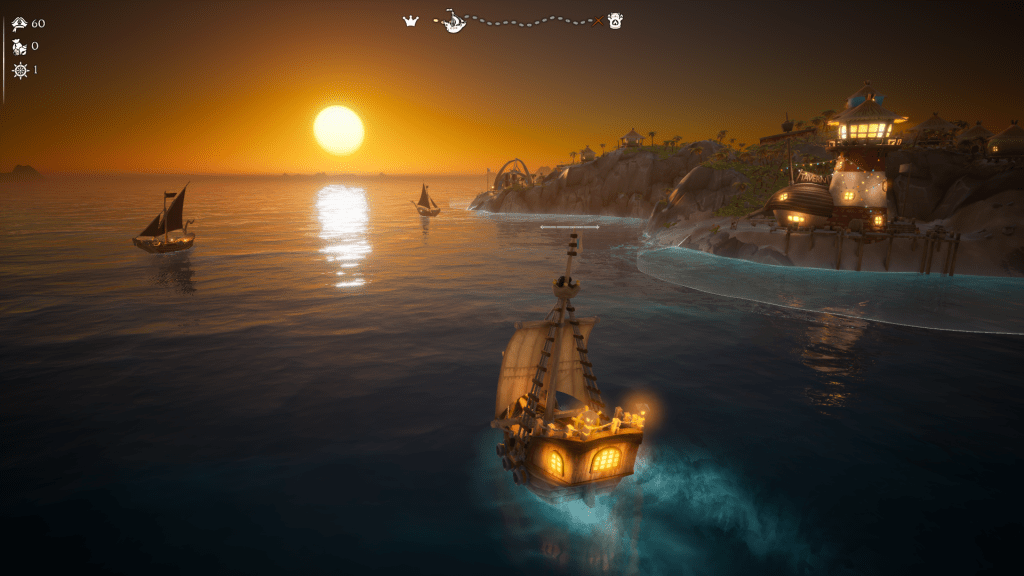
Gameplay – Fluffy Sailors is a naval combat roguelite, where the player is tasked with rescuing the Royal Cook for the Mouse Queen. To achieve this goal, the player must sail through various areas, combating the enemy ships that hold those territories. When starting a run in this game, the player always starts at the mouse kingdom island, where the tutorial battle occurs. Here the player will learn how to handle the ship.

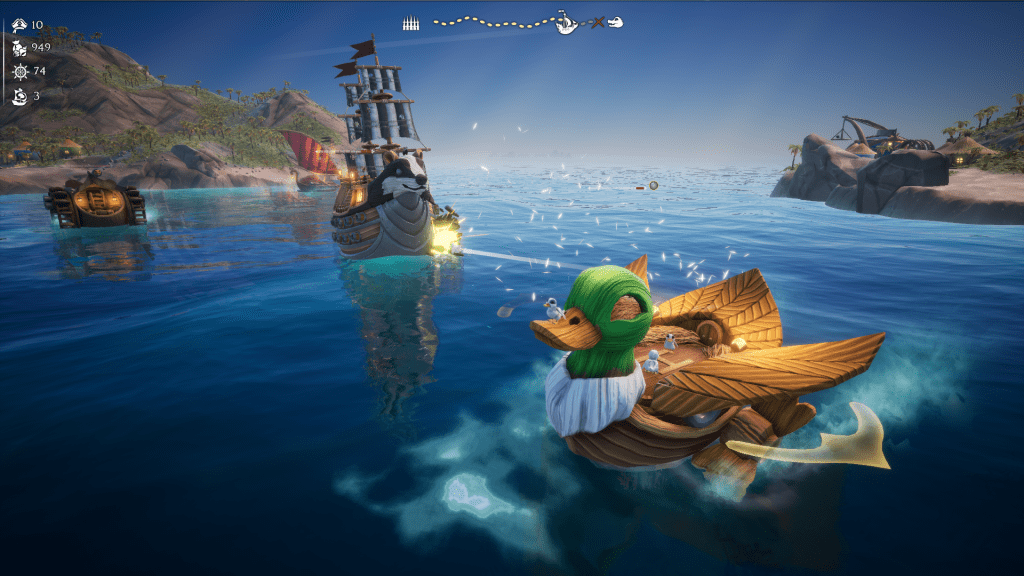
During ship to ship combat, the player can fire from cannons on the left and right of the ship. This is where the unique gimmick for the game comes in, as the ammo for the cannons is the fluffy crew of the ship. Each time a cannon is fired, crew members will be fired at the enemy, dealing damage when a successful hit is made. But this comes with a caveat, if the ship runs out of crew, they will be defenceless, leaving them open to getting sunk.

Thankfully, the crew can be replenished, which can be done in two ways. The first and main way is restocking at islands. This will be free at the mouse kingdom, but every upgrade after will cost seashells, which are earned by destroying enemy ships and collecting salvage. However, there will also be rafts that can be found floating in the seas, which will add some crew members to the ship. This gives the combat system an element of tactics.

The game is split into stages, with the foes that you face varying from run to run. These enemy vessels have themes based on their species, including Rat Pirates (Pirats) in black sail ships, Hamsters with wheels on their boats and more. When all enemy ships have been sunk, the player will clear the stage and be given Seashells as a reward. There is also the chance for skill points (discussed further below), or if the player is lucky they can capture an enemy ship.

When an enemy ship is captured, they will be able to use that ship as part of their fleet from the next stage. All of the different ships have their own unique strengths and weaknesses. Some will deal big damage at the cost of ammo supply, whereas others can do low damage with a lot of ammo and fire rate. If a ship is destroyed, they will be removed from the fleet, but don’t fret as damaged ships can be repaired at islands for seashells.

The further the player gets into the game, the more things that will appear on the islands. There is the chance for item shops to spawn, providing temporary boosts for the player. These items can have both positive and negative effects, like increased damage dealt at the cost of reduced defense. Each ship in a fleet (if the player captures any), has one slot for an item which will be with them for the duration of the run.

After clearing a set number of smaller islands, the player will encounter milestone areas which act as bosses. In these areas, the player will battle a higher number of enemies, with areas of the stage that have gimmicks that are unique to them. These milestone stages are highly challenging, with the chance for defeat being pretty high. The further the player gets into a run, the more challenging and deadly the stages will become.

If the player gets all of their ships sunk, they will be sent back to the Mouse kingdom. When this happens, the player will be able to use all of their earned skill points to get new permanent upgrades. These upgrades are set into three tiers, with the first tier unlocked and the other two unlocked when milestones are cleared. These skills include the ability to ram enemy ships, reduce costs to restock/repair ships and even rescue ammo crew.

Due to the nature of the roguelite genre, there is a lot of luck that players will need to hope for in order to succeed. The random nature of this type of game can affect the way that runs play out, with the chance for very strong enemies to appear early on. This can lead to a quick defeat, which can be frustrating for players. If they are lucky, they will get lower level enemies, which will give the player a chance to build their supplies for the harder stages.

The last thing to discuss is the interactions between the Mouse Queen and the chosen Hero. Between each run, the player will return to the mouse kingdom, where they will speak to the queen, relaying information about the adventure. These can be both humorous and helpful, as the queen will react to the events that occur, occasionally giving advice to the player. This gives the game a unique charm that adds to the fun of the game.

Now with the gameplay covered, it is time to discuss the other aspects of this release, starting with the controls.

Controls – Fluffy Sailors has a twin input system, with the option for mouse/keyboard as well as the ability to use controllers. The player controls the ship and camera independently, with the skill functions and cannons on their own buttons. For ease of play, there are on screen inputs that players can use for quick reference. The controls work well, but there can be some janky camera movement with mouse, but adjusting the DPI can help.

Difficulty – since this is a roguelite, there is an odd difficulty curve that can be a little bit inconsistent. When playing through the game, it can be entirely dependant on luck if players will make it to the first milestone, let alone the end of the game. This is due to the high chance the game will spawn strong enemies early, reduce the amount of salvage that appears and even if ships can be captured. These systems can be frustrating, but also highly rewarding during play.

Presentation – there is a very pleasing style to the visuals of this game, with the animals having a cute look to them. This contrasts well with the look of the islands, the seas and the ships that appear on the seas, making the world feel lively and interesting. There is the odd hiccup with visual performance, but it doesn’t severely impact the game. The sound is pleasing, with cute squeaks for the mice and other animals, combined with an exciting soundtrack.

Final Thoughts – I am an enjoyer of the naval combat style of play, with the open movement and exciting cannon battles. So when Fluffy Sailors was made available, I decided to give it a chance. My first impression of the game was a little iffy, as I experienced some very bad luck which was a frustration. But as I spent more time playing, I got used to it and the experience was more enjoyable, being able to overcome some of the slightly wonky flaws.

The general gameplay experience can be a bit of a mixed bag, with the random nature of the roguelite genre, which can be frustrating for players. However, the gameplay loop is rewarding when getting to grips with it, becoming a little easier as the player gets used to it. There is even a special survival mode that can be unlocked. With all of that being said, I can recommend those looking for a challenging and rewarding game, all wrapped in a cutesy presentation.

In the end, I give Fluffy Sailors a final score of 3.75/5. This is a fun and enjoyable roguelite naval combat title, with a slightly awkward control system, but a rewarding and challenging gameplay loop that has an adorable style to it. if you want to check this release out for yourself, a link to the game will be below.

Link to Steam version (HERE)

Lost Gems – SimCity (Super Nintendo)

Hello there! I am back again with another entry in my feature covering games that are no longer available. This time for Lost Gems, I want to share one of my favourite game releases for the Super Nintendo (SNES), SimCity, which was a launch title for the System in Europe and North America. During a time when console simulation games were uncommon, Nintendo partnered with Maxis to create one of the best city management Sim games.

Disclaimer: While the game discussed here is no longer officially sold, there are ways to obtain the game. This can either be through the second hand market, or through unofficial digital roms/rips. I do not condone or promote piracy, so there won’t be any links to roms or rips of the game being discussed.

So with the introductions out of the way, let’s get started. I will be starting with the general game experience, then giving my personal thoughts on the title.

About the game
SimCity is the premier city building and management simulator, where players can construct their own city to build a bustling population. Starting off with a blank slate, the objective is to build Commercial, Industrial and Residential zones to grow the city. When starting the game for the first on SNES, the player is given three options to choose from, Practice, New City and Scenario. If a city is already in progress, players can choose to load an existing city.

In the Practice mode, the player will be given all of the tools to build a city up to a target population, using a preset map for this mode. All while learning the ins and outs of managing their city. The scenario option gives players a selection of prebuilt cities, with objectives and challenges to complete. These include an earthquake in San Francisco and monster attack in Tokyo, making them distinct from each other.

The main attraction for this game is the new city mode, where players can build up their own township from the ground up. When creating a new city, the player will need to select the land that they want to build on. There are a total of 1000 possible maps that can be used, giving an incredible amount of replay value. After the map is chosen, players must name the city and select a budget, with Easy at 20K, Medium at 10K and Hard at 5K.

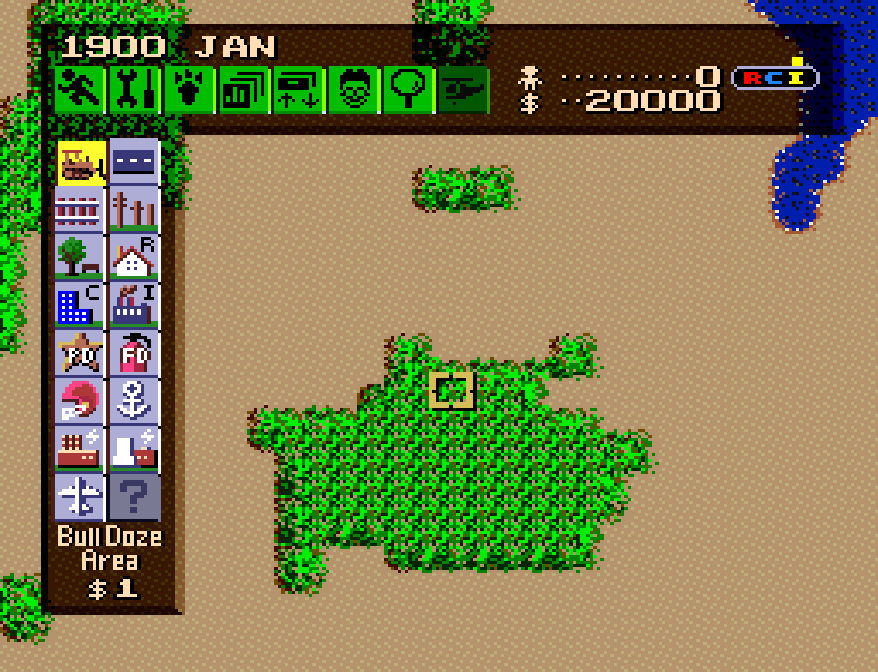
When the player starts a new city, they have a blank canvas on which to build their civilization. The progression of the game is split into stages, with the first stage being a village. It is advised to start off by building a power source, with the choice between Nuclear and Coal. Then the player can start to build Residential, Commercial and Industrial zones to meet the demand for each, with power lines connecting them to the station.

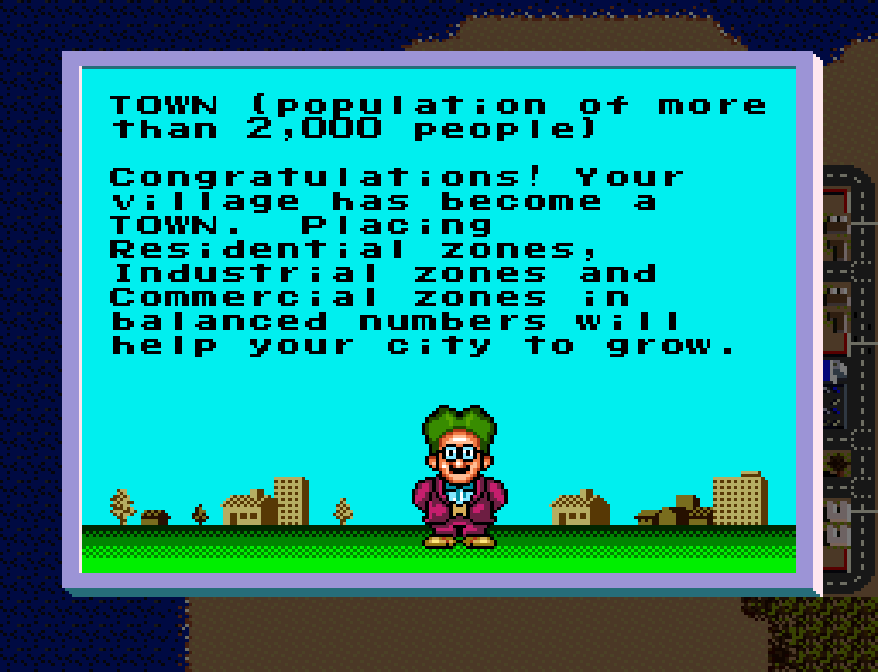
To encourage the growth for different zones, the player will need to build roads and rail lines, connecting the different areas together. As the different areas are connected, the areas will grow and the population will increase. When the population reaches set milestones, the stage will increase, starting off at a village and increasing all the way to Megalopolis. As the stages advance, the music that plays will also change.

The main zones that players can build aren’t the only things players can build. There are police and fire stations, which protect the surrounding areas, Parks that add greenery and even stadiums for the residents. Players can even earn special items, including the Mayor’s House, Theme Parks and Casinos when special criteria are met. These rewards increase the options for a new mayor, while also providing various benefits.

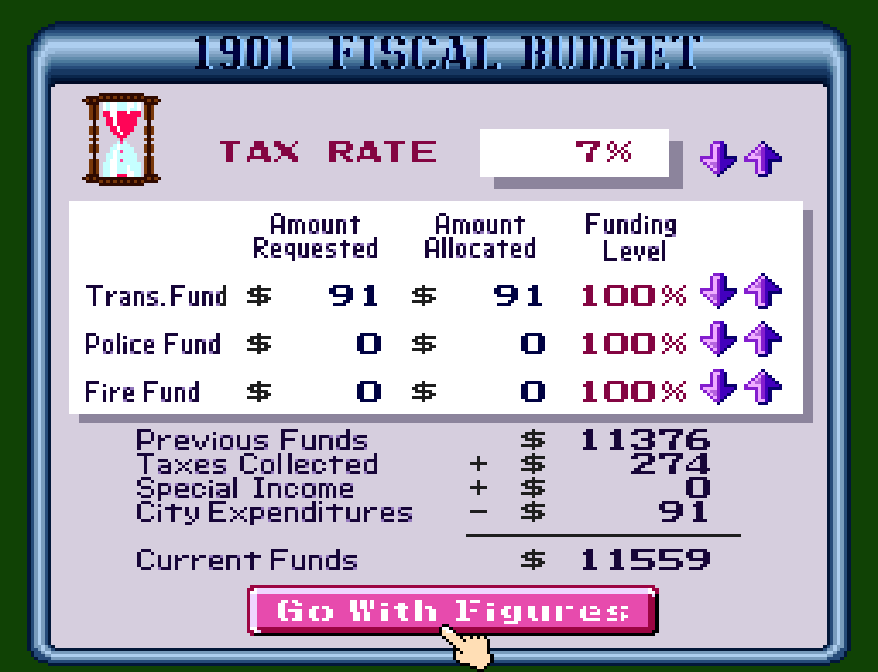
As this is a city management game, the player will need to earn money in order to keep everything running smoothly. At the end of each in game year, taxes will be collected from the population, with money being added to the budget and expenses deducted. Players will also get special expenses from the rewards that have been obtained. The expenses consist of transport for rail/road, fire departments and police forces.

It is very important for the mayor of the city to make sure to keep expenses paid, as the city will fall into disrepair and the growth will suffer. If the expenses cannot be paid, the roads/rail will crumble and crime will increase. The funds will also be needed in the event of a natural disaster, like fires, flood or even Bowser attack. In the event that all funds run out, the player can get take out a loan, but if it cannot be repaid and the city goes bankrupt the game ends.

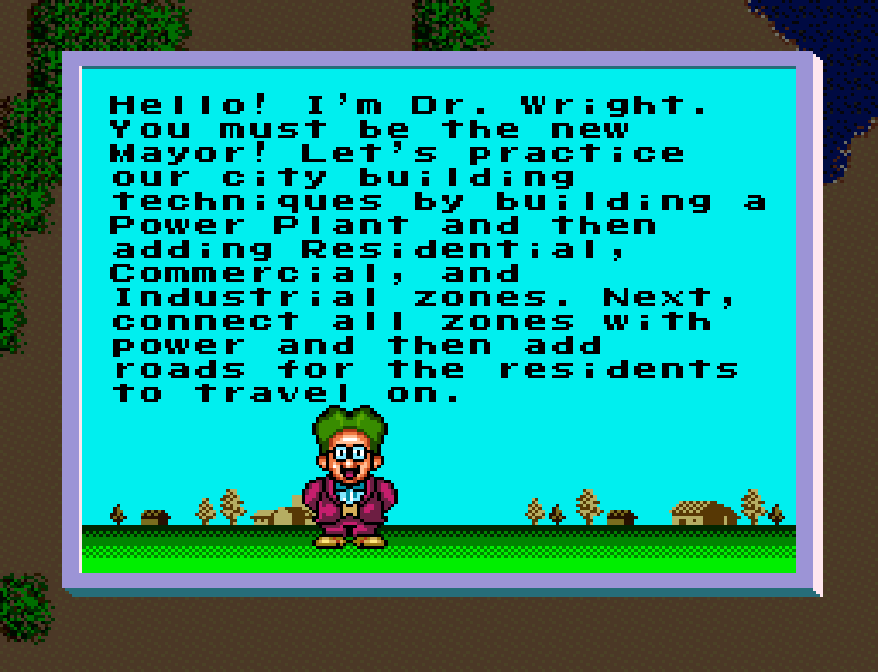
The last thing to discuss is the mascot of SimCity for Super Nintendo, DR. Wright, a personification of the creator of SimCity. DR. Wright will appear throughout the game, giving the player tutorials, important alerts and congratulations when milestones are met. This system adds to the colourful presentation of SimCity. There is even some humor added with DR. Wright reacting to crime, pollution and even natural disasters.

Personal Thoughts

This is another game that is ingrained in me, holding a special place in me for as long as I can remember. While I am not a fan of the city management genre of simulations, I do have an exception for SimCity as it doesn’t have the overly complicated systems later games do. There is also the distinct Nintendo charm that this game has, with the expressive mascot version of DR. Wright, alongside the inclusion of Bowser as a disaster.

The use of DR. Wright gives this version of the game its own unique identity, making it feel like there is an achievable goal, rather than a run of the mill simulation. This is enhanced by the inclusion of the stage system, going from village to town, all the way to Megalopolis as a final step. Then there is the soundtrack, which changes along with the growth of the city, as each stage is passed, the music becomes more grandiose.

Then there are the alerts that pop up, showing the DR. either happy or in distress, with their own distinct music and imagery. All of these elements give the game that Nintendo flavour, making it more than just a simple port of the PC game to a console. The ease of use for everything makes the game very approachable, so players can play without needing the manual. This is refreshing, given the progress the genre has made and how complex it has become.

I find this to be one of those games that needs to be experienced by everyone, as it has everything that would qualify it as a “cozy” game in this age. When the Nintendo Online library services were released, I was hoping that this game would be included, but sadly the omission of this game left me disappointed. It would have been perfect for the Nintendo Switch, given the hybrid nature of the system, allowing players to start their city at home and take it on the go.

Thankfully, it is not an expensive game to pick up on the secondary market, with loose cartridges and even boxed versions of the game at affordable prices. This is a fairly well-known game and I am surprised that it is as affordable as it is, given how the market tends to fluctuate with good games. I would have hope that this game can be made available to players again, but honestly there is probably no chance given how EA treat their old games with partners.

Thank you for taking the time to check this out, if you enjoyed it, please check out the other content that is available on the site, alongside the other instalments of this feature. There will be more features coming soon, so stick around and see what catches your fancy.

3D Don’t Die Mr Robot – PlayStation 4 Review

Overview – developed by Infinite States Games and published by Eastasiasoft, 3D Don’t Die Mr Robot is an arcade style collection game, where the player must avoid enemies and collect fruits. Play through the 50 stages of Remix mode, alongside special challenge modes and a cosmetics unlock system. This title is available on all console platforms, with a link to each version of the game at the bottom of this review.

Disclaimer: before I get into the review, I would like to thank Eastasiasoft for providing the copy of 3D Don’t Die Mr Robot that was used for this piece, via the keymailer service. The provision of this software has not influenced the contents of this review, all thoughts and opinions contained within are my own.

Now with the introductions out of the way, let’s get into the review. There is no plot for this release, so I will be going straight into discussing the gameplay.

Gameplay – this title is an arcade style score game, where players must dodge the enemies and hazards that appear on screen. There is a top down perspective, allowing players to see everything that pops up. In these arena stages, there will be fruits that appear, exploding when collected, destroying the enemies and moving hazards within the blast radius. These explosions can be chained together, for bigger scores and to collect coins.

In this mode there are several challenge modes for the player to take on, with the main attraction being the Remix Mode. This challenge mode offers 50 stages for players to challenge, broken up into 5 level chunks. In the Remix stages, the player will have a variety of challenges to take on. These mission include collecting fruits, killing enemies and chaining together explosions. There will be 4 ranks to obtain, ranging from bronze to platinum.

The challenge stages can end in two ways, either through player death or achieving the platinum target. If the player does not reach the bronze target, they will need to retry from the start of the stage. When the player has earned enough target points, they will be able to unlock the next batch of stages. The stages that have been cleared can be replayed, allowing payers to go back and achieve the trophies that they may have missed.

All of the stages for this mode will be different shapes and sizes, with some special stage gimmicks that get added. These can include special stages where they are trapped in a section, with the player needing to chain off explosions to reach the other areas. All of the different stages keep the action of Remix mode fresh, preventing the game from being boring. The difficulty of Remix increases over time, with some real spikes in challenge at times.

Then there are the extra challenge modes for players outside of remix. The first is Arcade, which is a special high score challenge, where players must survive for as long as possible. In this mode, points are gained for killing enemies with bombs, getting near misses, collecting fruits and setting off explosion chains. The top score that the player sets will be added to the leaderboard, with the top scores on the main menu for quick reference.

Next to discuss is Lime Attack, which is a timed challenge, where the player needs to try their best to rack up the best score possible. The player will have 2 and a half minutes to survive, with points being lost each time damage is taken, with more points being lost with each successive hit. The best score is added to the local ranking for players to try and beat. There will also be a global ranking, where players will be able to compete worldwide.

Finally we have Chill Out Mode, which is set on a quiet island setting. Here the player must set off as many explosion chains as possible, causing coins to be dropped. These coins must be collected to add to the score, with enemies appearing and moving slowly across the island. Like the other modes, there is a local ranking keeping the score and increasing the replay value. Like the others, there will be additional global rankings for players.

Last to discuss is the cosmetics system, which has a gacha style of being unlocked. All of the coins that players earn will be added to the player total. This coin reserve can be used in the costume menu under Appearance, which puts the player in a separate space with a slot machine and wardrobe. Each try of the slot is 200 coins, with the chance to get hats, glasses and shoes. One of each can be applied to the character in the wardrobe setting.

Now with the gameplay covered, it is time to cover the other aspects of this release, starting with the controls.

Controls – the control system for this release is super simple to get used to, with the only thing needed during gameplay is the Thumbstick or D-pad. All the player needs to do is move around the stages, as the bombs explode when Mr Robot makes contact with them. The thumbstick allows quick movement in all direction, with the D-Pad offering more precision. This makes it an accessible experience that everyone can pick up and play.

Difficulty – there is a fairly moderate difficulty curve to this title, with the early stages of Remix being easy for players to get into the flow of action. But the further that players get, the tougher it will become to get the maximum score rank, with some tough spikes that can come out of nowhere. In general the game offers a challenge that is approachable, with it being beatable by all players, with a higher skill ceiling for those who want maximum completion.

Presentation – the look has a very old school look to it, with big chunky polygons and neon lighting to emphasise the aesthetic of the game. For the most part everything can be seen well, but it can get a little busy at times due to the way models and maps look. There were no issues with performance or lag during pay, which is important for a game like this. The sound is decent, with some good electronic music that works for the style and theming of the game.

Final Thoughts – I had seen the original game here and there back in the day, but it had been so long I had forgotten about it. When I saw this game, it was a blast from the past and I was very interested to get my hands on it. The experience I had felt a little clunky when I started, but the more I played, the better it felt during play. I had a lot of fun with this game, as it is a real throwback experience, emphasising a fun gameplay experience.

I very much enjoyed my time playing this, even if there were some high difficulty spikes and the occasional issue with visibility. The inclusion of global rankings is a good addition, alongside the extra play modes and cosmetics, as they increase the replay value on offer. This is a pretty fun budget release, with plenty on offer in a modest package. All of these elements make it easy to recommend this game, as it can be picked up and played by everyone.

In the end, I give 3D Don’t Die Mr Robot a final score of 4/5. This is an easy to pick up and play game, offering a fun experience with plenty of content, vibrant visuals and a gameplay system that makes it accessible by everyone. If you want to check this game out for yourself, a link to each version of the game will be below.

Link to PlayStation version (HERE)

Link to Nintendo Switch version (HERE)

Link to Xbox version (HERE)

S. Prysm Destroyer – PlayStation 4 Review

Overview – developed by MaidsWithGuns and published by Eastasiasoft, the endless 2.5D run and gun platform shooter S. Prysm Destroyer comes to consoles. As anime girl Amor, pilot the giant mech Prysm Destroyer, taking on the primordial beasts that have overtaken humanity and pushed them underground. This version of the game is now available for all console platforms, with a link to each version of the game at the bottom of this review.

Disclaimer: before I get into the review, I would like to thank Eastasiasoft for providing the copy of S. Prysm Destroyer that was used for this piece. The provision of this software has not influenced the contents of the review, all thoughts and opinions contained within are my own.

Now with the introductions out of the way, let’s get into the review. There is little in terms of game story, so I will be going straight into discussing the gameplay of S. Prysm Destroyer. Please be aware, I have already covered the Steam version of the game, so some of the details from that review will be similar between both reviews. You can find that coverage (HERE).

Gameplay – S. Prysm Destroyer is an endless run and fun shooter, taking gameplay elements from different shooters in the genre, all wrapped in a sci-fi presentation. The player controls a powerful mech armed with a powerful blaster, moving through each of the stage and wiping out the enemies within. The player is able to shoot in 8 different directions, move left and right, as well as jump and use a jet pack to get to higher points.

The core gameplay loop revolves around shooting the enemies on screen, platforming and trying to get to the goal. But enemies aren’t the only hazard that players will need to worry about, as there will be traps and hazards they will need to avoid. These consist of Turrets, flamethrowers and electrical traps, increasing the dangers of the surface world. As the player makes their way through each segment, the challenge will increase.

During the stages, the enemies will appear from all sides, which can make the run and gun action rather frantic. To help with this, players will be able to use a lock button, where they will be able to stand in place and shoot in all 8 directions. If the player tries to shoot down without using the lock button, the mech will go prone and shoot forward. Players can also shoot and jump/drop through thin platforms, giving the player options during the action.

While the player takes on the challenges of a run, the player will be able to pick up temporary upgrades. The power-ups can be dropped by destroying enemies and objects that are scattered through stages. These items include boosts to fire rate, temporary shields and even the ability to shoot through walls. Players will also be able to collect health upgrades, restoring damage that is taken as this game has one life per run.

This game has a special gimmick that makes it stand out among the others in the genre. There will be points during the stages where a glowing icon appears. When the player makes contact with this glow, they will activate an ultimate attack for a limited time. These special ultimate attacks will provide the player with a special weapon, with a flaming Katana, Ice thrower and thunder guitar, which change significantly increase attack power.

As this game has a permadeath system, the player has just one life to get the best possible score they can. As the player gets through the stages, the enemies will become more powerful, with their color changing to show how strong they are. This increases the risk to the player, as the damage increases with the enemy power. When the player dies, their score will be recorded on the local and global leaderboards, letting players compete against each other.

Speaking of score, there is a multiplier that will build when the player takes down enemies. This appears on the bottom of the screen, with a bar that runs down and players can keep the combo alive by defeating enemies. However, if the player takes any damage during a combo, it will be lost immediately. The best way to get a big score for the leaderboards is to get combos, but this can take some time and practice to consistently hit the big multipliers.

The last thing to discuss is the unlockable content. During the game, the player will be able to unlock new costumes for Amor, which are obtained by fulfilling special requirements, increasing replay value. These cosmetics include a bunny outfit, maid uniform and even a nod to the Touhou franchise. When using these different outfits, the model that appears on screen for Amor will change, appearing on screen in the HUD and during ultimate weapon cinematics.

Now with the gameplay covered, it is time to discuss the other elements of this release, starting with the controls

Controls – as an arcade style run and gun game, there is an easy to pick up control system, allowing players to quickly get into the action. There are three buttons that players need to use, with the jump/jetpack, shoot and aim buttons set up in a comfortable way. All of the inputs are responsive, working well with the Dualshock 4 controller, making for an easy to play shooter. Everything feels just right during the flow of play.

Difficulty – as an endless shooter, there is no true ending that can be reached, with players looping through stages with ever increasing difficulty. The damage that is taken from enemies will increase, scaling up with their color changes. This is can really make the game tough during the later stages, with the difficulty ramping up the further the player gets. It can take a little while to get used to it, but with a little practice it is possible to go really far.

Presentation – this game uses an old school low poly style to the visuals, with chunky models and a filter on screen. These elements combine to give the game a retro feel, like the action is playing out on a CRT monitor. Then there is the sprite work, which adds an extra little wrinkle to the presentation. The sound is excellent, with music that has a spacey feel to it, really building the sci-fi atmosphere combined with minimal, but effective voice work.

Final Thoughts – I played this game on Steam several months ago, and had a great time. So it was easy to return to it for this review. When I got the game on the PlayStation 4, I jumped straight in and it took a moment to get used to it, but after a little while it just slotted into place. The console version feels much better to play in general, as the unfortunate jank that PC games introduce isn’t present here. So I had an easier time playing this version.

All of the mechanics that were satisfying in the PC release, are just as pleasing here, with the costumes and trophies giving the game a lot of replay value. There is a satisfying snap to the action, with fast paced shooting and challenging platforming. This is a super rewarding game, that is perfect for consoles and I am so glad I could play it. I am happy to recommend it to everyone as it is great for newbies and fans of the genre.

In the end, I give S. Prysm Destroyer a final score of 5/5. This game made the jump to consoles flawlessly, maintaining the satisfying gunplay, platforming and general smooth run and gun action, with a tremendous amount of replay value for players to get sunk into. If you want to check this title out for yourself, a link to each version of the game will be below.

Link to PlayStation version (HERE)

Link to Nintendo Switch version (HERE)

Link to Xbox version (HERE)

Lost Gems – Spawn in the Demon’s Hand (Dreamcast)

Hello and welcome to the next instalment of Lost Gems, covering games that are no longer available. In this entry of the feature, I will be discussing Spawn in the Demon’s Hand, an arcade action game from capcom for the SEGA Dreamcast. Based on the ultraviolent comic book series from Todd McFarlane, with the action taking place across the arcade boss rush and score battles, featuring characters from across the series.

Disclaimer: while the game discussed here is no longer officially sold, there are ways to obtain the game. This can either be through the second hand market, or through unofficial digital roms/rips. I do not condone or promote piracy, so there won’t be any links to any roms or rips of the game being discussed.

So with the introductions out of the way, let’s get started. I will be providing details of the general game experience, alongside my own personal thoughts on the title.

About the game

Spawn in the Demon’s Hand, developed by Capcom is an arcade action game based on the iconic comic series. This 3D action title uses elements of the comic book series, mixing locations that are inspired by the source, with more fantastical spaces. The game was originally released in arcades, using the Naomi hardware, with the core arcade experience ported to console. However, there are additional play modes that have been added to this game.

On the main menu, there are four options for players to select from. These are Arcade, Tournament, Gallery and Options. The main option that most players will spend their time with is Arcade, which provides an experience that is as close to the arcade as possible. when selecting Arcade mode, the player will be given the option to select a number of players, up to the number of controllers attached. This will affect the options available.

When playing the game alone, the player can access the main 3 game modes, Boss Attack, Battle Royal and Team Battle. The real star of this release is Boss Attack, which is a stage based boss rush, pitting the player against powerful foes. This can be played in two ways, Solo or with a partner. In single play mode, the player will only be able to play 7 stages, but if the player has a partner, either CPU or human, the whole game will be playable.

Before any mode can start, the player will be able to select their character from a starting roster of 12, with many more to be unlocked. The characters are split into a few different categories, with some using guns, others bladed weapons and even supernatural powers. It is recommended to try out the different characters to see which one feels right. In split screen, players are unable to select some of the characters due to their size.

The majority of characters will have unique weapon sets, with the title character Spawn having an assault rifle and grenades. Then there are characters like Redeemer and brimstone, who have powerful melee attacks, as well as magical power attacks. Additional weapons can be found in the stages, either from chests and boxes, or from enemies that are defeated. Picked up weapons will be lost if the player dies.

In the different boss rush stages, the player will be given a target and a time limit to beat them. These boss opponents include the Mafia, a demonic Clown, terrifying cyborgs and a wide array of hellish foes to fight. The different stages of boss attack will be split into two types, sectioned and arenas. In the sectioned stages, the player will need to defeat enemies that spawn in, with the boss appearing after a set time and enemies defeated.

During arena battle stages, the giant boss will appear immediately, with their subordinates at the same time. These differences keep the action of boss attack flowing well, with the different stages adding to the depth of the action. As mentioned earlier, there is a time limit that will run down during boss attack stages, with time penalties for each player death. If this time limit expires, the stage will be lost and the player will need to try again.

At the end of a run of Boss Attack, a new character will be unlocked to be used in subsequent attempts. Each of the playable characters will unlock a new one, with special ones that are unlocked when special conditions are met. All of the playable characters that can be unlocked appear in the games Boss Attack mode, giving players an idea of what can be unlocked. These characters can be in the Free-for-All and Battle Royal modes.

Speaking of the Team Battle and Battle Royal, the player will be pitted against the selected characters. During the PVP stages in both of them, the objective is to score as many points as possible. These points are awarded for killing the opponents, but will be deducted if the players accidentally kill themselves. When the time limit for the battle expires, the player or team with the highest score will win the battle.

Now after the Arcade mode, there is Tournament, where the player will battle through a series of opponents. There is a Battle Royal and Team Battle mode. In each of the battles, the player will be given a target score that they have to meet, alongside a time limit. If an opponent passes the target, the player must surpass them before the timer runs out. During a stage in Tournament mode, the same rules as the battles in Arcade mode apply.

The Tournament mode is single player only, which is unfortunate. However, both the Team Battle and Boss Attack are multiplayer, letting players work together is split-screen action. The last mode to discuss is Gallery, where artwork and game assets can be viewed. These are unlocked by completing various conditions that the game does not tell the player, further adding to the many secrets that this game holds for players to discover.

Personal Thoughts

I first experienced Spawn as a character from the 1997 film, not knowing it was a comic book series. Then I played the Dreamcast game and fell in love with the characters, the world and all of the crazy ultraviolent chaos that comes with it. I have many a memory of playing this game with friends as a kid, going through the Boss Attack mode and unlocking the new characters. The rush and excitement of fighting all the bosses was awesome.

Then we have the PVP modes, which were just as chaotic as the Boss mode. It was one of those things that would never get boring, as I would keep playing with the different characters, trying new combinations in team battle. It is one of those titles that manages to stay fresh in all modes, with an almost endless number of character combinations in the different modes. Then there are the secrets and rewards, which further add to the replay value.

There is a great satisfaction that comes from playing this game, with the fast paced action, the way you can decimate enemies and the over the top violence. There is also the option for adjustable violence and damage settings, with the potential to make every attack leave behind a fountain of blood. This makes the game perfect for those who want to enjoy carnage, especially with the Giant characters which turn foes into bloody chunks.

From a visual perspective, the game still holds up today. It may look dated to some with the chunky polygons, but the overall look of the game and design is timeless. If anything the game looks just as good now as it did back in the 2000s. Then we get the soundtrack filled with heavy rock tracks, which give further bring the world of spawn to life. All of the music fits the gory action, with the heavy metal feel perfectly fitting the carnage on screen.

This is another title that deserves to be re-released, either the original Arcade release of the home version. There are emulation options out there to bring this game to modern platforms, with the revival of classic games from Capcom that were released on the Naomi hardware. The game came out 25 years ago and is still as fun now as it was then. The game can be expensive to pick up, with the Japanese version being very pricey, but if you like arcade action it may be for you.

If you enjoyed this feature, please check out the other content I have put on the site. There will be more Lost Gems in the future, alongside additional instalments in the Gaming Oddities feature, which will be a semi regular release. There will also be more features coming very soon in a later slot.

Wanted: Dead or Alive – Steam Review

Overview – developed and published by Team Axeta, Wanted: Dead or Alive is a hidden object puzzle where the player must catch the bandit hiding in the crowd. As the bounty hunter, can you spot the outlaw trying to hide among the other cowboys, just make sure you don’t shoot the wrong guy. This title is available on the steam platform, with a link to the game at the bottom of this review.

Disclaimer: before I get into the review, I would like to thank the rep for Team Axeta that provided the copy of Wanted: Dead or Alive used for this piece, via the Keymailer service. The provision of this software has not influenced the contents of this review, all thoughts an opinions contained within are my own.

Now with the introductions out of the way, let’s get into the review. There is no story for this release, so I will be going straight into discussing the gameplay.

Gameplay – Wanted: Dead or Alive is a fast paced puzzle title, mixing hidden object and spot the difference mechanics. The objective for the game is simple, spot the bandit on the wanted poster among the crowd. There are four different possible choices, with the difference between each of them being the color of their bandana and hat band. When starting a game, the screen is static, but as each target is captured the difficulty escalates.

The better the player does at spotting their target, the more challenging the puzzles become. After the static images, the targets will start to move, varying in pattern and speed. This will be combined with the timer, which will tick down, adding more pressure to the player. With every successful capture, a time bonus will be provided with the max capping out at 40 seconds. This timer adds further pressure to the gameplay.

Players must be careful not to let the timer run out, as the game will immediately end when the timer expires. Then there is the life system. When starting the game, the player will have three lives which will lost if the wrong target is selected. This gives the game an extra level of complexity, as the player can’t just mass click the screen. At the end of an attempt, the player will be prompted to enter their name and best score to the leaderboard.

Now with the gameplay covered, it is time to discuss the other aspects of this game, starting with the controls.

Controls – as a spot the difference/hidden object game, there is only one style of control that is implemented. This is Mouse/touchpad and it makes the game very accessible, allowing all players to enjoy the game. There is the possibility that touch screen support may be available, but I am unable to test this out. In general the play experience is enjoyable and can be a fun time for all.

Difficulty – this is not the toughest of games, but it can be made a little more complicated by chance. There is a lot of random chance to this game, which can make some attempts end very quickly. But then the reverse can be true, with the chance to have a game be pretty easy, with the target findable very quickly. This does make a rather simple game a little more exciting.

Presentation – Wanted: Dead or Alive is a visually “basic” game, with little in terms of flair, but the simplistic pixel art works in favour of this game. The use of simple and bold colors makes the outlaw stand out, contrasted with the background. All of these details make it feel a little nostalgic, like a game you would find on a pc in school. The sound for this game has that western twang to it, with a gunshot effect that is simple yet effective.

Final Thoughts – this is a simple and enjoyable puzzle game, which I took the chance to cover because it reminded me of classic pc games. I had a real hit of nostalgia, as this type of game was part of the Mario 64 DS port, which I played a lot as a teen. I spent a few hours playing this game, improving my score each time, to the point that I reached the top of the leaderboard. I had a lot of fun playing this and it was very satisfying.

As a puzzle game, there is plenty of play value and can be a good challenge to share with friends, especially at such a low price point. The game is accessible by all, with the simple control scheme and easy to understand gameplay. I am more than happy to say, pick this game up, it is a good deal and plenty of fun for everyone. It is a really simple game, but is worth every second of play time that you put in.

In the end, I give Wanted: Dead or Alive a final score of 5/5. I am unable to find fault with this game, it is a fun game with plenty of challenge to the gameplay loop, all wrapped in a presentation that has a good kick of nostalgia to it. if you want to check this game out for yourself, a link to the game will be below.

Link to Steam version (HERE)

Coin Pusher Casino – Steam Review

Overview – developed and published by TreeNutsGames, Coin Pusher Casino brings the flashing lights and arcade sounds of classic coin pushers to computers. Bring the flashing lights and toppling towers home, with realistic physics and satisfying gameplay. This title is available exclusively on the Steam platform, with verified steam deck support, with a link to check the game out at the bottom of this review.

Disclaimer: before I get into the review, I would like to thank TreeNutsGames for providing the copy of Coin Pusher Casino that was used for this piece, via the keymailer service. The provision of this software has not influenced the contents of this review, all thoughts and opinions contained within are my own.

Now with the introductions out of the way, let’s get into the review. There is no plotline for this release, so I will be going straight into discussing the gameplay for this release. Please note, this title uses A.I. generation for some elements of the text featured in the game.

Gameplay – Coin Pusher Casino is an arcade machine simulator, taking the arcade classic coin pusher mechanics and adding challenging gameplay mechanics. In this release, players are given a set amount of credits which are used in order to access the different machines. Each of the machines has a set buy-in, with the objective being to earn enough money to make a profit. This is achieved by collecting various cash items on the machine.

While playing a machine, the player will be given a set number of tokens for that challenge. This amount is all the player will be allotted, with the only way to keep playing is by pushing tokens into the loot chute.  But these aren’t the only things that can be pushed into the chute, as players can collect chips of varying amounts, gold/silver bars and money. These will add to the machines cash earnings, going towards breaking even and making a profit.

In these pushers, the player will also be able to collect items, like dice, keys and even chests. These items will vary from machine to machines, giving players an additional challenge for each of the pushers. Some of the items earned can be sold or used to earn credits, while others will be used in the arcade mode (discussed below). Once the player is done collecting money, items or is just finished playing, they can end the stage with the pay-out option.

There are multiple machines that players can enjoy, split between three gameplay modes. The first is Zen mode, where the player has no time limit, allowing them to drop tokens at their own pace. Then there is classic, where there is a time limit, with bonus time that is earned by dropping tokens. This is a challenging game mode, as players will need to keep earning tokens, as they will fail if they fail to break a profit within the time limit.

The last mode to discuss is Arcade, which features machines inspired by those that can be found in real arcades. The player has a time limit and no bonus time when dropping loot, making this a high intensity challenge compared to the other modes. Each of the tables in this mode has a special gimmick, alongside mechanics that can be used to yield high rewards. The player can also use items like magnets and dice to increase their earnings.

There are more than 80 different machine layouts that can be challenges, with some of being more extravagant than others. There is a nostalgic feel to some machines, using simple layouts that have been used in arcades for decades. Whereas some have a more fantastical look to them, with multi-level tiers, giant stacks of items and visual elements. This keeps the experience from getting stale, as there is a level of fatigue that can occur with long sessions.

Outside of the coin pushers, the player can access a few options that can affect the experience of the machines. In the coin shop, the player will be able to use credits to buy new types of token. These cosmetics will change the look of the coins that are used in machines, giving players a way to customise some elements of the machine. Then there are the special items, like chests and keys that will yield rewards when opened.

The last thing to discuss is the perk system. As the player earns credits, they will be able to gain new abilities and skills. These skills can be used on the different machines, improving the gameplay experience for the player. These perks include increasing the speed that tokens can be added, auto collection of loot dropped and even luck modifiers. In order to unlock the perks, players will need to spend credits, with some costing millions to obtain.

Now with the gameplay covered, it is time to discuss the other aspects of this release, starting with the controls.

Controls – the controls for this game are incredibly simple. The player can use mouse, keyboard and controller to play the game. To play the game, the player will only need to use three buttons to get into the action for the most part. Due to the simplicity of the controls, the player can automate the gameplay experience by holding down the coin drop button. This can give the game a hands-off or idle feel, just sitting back and letting the game play itself.

Difficulty – there is an unusual difficulty curve to this game, as there are some of the machines that will be significantly harder than others. This can lead to some frustrations for players, due to the limited tokens and time limits of some of the tables. The three game modes also have three difficulty settings to them, which have different amounts of tokens, time limits and bonus time. These make a rather mundane challenge tougher.

Presentation – from a visual perspective, this title looks like a mobile release on the surface, with the simple menus and basic elements. But during play, the machines and general feel look pretty good, with a solid performance even with a lot of items on screen. Then we have the sound, which gives that brain tickling reward of clattering coins when they hit the chute. The music is okay, but can take away from the arcade feel.

Final Thoughts – when I first saw this, I thought it was just your run of the mill phone pusher, as the market has been flooded with them in recent times. However, when I got started, I was pleasantly surprised. There is more to this game than it seems on the surface. The machine designs, gameplay elements and gimmicks can make it an engaging experience. This may seem like a rather mundane game, which may put some players off and it can feel a little basic.

I did find myself resorting to just holding the coin button down, letting the game play itself and just sitting back and watching. But some of the machines require a little forward planning, as it is not possible to just drop coins and hope for the best. If you are into coin pushers or arcade sims, this may be for you and there is plenty of content. Sadly, this game is missing a little bit of polish in areas, like some text not working, but it is otherwise solid.

In the end, I give Coin Pusher Casino a final score of 3/5. This is a relatively easy to play arcade sim, offering an experience that is more challenging than it appears on the surface, with vibrant tables and interesting game mechanics. This is a pleasant time, but does need some more polish in areas. If you want to check this game out for yourself, a link to the game will be below.

Link to Steam version (HERE)