Love Chemistry – Sibella’s Formula – Nintendo Switch Review

Overview – developed by Male Doll and published by Eastasiasoft, Love Chemistry – Sibella’s Formula is a side scrolling platformer where an unhinged scientist goes on a chaotic adventure. As Sibella, traverse a variety of locations and use the syringe shooter, blasting robots, man eating plants and people wandering around to subdue them. This title is available on PlayStation and Nintendo Switch, with a link to each version at the bottom of this review.

Disclaimer: before I get into the review, I would like to thank Eastasiasoft for providing the copy of Love Chemistry – Sibella’s Formula that was used for this piece. The provision of this software has not influenced the contents of this review, all thoughts and opinions contained within are my own.

Now with the introductions out of the way, let’s get into the review, starting with the story. Please note, I will be referring to the game with the shortened name of Love Chemistry, this is for the sake of brevity.
Story – the mad scientist Sibella has finally completed her formula, a special mixture that will drive people crazy. After completing her work on this experimental formula, she decides to set out and test it to see the effects it has. Loading up her shooting bracelet with syringes full of her formula, she sets out on a mission to get the results she is looking for. She starts her quest out at the university she works at, ready to unleash chaos upon the staff and students.

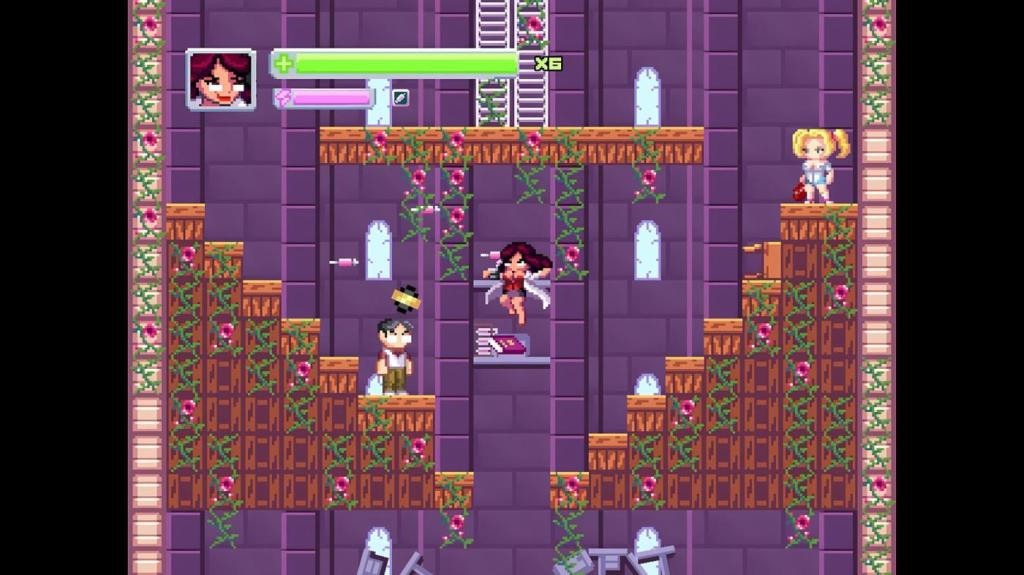
Gameplay – Love Chemistry is a side scrolling action platformer, with run and gun style action, in a manner similar to that of Mega Man. The player controls Sibella, the mad scientist and guides her through the perilous locations, including the University she works at. Each of the stages are rather large, with sections that are linked together via checkpoints. As the player makes their way through the zones, they will encounter various dangers.

The most common of these threats are the robotic foes, including flying bots, snail-like proximity mines and blaster turrets. These foes will bet scattered throughout each of the zones, starting off rather easy but becoming more challenging the further the player gets. Then there are the biological enemies, with humans including the university attendees and police, alongside monsters like man-eating plants and lizard people.
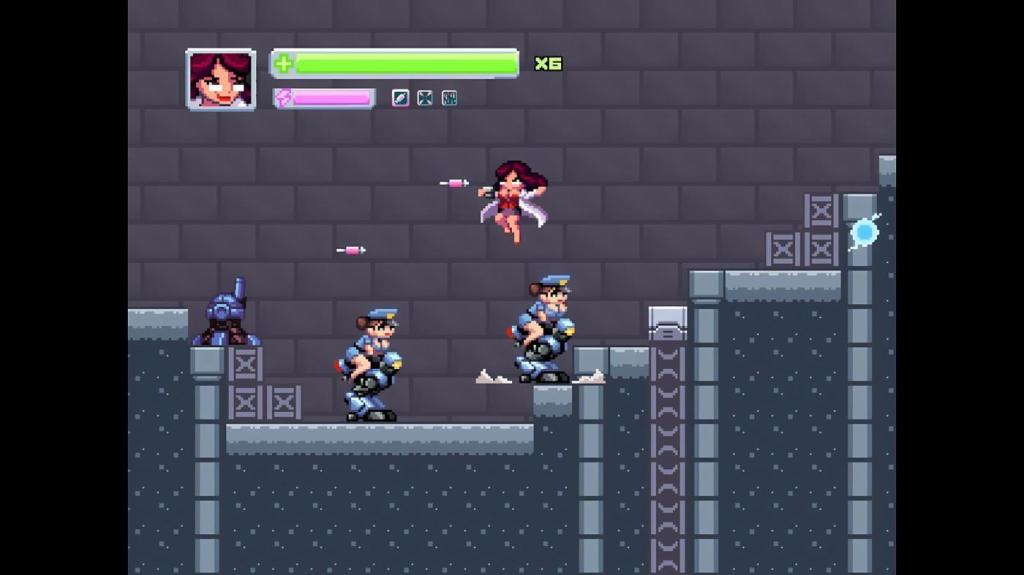
To fight off all the enemies, the player can use their Syringe bracelet to shoot enemies. The player can make three shots at once when rapid firing, with a brief delay between shots. While making shots, they can pass through the level, hitting enemies behind walls and ledges, letting players be cautious. When shooting the robots, when enough damage is dealt, the robot will explode but be careful as some of them will leave traps behind.

When battling the biological creatures, dealing enough damage to them will cause them to fall in love and incapacitate them. As an enemy is in the love state, the player will be able to interact with them, causing a brief animation to play. For the humans, Sibella will hug or kiss them during the animation, whereas the creatures will react as if they have become Sibella’s pets. The first time each of these animation plays, they will be added to the gallery.

If the player takes damage, they can recover health by collecting green life capsules from enemies. The enemies are not the only threat to the player, as there will be environmental hazards that will instantly kill Sibella. These consist of spikes and thorns, which will be scattered throughout the stages, often with tight platforming and ladder climbs tied to them. In the event that the player dies, they will be sent back to the last checkpoint reached.
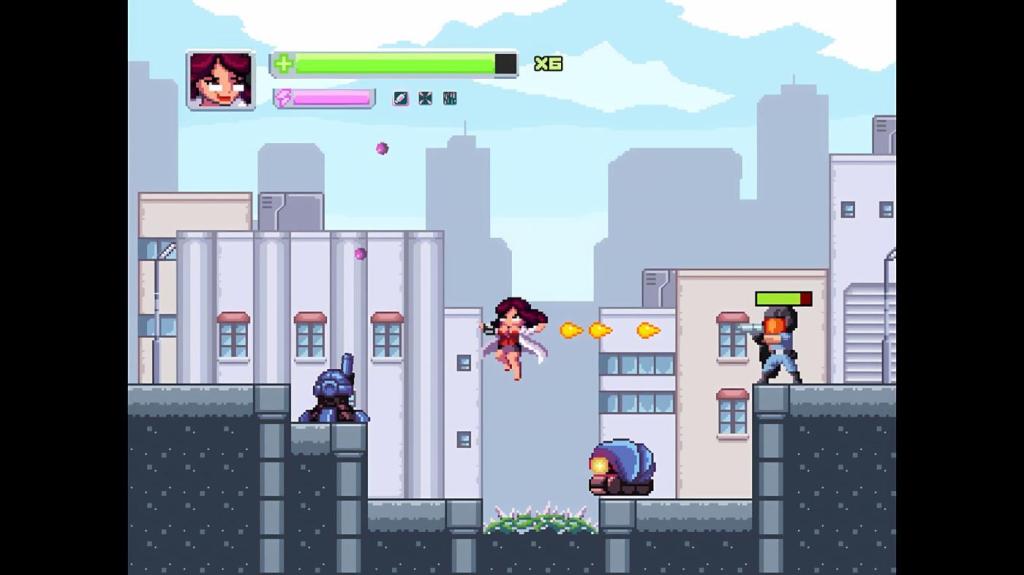
At set points in each of the large levels, the player will encounter a boss, which will battle Sibella in an enclosed arena. Each of the boss battles have their own special attacks, including a boss that will rain down blasts on the player and one that has attacks that trail the ground. These battles can be tense and challenging, but if the player is able to defeat them, they will be awarded with a new weapon they can use based on the special attack.

There are four additional weapons that can be collected, which can be toggles between at any time after they have been unlocked. However, using them comes at a cost, as each of the weapon upgrades has an energy bar, which depletes when used. The amount of energy needed for an attack varies, making it important to use weapons responsibly. To refill the energy, players must pick up pink capsules which can be dropped by enemies.

If the player runs out of lives, they will be sent back to the main menu with the option to continue. When continuing play, the player will be sent to the start of the stage they died on, losing all of the progress for the current stage. The player has a limited number of lives, which carries over between stages but they are not reset when continuing, keeping the same number as when that stage started. Thankfully, there are plenty of lives in the stages to pick up.
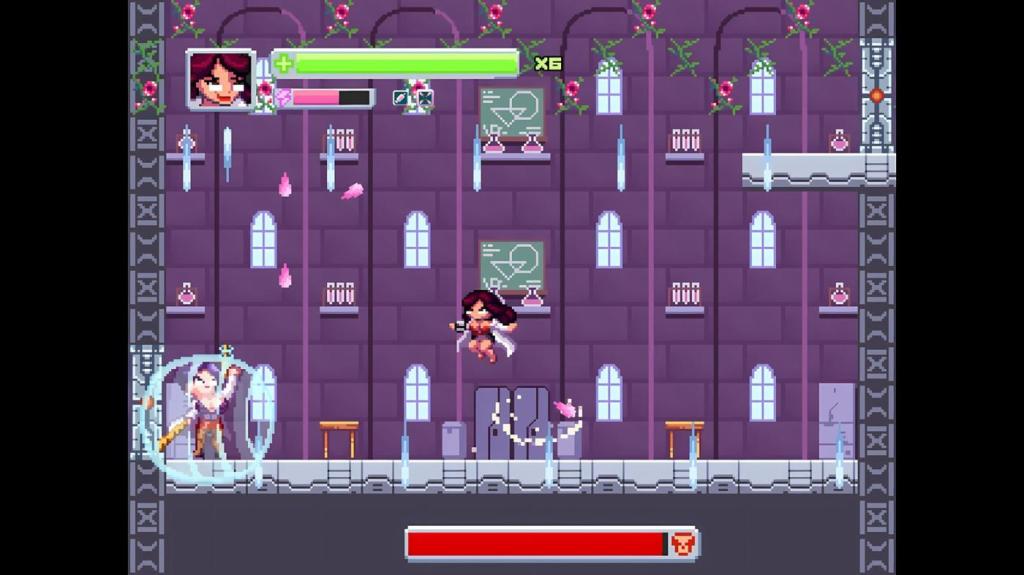
The game does feel rather short, only taking a few hours to clear, but there is plenty of challenge on offer. There is a lot of tough platforming, with tight small ledges that players must go between, as well as enemies that will make it tougher. There is also an auto scrolling section, which is pretty tough with the player being chased in a tight tunnel section. The game does have some replay value, with two difficulty settings to select from.

Now with the gameplay covered, it is time to discuss the other aspects of this release, starting with the controls.

Controls – there is an easy to pick up and use input system for this release, with traditional run and gun/platforming controls. The player can use the thumbstick or d-pad to move, with the face buttons to jump and shoot. The shoulder buttons control the weapon switching, making it easy to swap attacks on the fly during the stages. All of the input for this release are responsive, with no issues in terms or lag or delay during play.

Difficulty – there are two difficulty settings for Love Chemistry, with the option for Normal Mode and Hard Mode which is selected when starting a new game. In the Normal Mode, the player will start the game with 6 lives, as well as more frequent checkpoints during the stages of the game. When playing the Hard Mode, there are fewer lives for players and the checkpoints appear less frequently, increasing the challenge significantly for the game.
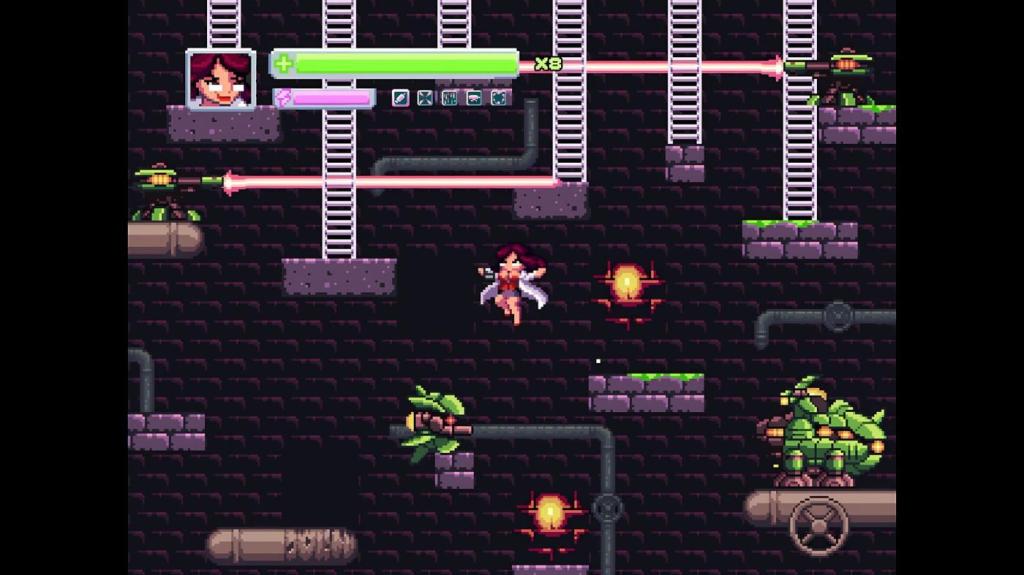
Presentation – Love Chemistry has a rather pleasant look to it, with decently sized sprites that make it easy to see the character and enemies. There is a good use of color for this release also, having some vibrant environments, while having relatively simple details to prevent them from feeling cluttered. The sound is decent, with some good music and effects that work well for the release, rounding out the whole experience quite well.

Final Thoughts – I do enjoy the side scrolling action genre, with games like Mega Man, Metal Slug and others being games that I return to often. So Love Chemistry appealed to my interests and it was a lot of fun to play, with an enjoyable gameplay loop. It is a rather limited game experience, with a few hours of gameplay, what the game offers is worth the entry fee. It has a level of silliness to it, with the smoochy animations adding to the fun.

It does feel like the developer was going for something a little more lewd, as it has elements that would be seen in an adult game. But this doesn’t hinder the experience, as it gives it a silly comedic feel. The game isn’t perfect however, as some enemy placements can feel unfair, the enemies respawn constantly and when continuing, lives can be scarce. But overall, I can recommend this as it is a rather decent game that won’t break the bank for players.

In the end, I give Love Chemistry – Sibella’s Formula, a final score of 4/5. This is a challenging and rather well made run and gun platformer, offering a lot of silly fun, tricky boss battles and plenty of gameplay content in a budget friendly package. If you want to check this game out for yourself, a link to each version of the game will be below.

Link to Nintendo Switch version (HERE)

Link to PlayStation version (HERE)
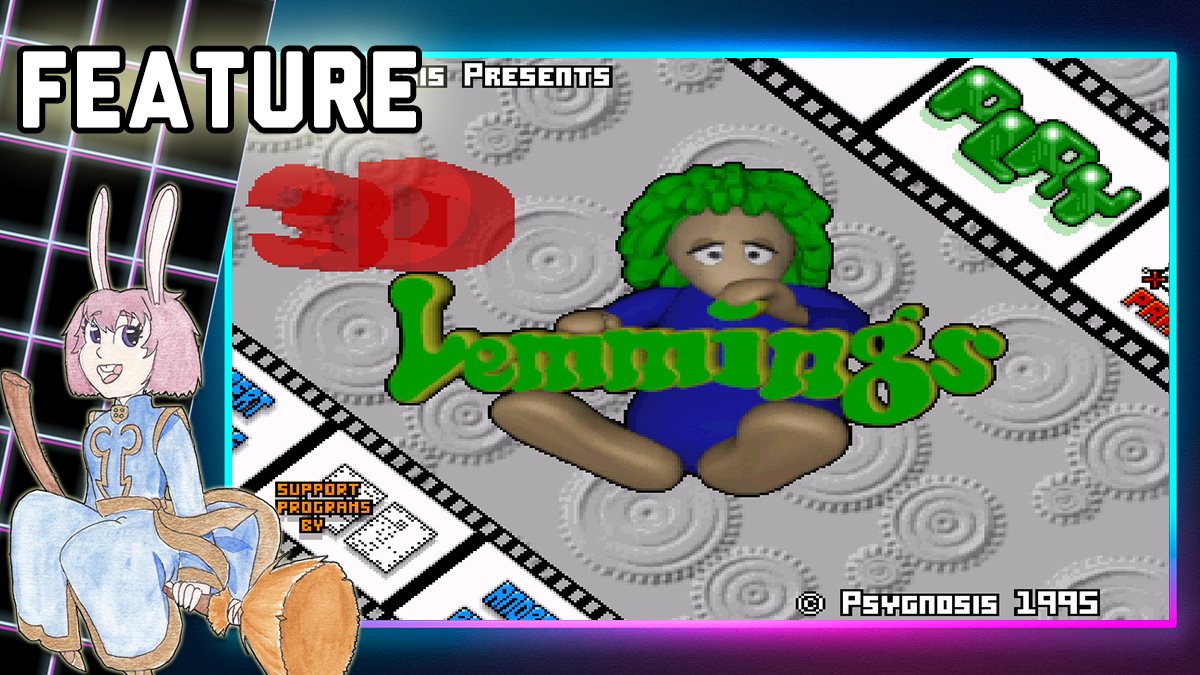
Lost Gems – Lemmings 3D (Various)

Hello and welcome to the latest installment of Lost Gems, the series where I cover classic games that have been lost, abandoned or simply forgotten. This is a special milestone feature as it is my 500th post, and I will be covering the sequel to Lemmings that took the puzzles from 2D to 3D. So this week let’s take a look at Lemmings 3D, developed by Clockwork Games and published by Psygnosis across PC, PlayStation and SEGA Saturn between 95/96.

Disclaimer: while the games discussed in this feature are no longer officially on sale, there are still ways to obtain it. This can be either through the secondary market, or via unofficial digital roms/rips. I do not condone or promote piracy, so there won’t be any links to roms or rips of the games being covered.

So with the introductions out of the way, let’s get started. I will be starting with the general game experience, then give my personal thoughts on the title. I previously covered the first Lemmings game, which you can find linked (HERE).

About the game

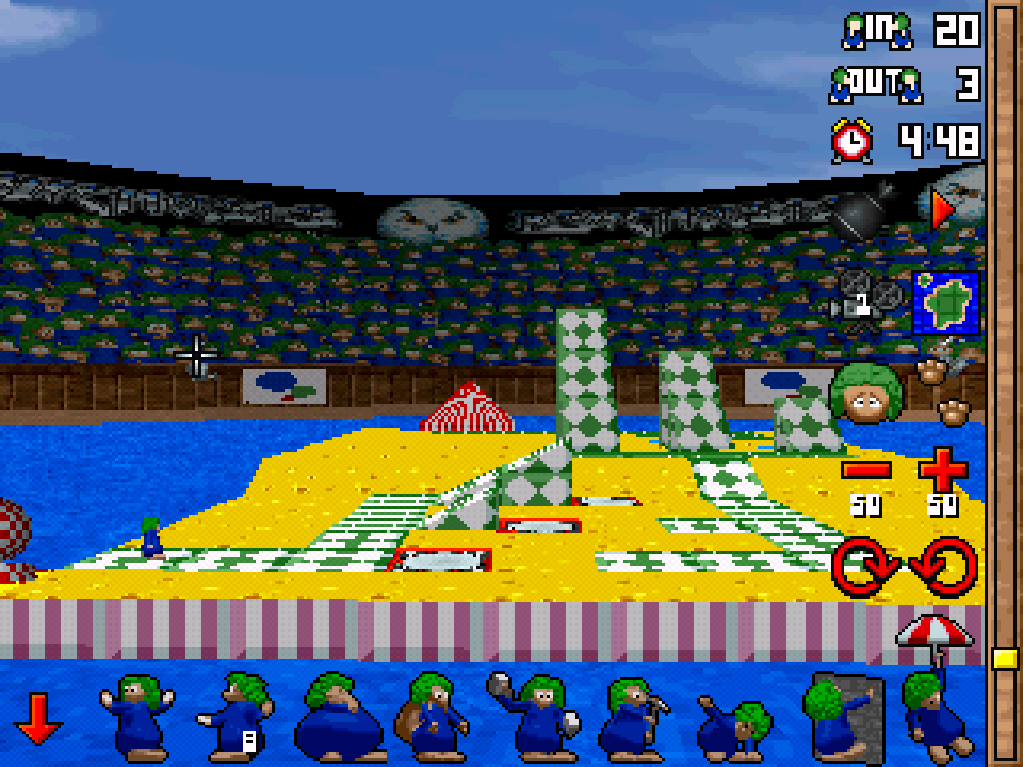
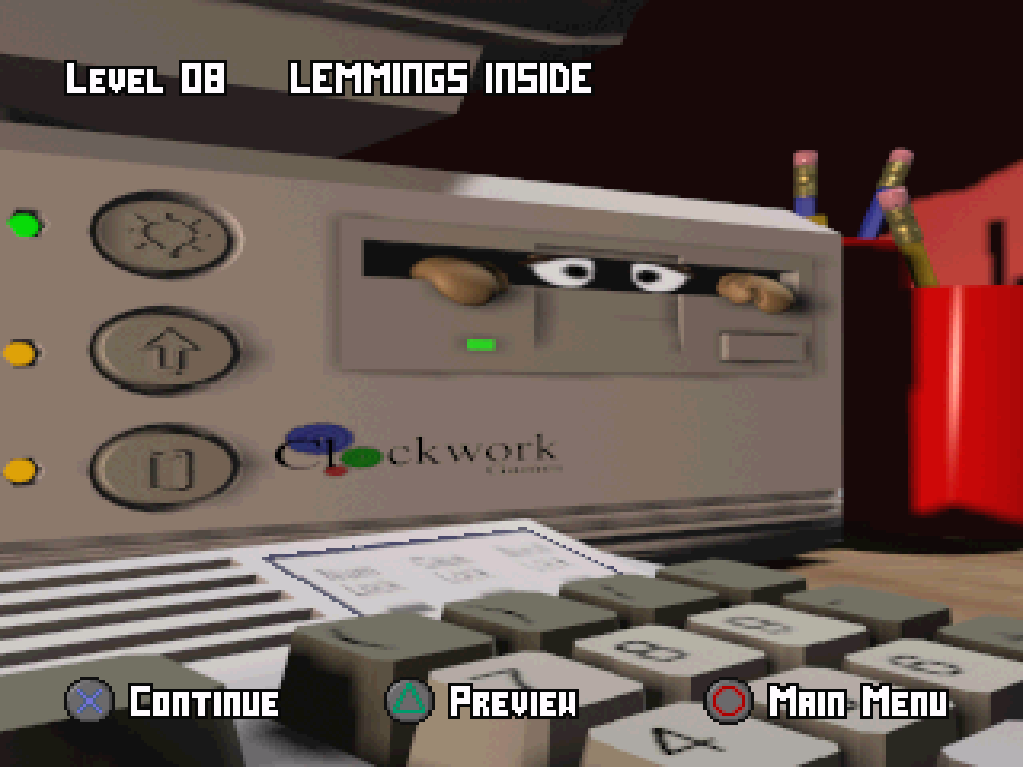
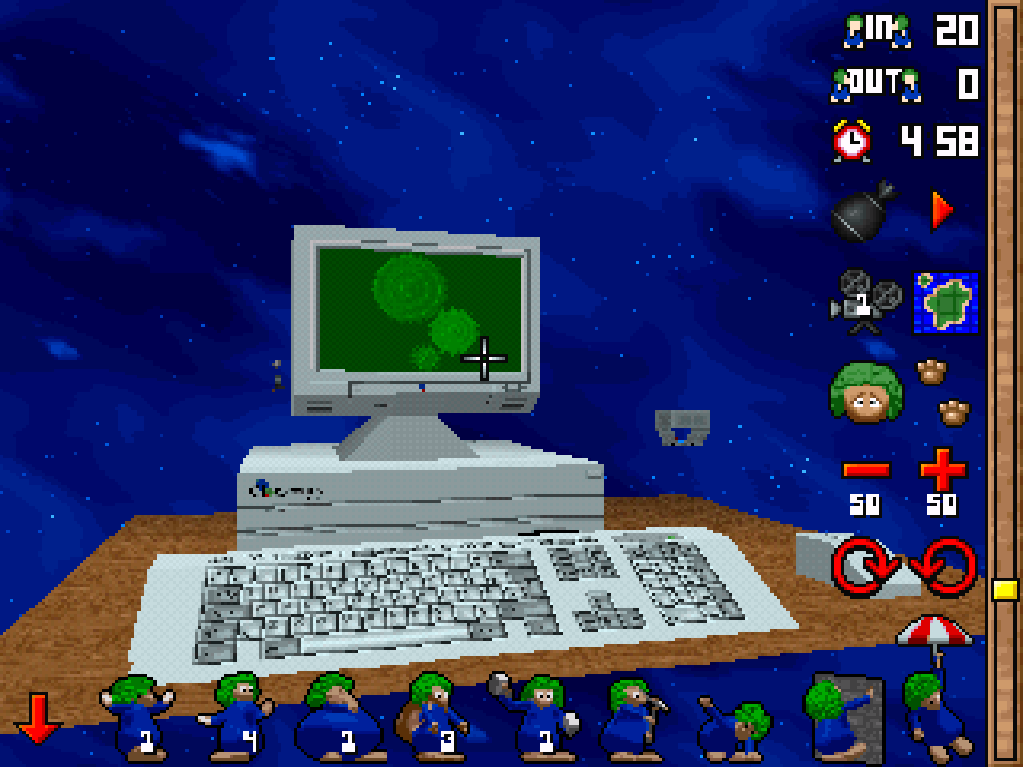
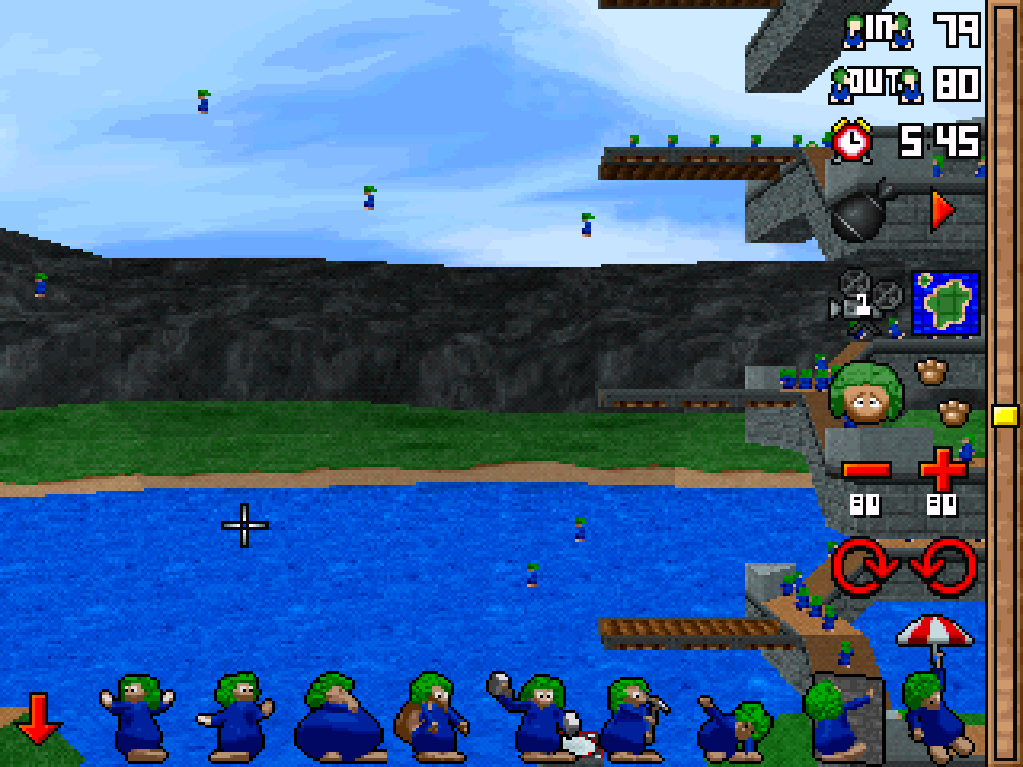
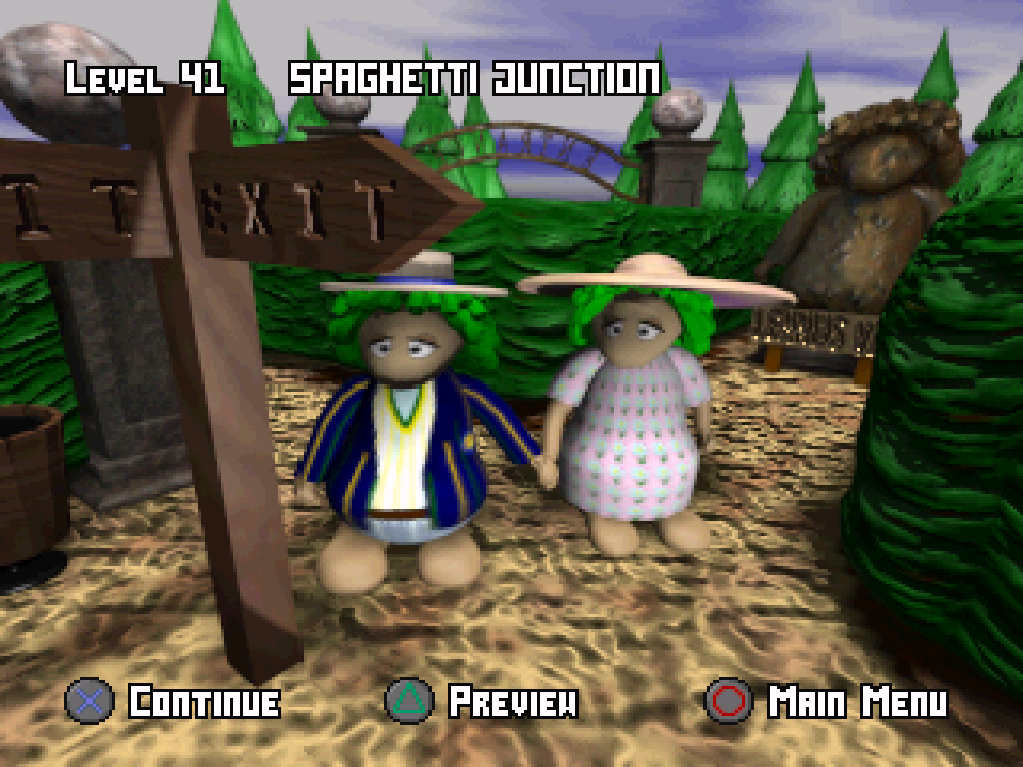
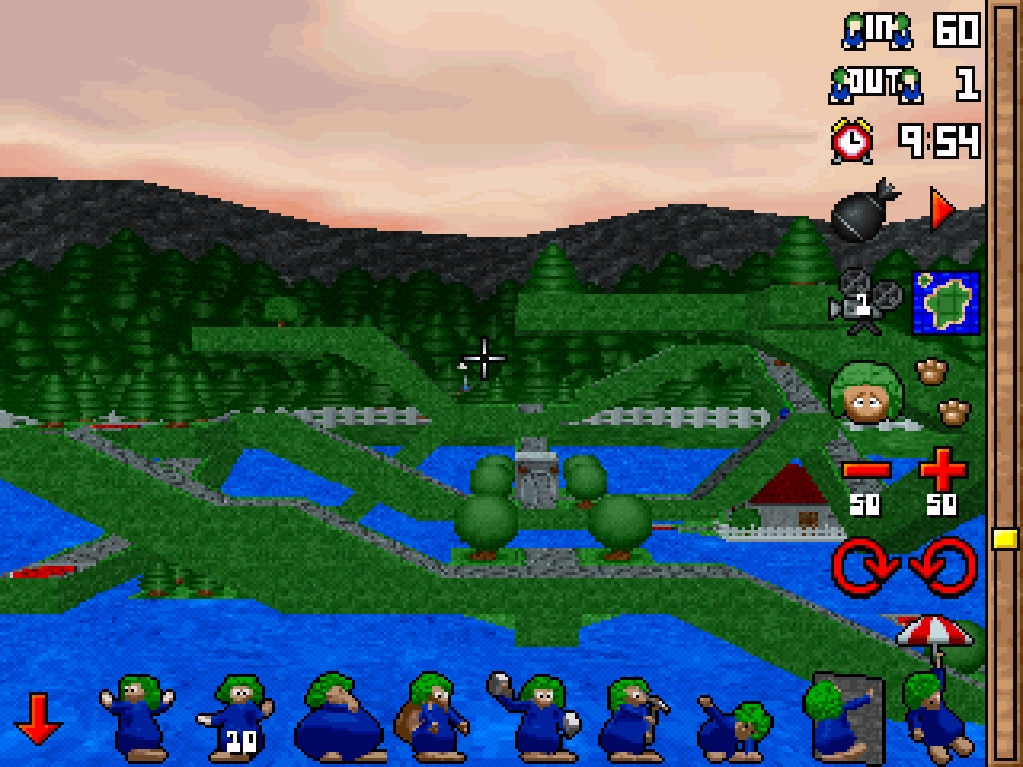
Lemmings 3D is the evolution of the puzzle series, where the player must guide the green haired “lemmings” to the exit of the stage. While the original game featured a side on screen, where the little creatures would move left and right in a side scrolling nature. This version of the game evolves to full 3D environments, with cameras that allow the player to move in 360 degrees, using full 3D polygons instead of the traditional flat sprites.

The core of the gameplay remains the same as the original 2D game, where the core objective is to rescue as many of the Lemmings as possible. In each of the stages, the target number will be shown in the top corner of the screen, replacing the percentages of previous releases. In each of the stages, the player will have obstacles that they need to overcome, with pitfalls and slippery blocks and trampolines, replacing the traps of the first game.

During a stage, if the player loses too many of the Lemmings, the player may use the Bomb to nuke the level and try again. By doing this, the level can be restarted quickly to get back into the action and try again. To complete the stage and guide the lemmings to safety, the player will need to assign skills to specific Lemmings. Each of the stages have a set number of skills tied to them, with the management of these skills being important to success.

In this version of the game, all of the skills from the first game carry over, with the climbers, floaters, diggers and bashers to name a few. Then there is the unique skill added for the 3D levels, which is the Turner, where the selected Lemming will stop and guide the others to change directions. When using this skill, the Lemming will stop at the edge of a “block” diverting the lemmings either left or right based on the choice of the player.

As this game uses a 3D perspective, there is a slightly awkward camera system, as the player must manually move the camera. To be able to see the different areas of the stage, the player will need to move the camera around, which can be clunky and awkward. But thankfully, there are four camera perspectives for the stages which will allow for quick changes. It does take a little time to get used to, but once everything clicks it becomes easier.

Included in this game is the Virtual Lemming option, which will follow a selected lemming taking their perspective. Which can be useful for some areas that have areas that are obscured from view. After a stage ends, an instant replay option is available which will duplicate the player inputs, taken from the previous attempt. This allows players to see their mistakes, where they can improve their skills, or to just watch back an exciting level clear.

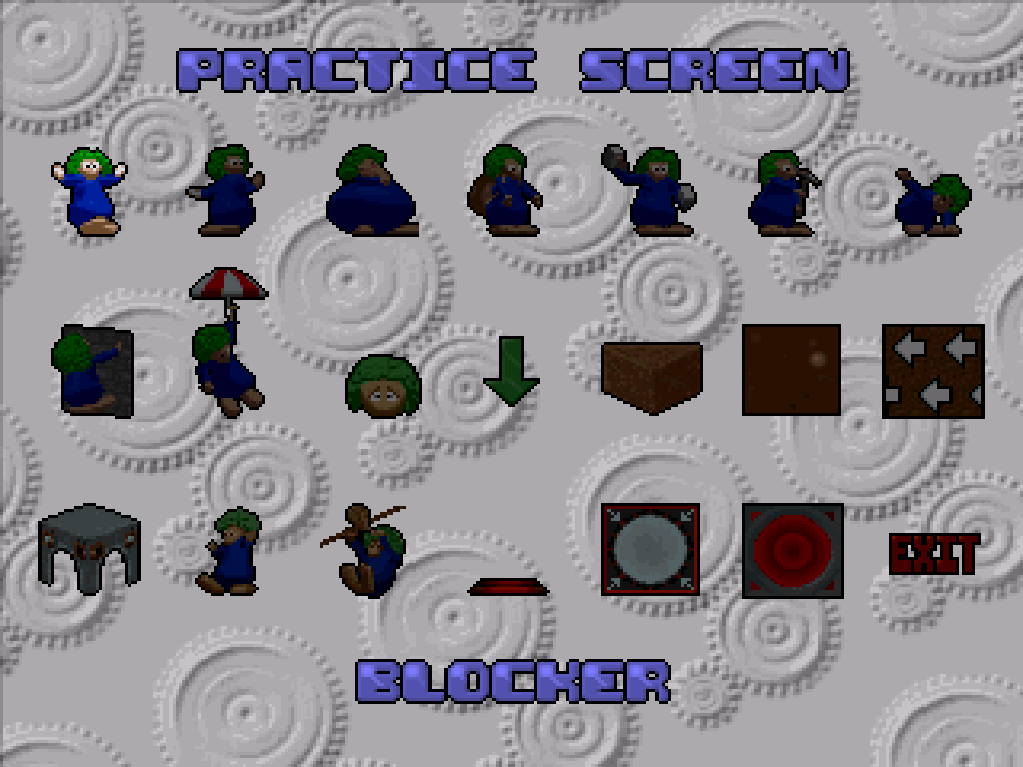
Just like the previous game I covered, the four difficulty levels of Fun, Tricky, Taxing and Mayhem return, with 20 stages in each of them for players to challenge. However, in this release there is the practice difficulty option, which allows players to learn how to play the game in this new perspective. It will teach the player how to use the different skills, the new mechanics, the 3D camera controls and general skills for play.

The password system from the original game is included, where cleared stages will give passwords so players get to continue from where they left off. There is also the option for players to be able to save their progress, using the memory card system so they can come back after turning the system off. When using passwords or the memory card, players will be able to return to previously cleared levels, so they can improve progress or clear time.

The visuals are pretty clear and vibrant in this release, with lots of color and chunky polygonal models. The frame rate is also solid, with no issues in terms of performance or lag during play, alongside well done cutscenes. The sound is nice and clean, with CD quality audio and music that works very well. However, there is an unfortunate issue with the audio, as the voice clips will play repeatedly, becoming loud and possibly annoying for players.

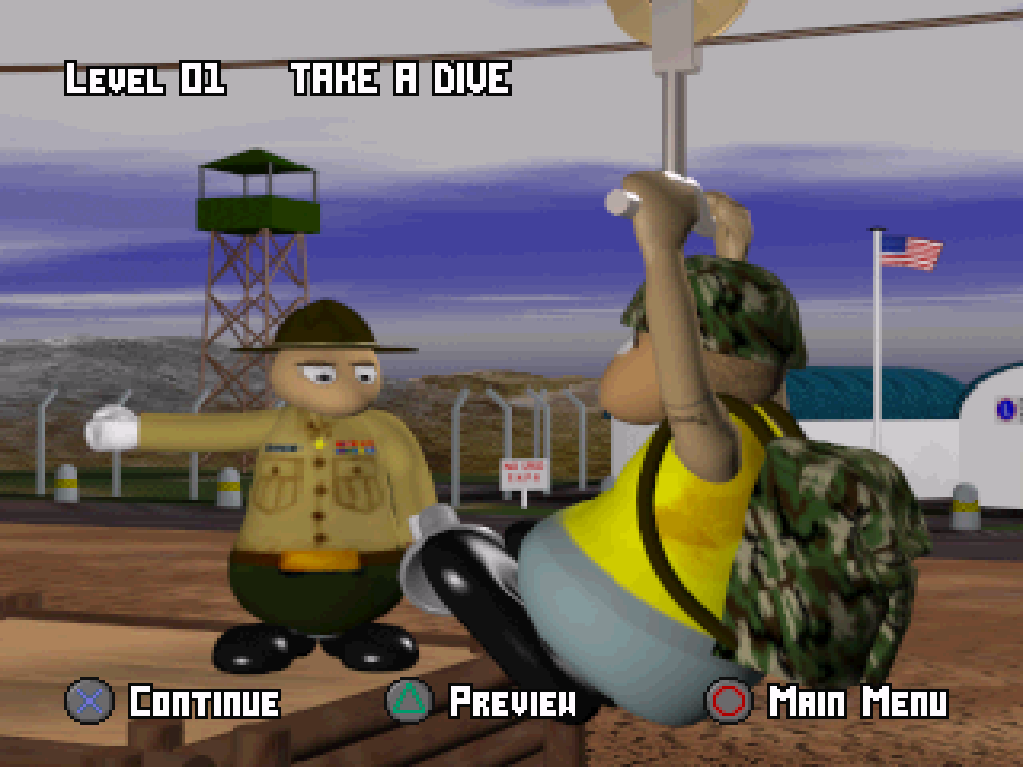
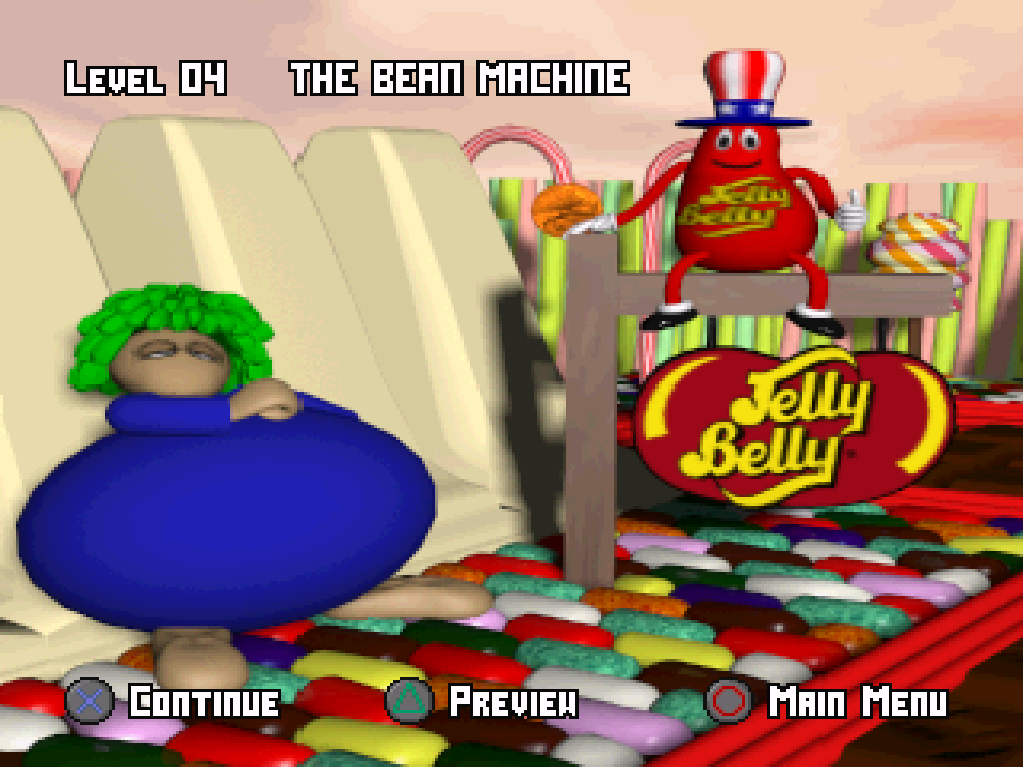
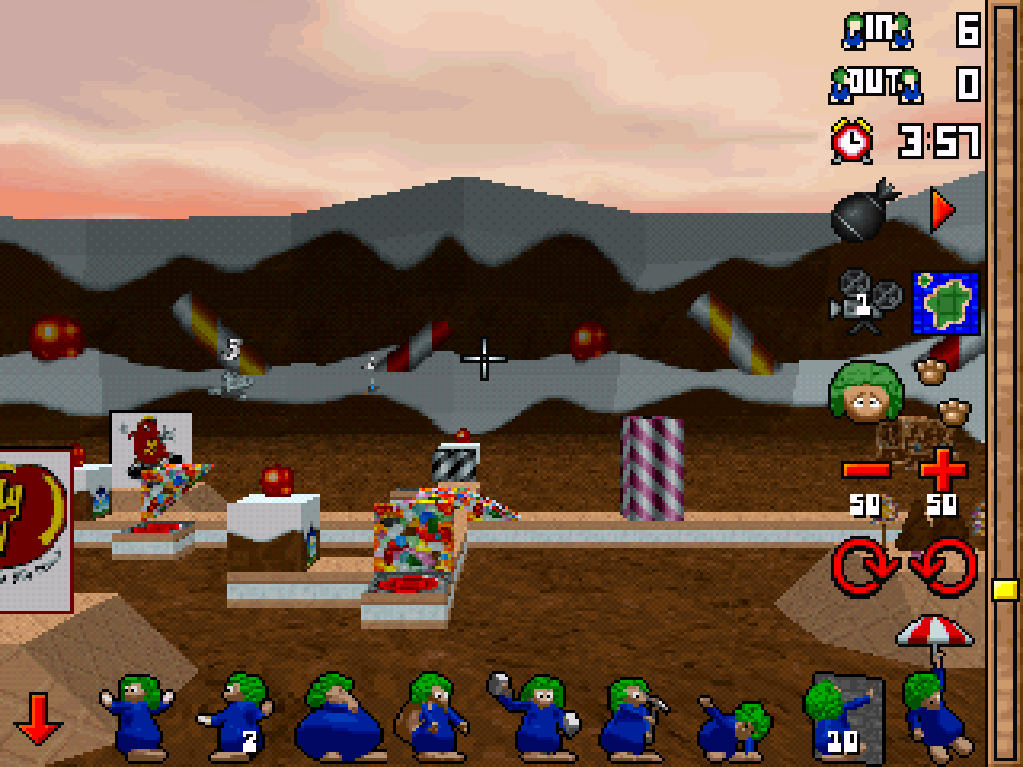
There is something unusual about this title, as there is a Jelly Belly Candy partnership within the PlayStation and PC versions of the game. This is an unusual inclusion, but it does add some nostalgia to the release and a real blast from the past, where these types of collaborations were commonplace. It does make it an interesting piece of game history, like the Chupa Chups inclusion in Zool and the UK Penguin biscuit bars in James Pond 2.

Personal Thoughts

Having been a fan of the original Lemmings as a kid and having it on the Mega Drive and Game Gear, I had an attachment to the series from the start. So when Lemmings jumped into the world of 3D, I was super excited being able to play a sample of the game via a Demo for consoles. I would spend hours playing the demos, trying my best to figure it out, but I never really had much luck. Sadly, the demo was my main exposure to the game for the longest time.

I had seen gameplay videos and got to play it with friends over the years, but didn’t own my own copy of the game. Luckily for me, that did change a few years ago. I received the PlayStation version of 3D Lemmings as a gift from someone close to me, which allowed me to be able to finally experience the game. Being able to sit down and play this game was an interesting thing, as I had lost all of my experience from the time I played the demos.

It was awkward to get used to during the start of play, but the more I played it, the more everything just clicked and it became more fun. The charm of the original game carries over, with the transition to 3D being as smooth as it could be for the time. Each of the models, animations and scenes look good for an early 3D console game. it still has that quirky and wacky humor, which doesn’t overstay its welcome, with silly images between stages.

All of the stages are done quite well, with varied environments and vibrant colors. The puzzles feel more difficult in the way that more planning is needed, which is must different to the 2D games. Unlike the original, it is not possible to just sketch out the levels, so it becomes more of a trial and error game. It is a relief that the instant replay option is present, as it can allow players to see where they went wrong, so they can try to fix mistakes.

There are some minor hiccups with the game, like the way that the sound bites can become a little annoying. Also the controls can be a little weird to adapt to, as the face buttons and d-pad control the camera, with the shoulders being used to activate skills and the side bar. But these issues can be overcome with enough time and patience, alongside the ability to adjust the controls and customise them in the settings. The janky hiccups do add to the charm of play.

After being gifted the game, I was able to drop onto a copy of the Windows version of the game, which is a little more polished. But I still enjoy playing the PlayStation version, as it is the one that means more to me than the PC version. It is also why I chose it to be the subject of this special milestone feature. It is rough around the edges, but it is a lot of fun to play, with the collaboration with Jelly Belly candy making it one of those unique oddities.

3D Lemmings is one of those games that is abundant in its availability online, with copies of the game being easily accessible on the secondary market. The prices have stayed rather low over the years, with the different versions of the games being rather cheap. The SEGA Saturn version of the game will be more expensive, as it wasn’t released in the US, but it isn’t as expensive as some titles that weren’t put out in North American territories.

I have a lot of love for this game and while it may not be the most refined, it is one of those unique pieces of game history that I feel should be experienced. Sadly, I don’t think that it will be, as SONY owns the rights to the series and have done nothing with the series, aside from a piss poor phone game. It will also be unlikely that it gets re-released without significant changes, due to the licensing of Jelly Belly product placements in the game.

If you have enjoyed this feature, then please stick around and see what else catches your eye. I cover a wide range of games in reviews, get special previews and put out regular features. I have Lost Gems, Retro Revival where I discuss re-releases and the occasional Gaming Oddities piece, where I cover weird and wacky titles. So stay a while and have a look around.

Retro Revival – NSO NES: Rygar (Nintendo Switch)

Hello and welcome to the latest entry of Retro Revival, where I cover games that have been given a second chance at life. In this series I cover HD remasters, emulated ports and compilations either in part or as a whole. This week we will be taking a look at an expanded port of an arcade classic, developed by Tecmo. So let us take a look at RYGAR for the NES/Famicom, released in 1987, and revived via the Nintendo Classics NES/Famicom library.

Disclaimer: This title is available via the Nintendo Online Subscription service, which I have paid for out of my own pocket. The opinions expressed within about this release are my own, with no sponsorship of the content within this feature. As this is part of a subscription, there will be no links to the software, unlike other features in this series. The game is included as part of the library on both tiers of the NSO membership.

So with the introductions out of the way, let’s get started. I will be discussing the general gameplay experience for the game, alongside my personal thoughts on the release.

About the game

In the land of Argool, the five Indora Gods kept the peace and the land was a paradise. However, the evil Ligar lay siege to the land and conquered it, taking over the land and corrupting the once sacred land. The land became a kingdom of evil, taking away the door to peace that the Indora had put in place. As the corruption spread, the people of Argool prayed for a saviour, with their wishes reaching the spirit of Rygar, reviving the legendary hero to do battle with Ligar.

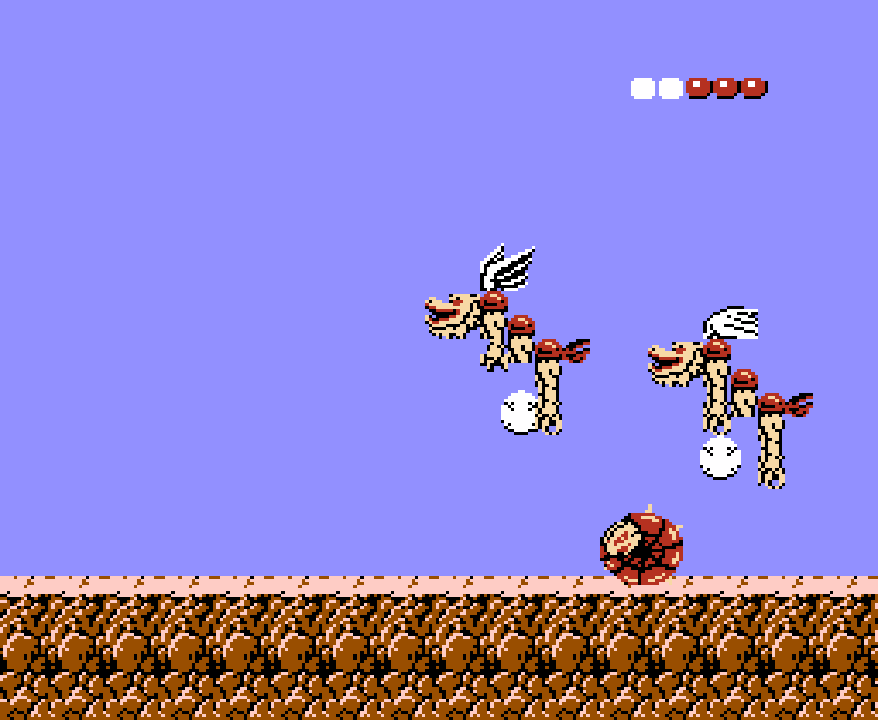
The original version of Rygar is a straight forward side scrolling platform action game, where the player battles enemies, crosses hazards and fights bosses. However, this version of the game has been enhanced significantly, turning it from a straightforward arcade game to a full adventure. This game utilises a mostly non-linear progression system, where the player can explore a large interconnected world, with side scrolling and top down segments.

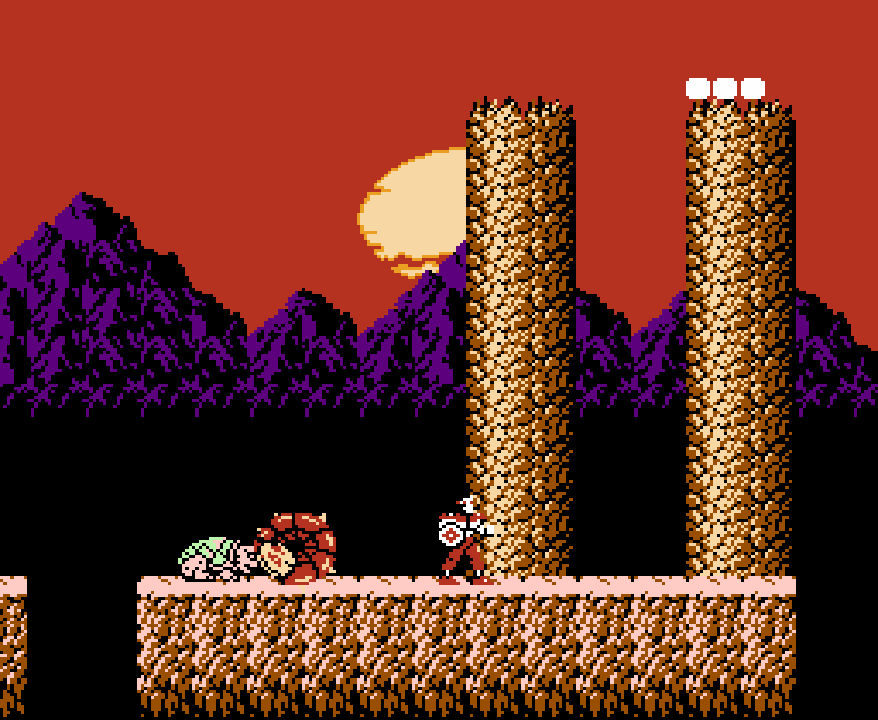
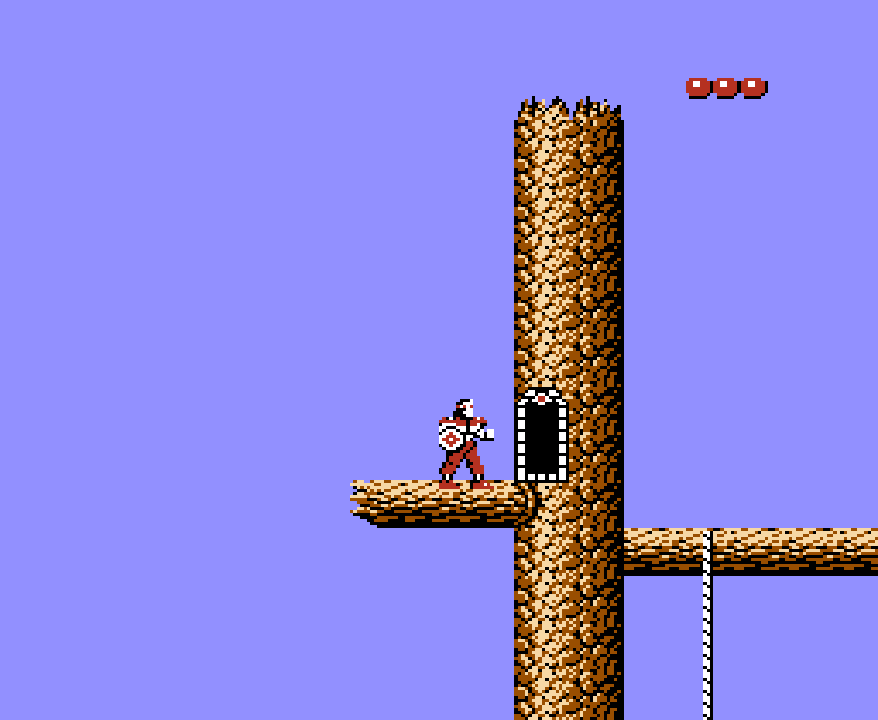
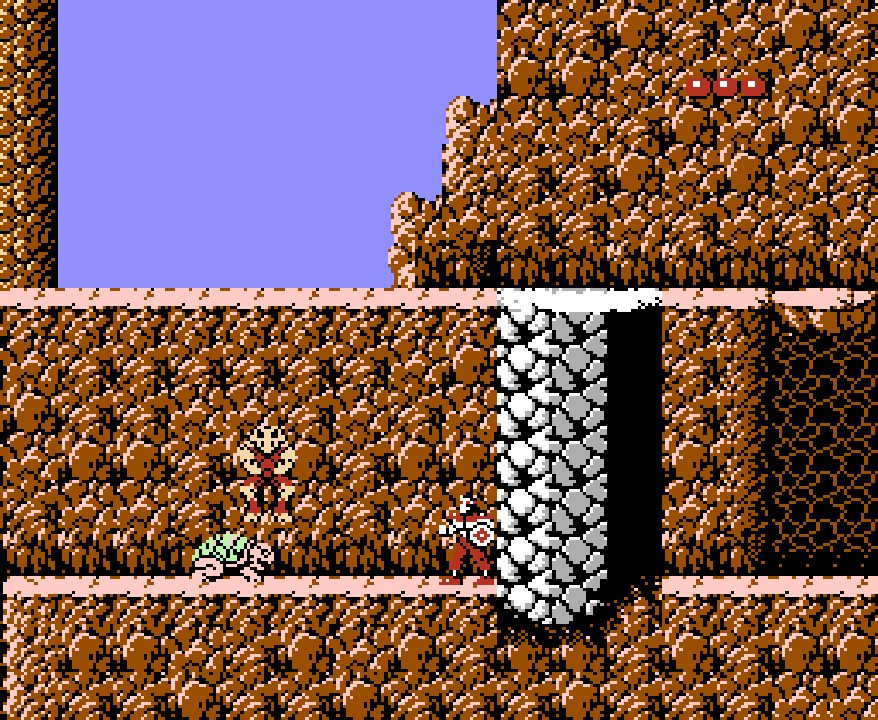
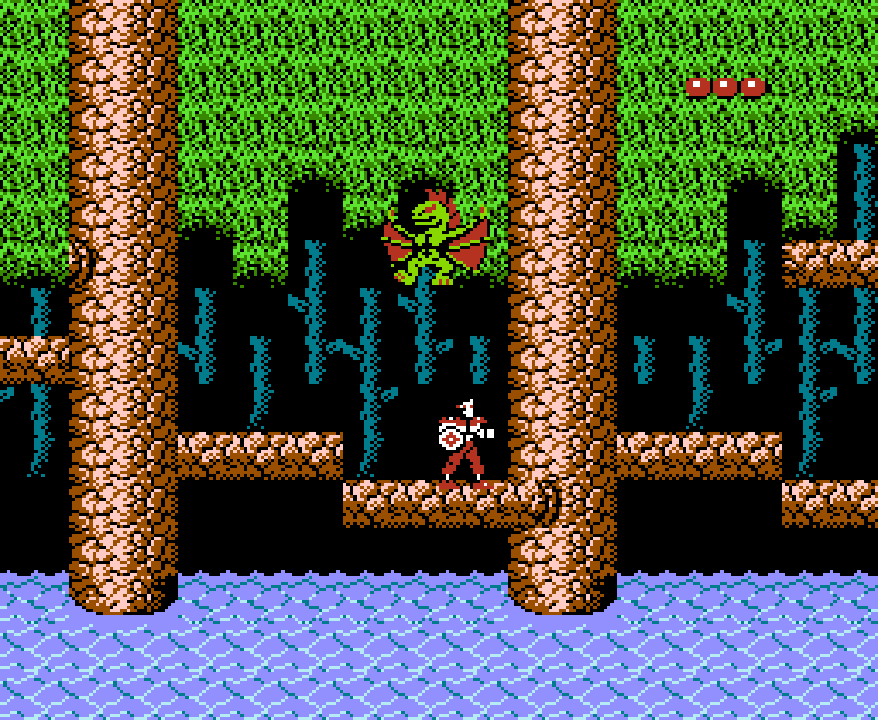
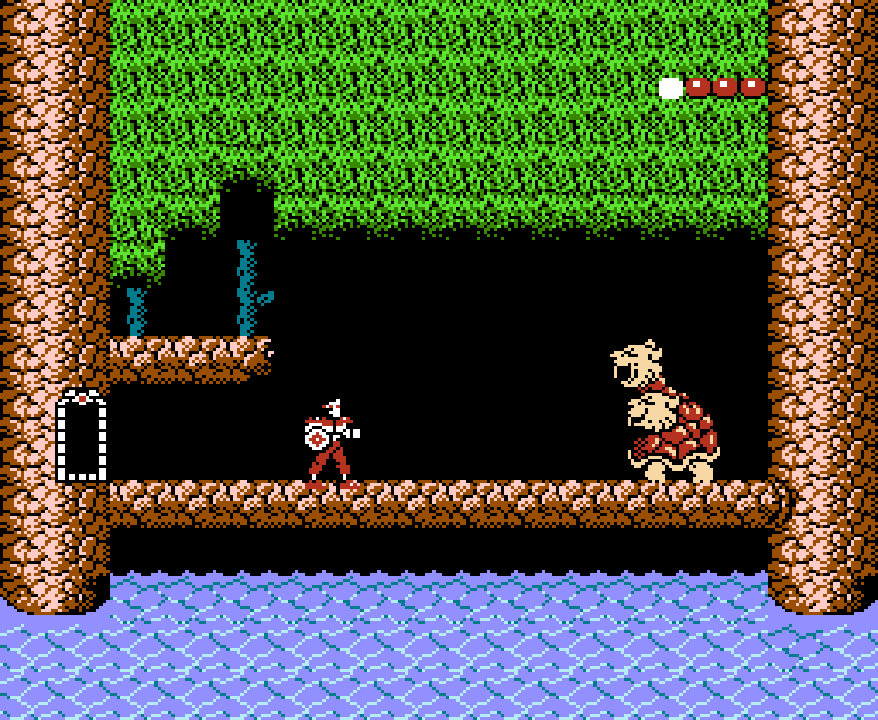
When the player is in the side-scrolling portions of the game, they control Rygar moving from left to right, being able to jump and attack. While exploring these areas, the player must cross dangerous gaps, fight monsters and avoid hazards. These areas are not just straight forward environments, as there will be transition areas within the different zones. To move between the zones, players will be able to climb ropes, going up and down between the screens.

While exploring these points the player will need to be careful, as there will be enemies that appear throughout the zones, attacking the hero. They will attack the player from the above and on the ground. To fight the enemies, the player must use the Diskarmor, a yo-yo like attack with limited range that goes in front of Rygar. To attack the low enemies, the player can crouch to strike. It is also possible to stun some enemies by jumping on them, stunning them for a moment.

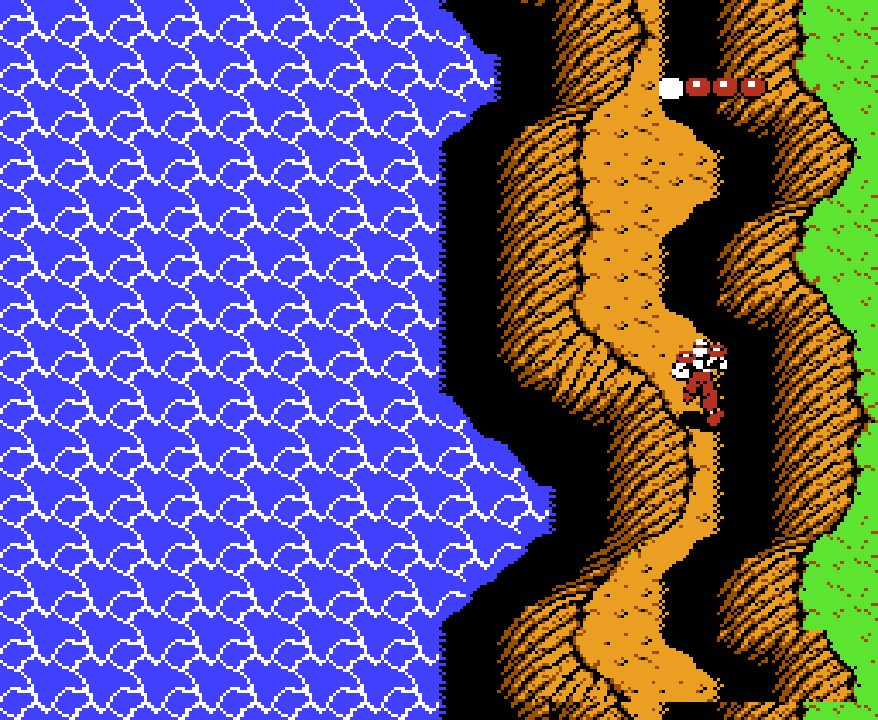
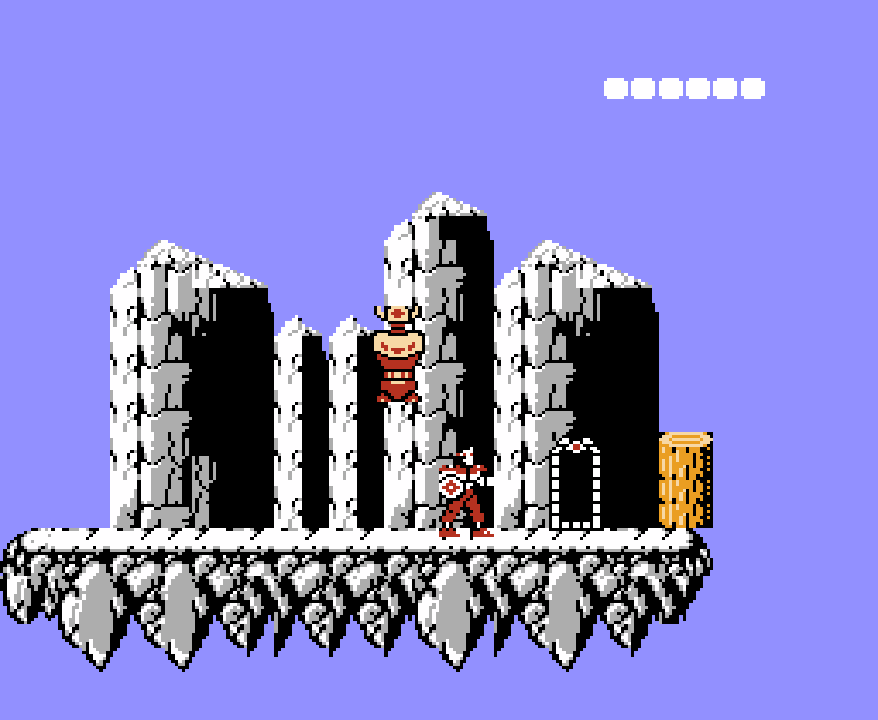
Then we have the top-down/dungeon segements, which function in a vastly different way to the side-scrolling zones. Within these areas, the player will be able to move in all four directions, jump and attack in the direction they are facing. These give the game a feeling similar to that of an action RPG, like the Legend of Zelda with enemies constantly spawning in. The first open zone that the player finds acts like a hub, connecting the player to other areas.

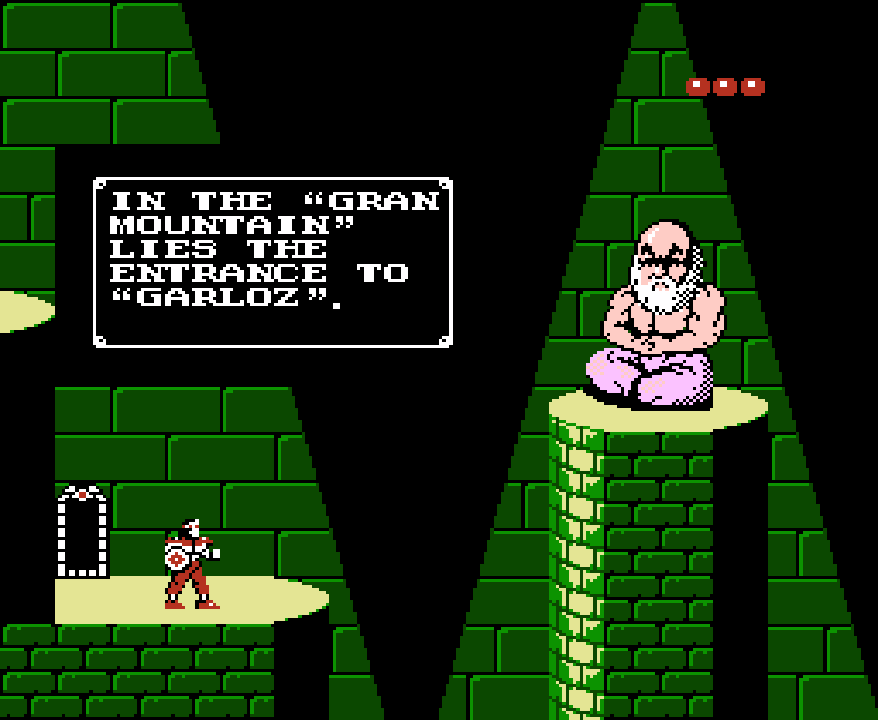
Inside the open top-down zones and side scrolling segments, there will be doors placed in different points. There are two types of door that players can use, with the first being boundary doors, which will let the player transfer to the next area. Then there are the safe rooms, which will contain the Wisemen, who give the player hints on how to progress. Some will also offer players the ability to heal up, offering a potion that fills up all lost health.

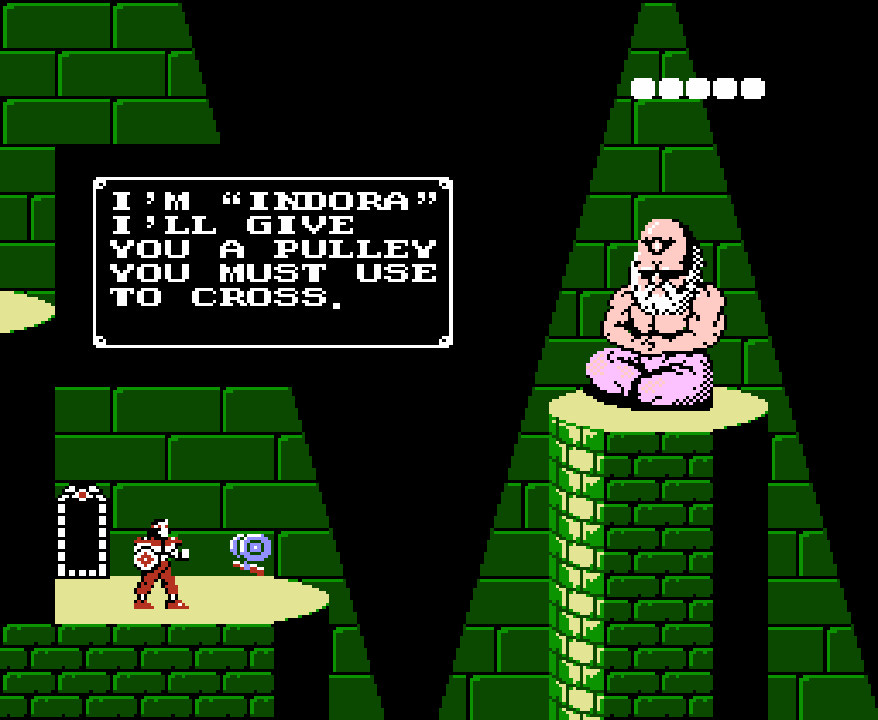
At different points around the world, the player will encounter deadly boss monsters that the player must defeat to progress. By slaying these monsters, Rygar will be able to meet the Fighting Gods of Indora, who will provide items that are used to open up new areas. These include the grappling hook, which allows players to climb to new areas, the crossbow to create rope crossings and the wind pulley to travel across the ropes.

With each new item that the player adds to the hero’s arsenal, the area that can be explored expands and some previously unreachable points open up. This adds an element of back tracking to the open exploration of the game, with players needing to go back and forth between the areas. The challenge increases with each of the new areas that are added, with deadly monsters and powerful boss monsters and challenging platforming.

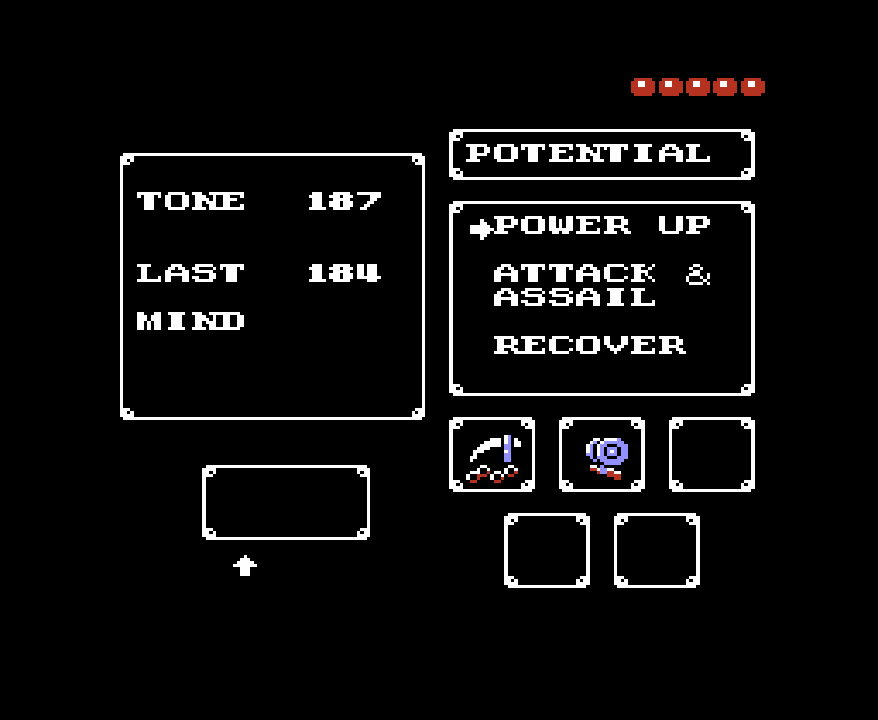
Defeating the monsters will provide the player with experience in the form of Tone, which will increase the power that the hero will deal to enemies. Then there are the Lasting points, which will increase total health the hero will have, starting with three hits and increasing to a maximum of twelve. The amount of experience that the player will earn varies, giving the player different amounts of experience with each monster kill in battle.

It is also possible for monsters to drop potions, which will restore a point of health each time they are picked up, as well as Mind points which are stones with stars on them. By collecting the Mind stones, the player will be able to use special powered upgrades. These points can be used to increase attack power and range of attack, a burst like attack to damage all on screen enemies and even recover lost health. Each power uses different amounts of Mind to use.

As Rygar doesn’t have a battery save feature built into the original game, the adventure needs to be cleared in a single playthrough. The game also lacks a password system, meaning that it is not possible to resume the game when stopping play. Luckily, the game features infinite continues, so if the player dies from falling off screen, being defeated by enemies or dropping into a pitfall, they can jump right back into play.

Since this game is available through the Nintendo Classics, NES Online library, players can use a few quality of life features. The first is the inclusion of Save/Load states, which solves the issue of needing to beat the game in a single sitting. Then we have the Rewind feature, which lets players take the game back a little bit if a mistake is made. These can be rather handy for players who may struggle with the challenge of the adventure.

Personal Thoughts

I like the Rygar franchise a lot, having played the original arcade and the rebooted adventures that launched on PS2 and Wii. I however did not get very far with the NES port of the game, often getting stuck or lost for the most part, due to the open ended nature of the adventure. I tried several times over the years, picking it up and getting as far as I could before failing and having to stop. But this was through bootleg carts and janky emulators.

I did get to see the game through to the end recently though, as I played it as a group when visiting family overseas, working together to make it to the end. After seeing the end of the game, I was also able to play it myself from start to finish, finally crossing it off my list of games I had yet to beat. There is a lot of fun to have with this release, as it mixes platforming, top down action and arcade quality gameplay to create something entirely fresh for the time.

It is one of the harder games in the NES library, as enemies can obliterate the player health bar and punishment for death is being sent back to the last door. The frustrating thing about how easy it is to die, is that with each continue, the player only has three hit points and all mind points are lost. However, the player gets to keep experience and levelling progress, which takes away some of the sting of death. Luckily, there are recovery safe rooms in areas.

Once everything falls into place, the action flows very well, offering players a fun and exciting adventure. I admit I am not the best at this game, and I die a lot from falling into the death plane, getting ruined by bosses and yet, I just keep coming back to the game. I even spend time grinding away to level up early, get mind points and even then the first boss just ruins me. That is what makes finally beating the game so satisfying.

As this is part of the NSO library, there are the quality of life improvements as mentioned further above. But there is also the inclusion of a filter, allowing players to give the game a feel of a classic CRT display. Having this as an optional extra is a nice addition, as it gives players a chance to get a feel for how the game would look on an original screen. It also feels good to play on a big screen, as well as in a handheld format when playing on the go.

This is a tough game, which was common for Tecmo at the time, as they made games like Ninja Gaiden and Bomb Jack, which were known for their high challenge. I have a lot of love for early Tecmo, especially Rygar as it was a very interesting and unique game, which blended action and RPG gameplay. I do hope that it gets a wider release, with the Console Archives series releasing Ninja Gaiden II and III, so there is some hope for it.

If you have enjoyed this feature, then take a look at the other content available and see what catches your eye. There are reviews, sometimes news and features that cover a variety of games. There is the lost gems series, special Gaming Oddities and more coming in the future. So stick around for a while and check out the other content.

Hyperdimension Neptunia Re;Birth1+ – PlayStation Review

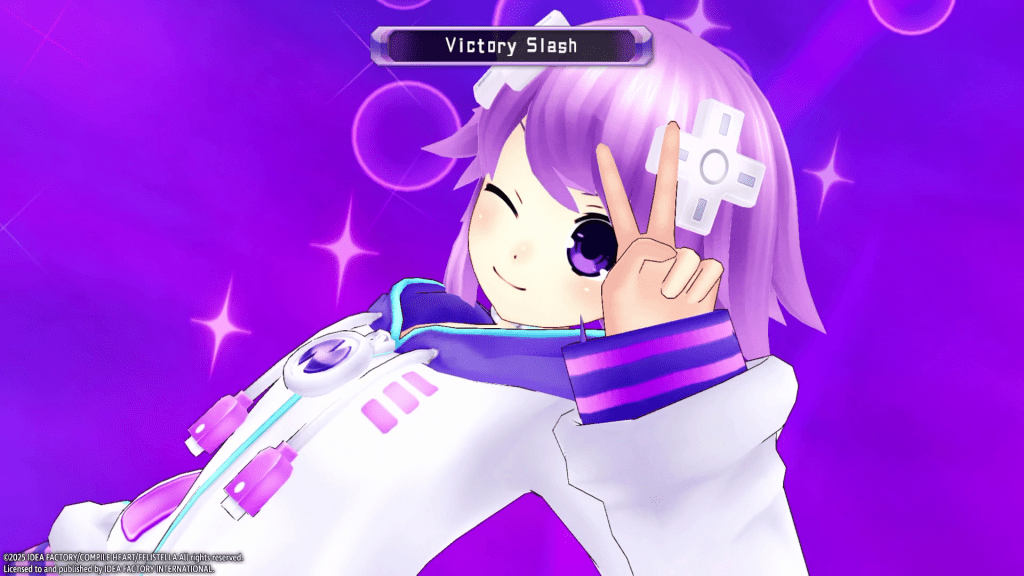
Overview – developed by Compile Heart, Felistella, Idea Factory and published by Idea Factory International, Hyperdimension Neptunia Re;Birth1+ is a remake of the original JRPG that launched the fourth wall breaking franchise. Experience the original adventure with Neptune and her friends, packed with all extra content included. This title is available for PlayStation platforms, with a link to the game at the bottom of this review.

Disclaimer: before I get into the review, I would like to thank Idea Factory International for providing the copy of Hyperdimension Neptunia Re;Birth1+ used for this piece, via the keymailer service. The provision of this software has not influenced the contents of this review, all thoughts and opinions contained within are my own. (Images used were provided by Idea Factory International via Presskits).

Now with the introductions out of the way, let’s get into the review, starting with the story. Unfortunately, there have been some complications with the game running via PlayStation 4, so my coverage will only be discussing the content I was able to experience. I will be referring to the game as Neptunia Re;Birth1+ for the sake of brevity. I have also covered other games in the Neptunia franchise, which you can find (HERE).

Story – Gamindustri, a world protected by four goddesses, the Console Patron Units (CPUs), who are locked in a conflict in Celestia known as the Console War. The CPUs are fighting to become the only goddess to rule, with the CPU of Planeptune, Neptune being defeated and sent to the land below. Upon crashing into the monster infested lands of Gamindustri, Neptune loses her memories, meeting Compa and IF, who assist her in her quest to recover what she has lost.

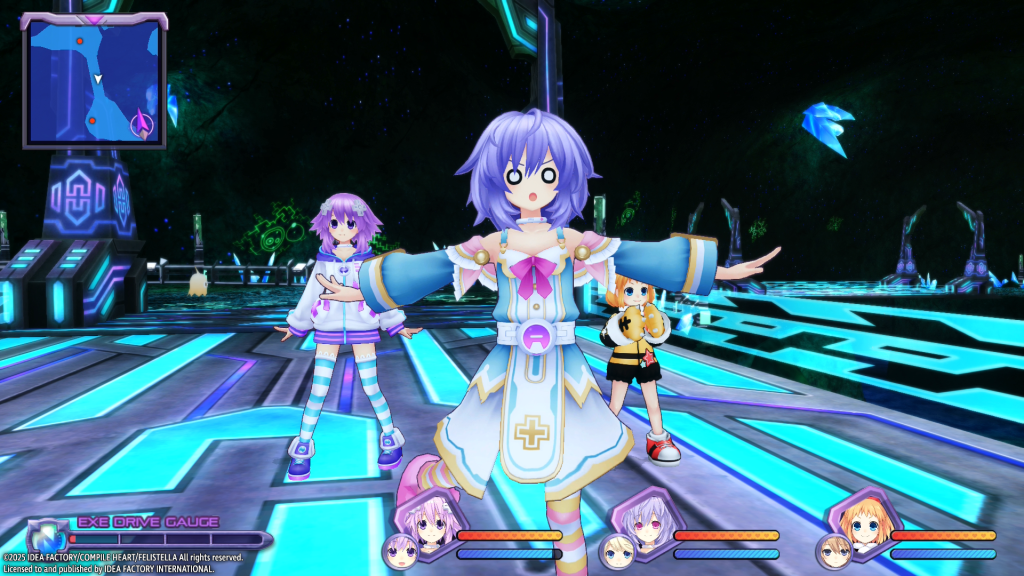
Gameplay – Neptunia Re;Birth1+ is a dungeon crawling JRPG, where the player controls the self-professed heroine and protagonist Neptune. As Nep-Nep, players must complete quests across several chapters, as the amnesiac goddess attempts to recover her memories. In the early part of the adventure, Neptune will be accompanied by Compa, with IF joining a short time which is where the party system comes into play.

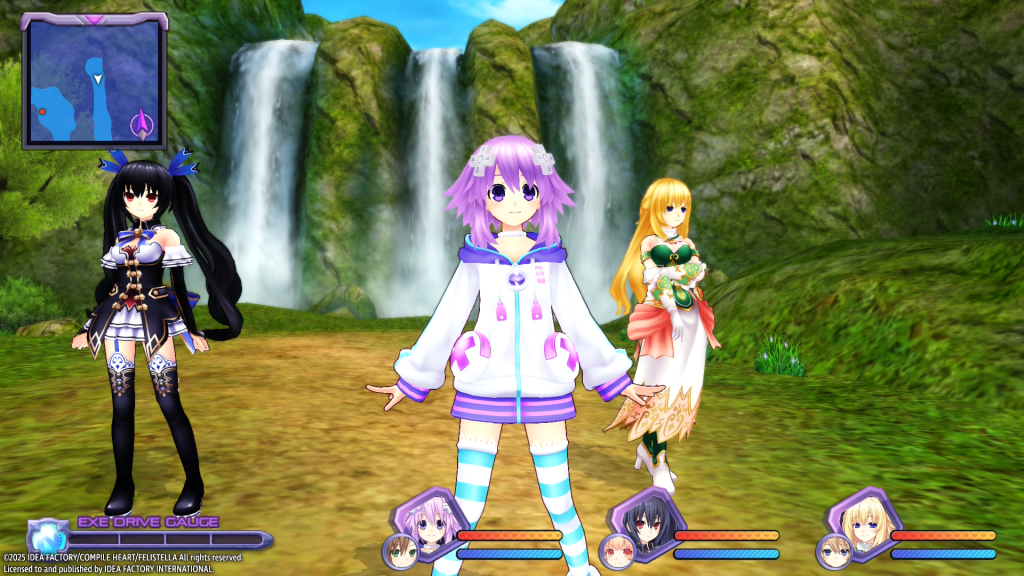
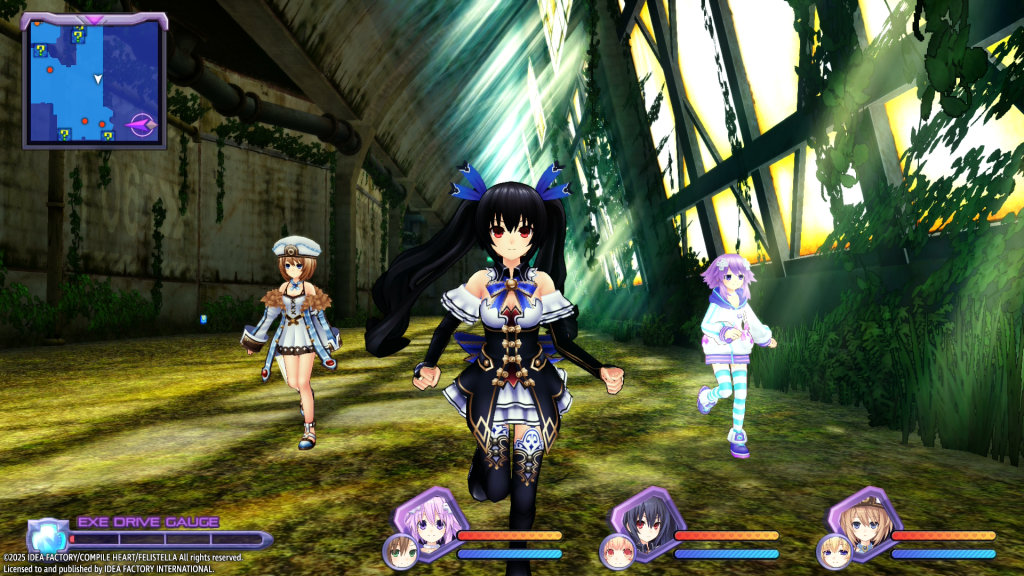
There are six slots in the party for the player to fill out, with three in the front that will be active and three in the back to offer support. As the player explores the dungeons, like the Virtua Forest and the Monster Cave, the front party members will appear and follow the leader. The dungeons are dangerous locations, where monsters roam around the different areas, attacking the party leader if they notice them in the dungeon.

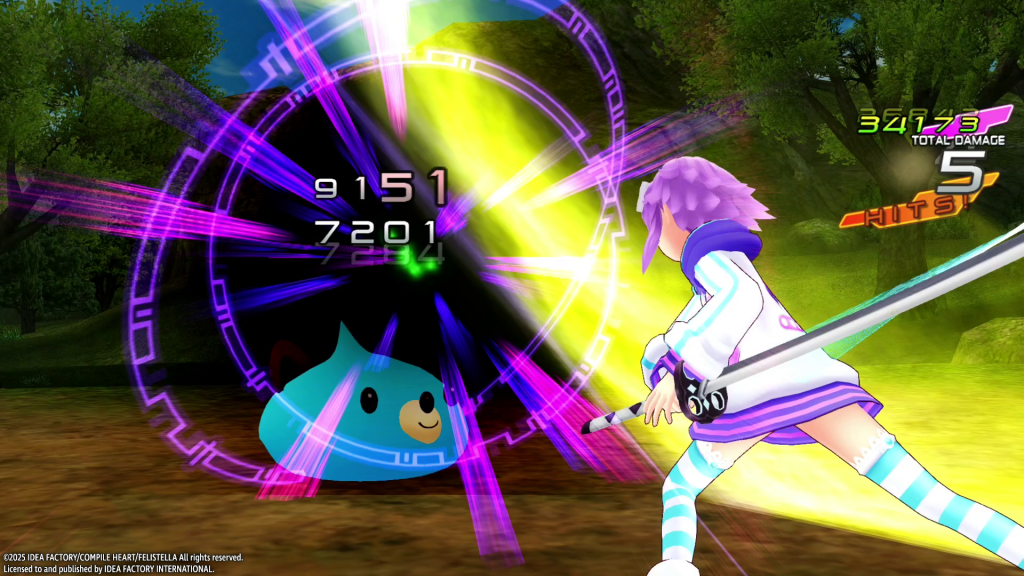
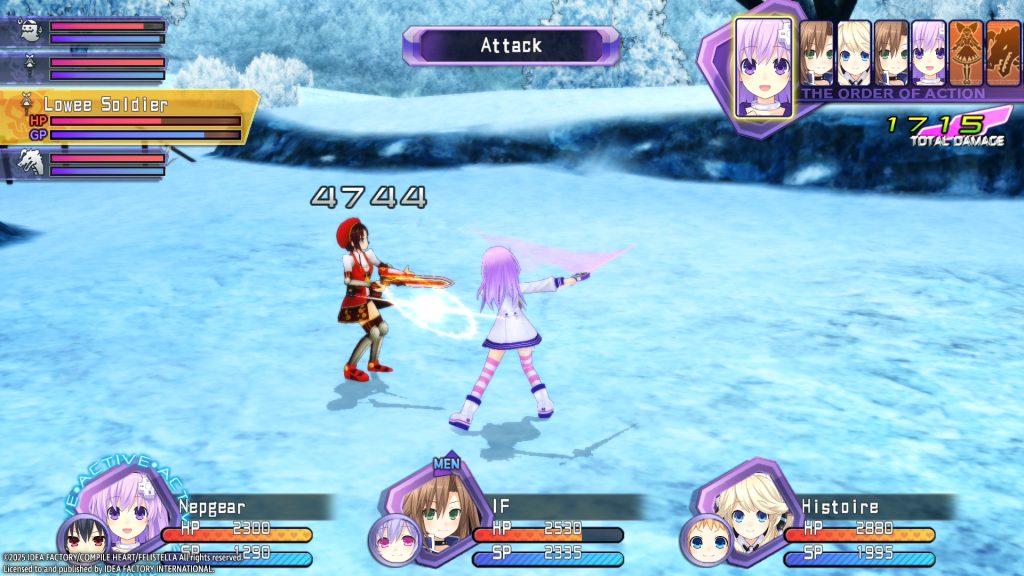
If contact is made with a monster, a battle will begin entering a separate arena space. During battles, the combat uses a turn based system, where the party and monsters will make their moves based on turn order. Turn order is determined by the agility of the combatants, with the fastest characters going first and the character priority shown in the top right of the screen. But there is a way to make sure that party can get priority in combat.

Before combat in the field, if the player manages to attack the enemy, they will get an advantage called the Symbol Attack. However, if the enemy hits the leader before the battle starts, they will get a surprise attack advantage and strike first. It is important to get the advantage, as the enemies will it hard if the party is weakened, or they are unprepared for battle. Once the battle starts, players have a few options when they make their moves.

The options in battle are as follows;

  • Normal Attack – chain together up to four attacks together in a combo. There are three different attacks types that have different affects to them. Assigning skills in the combo menu allows players to customise the available attack chains.
  • SP Skill – Unleash special moves on enemies using SP points, these are unique to each character and cost varying amounts of SP. There are offensive, defensive and support skills that can be used.
  • Defense – the character will brace themselves and end their turn, reducing the amount of damage they will take.
  • EXE Drive Skill – these are super moves that use up the special EXE Drive Gauge, allowing them to perform their ultimate skills.
  • Alternate actions – this allows players to access the secondary functions in a battle by pressing the toggle button.
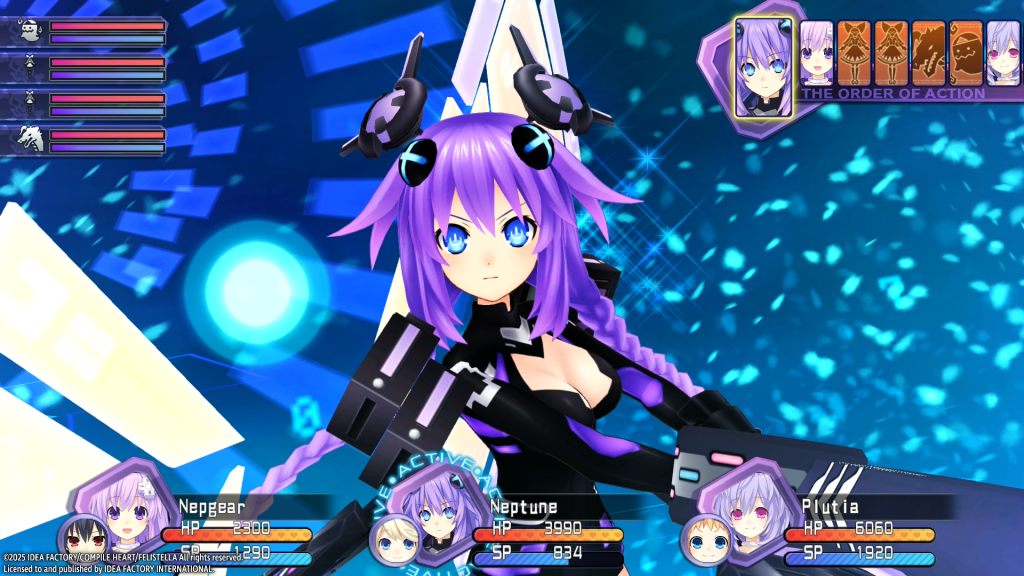
  • Transformation – Neptune and the other CPU Goddesses can use 20% of their total SP to transform into their powered up form. Activating HDD mode will increase the stats of the goddess, alongside boosts tied to special equipment.
  • Switch – pass the turn and switch to the character that they are partnered with if available.
  • Item – use an item to restore lost health, expended SP and more before passing the turn.
  • Run – if the battle is too much for the party, players can attempt to flee from the combat by moving to the edge of the battlefield, but there is a chance this may fail. Story battles will have the escape option disabled.

During combat there are a few different mechanics that will affect the flow of battle. The main mechanic that players must focus on is the guard break meter. As damage is done to enemies, through normal attacks and Skill attacks, the guard meter will be drained gradually, with increased damage if dedicated Break Attacks are used. When the meter is depleted, the enemy will enter break state where their defense drops significantly.

Then there are the Power Attacks, which are the heavy attacks that pack a real punch. These hit even harder when the enemy is in a Break state, allowing for strong enemies to be taken down faster. The last basic attack is the Rapid Strike attacks, which are weaker isolated combos. These attacks fill up the EXE Drive gauge, with one level to start but more can be unlocked. When the EXE drive is filled, special EX Finish moves can be used to end a combo string.

At the end of a battle, if all of the enemies have been defeated, the player will be awarded with experience points, money in the form of credits and the chance of items. When the party members reach set experience milestones, they will level up and increase their general stats. At different levels new skills will be unlocked, with combo attacks, SP Skills and EXE Drive Skills. Party members that haven’t been knocked out in the front and back position will gain EXP.

Between battles, the party will be able to freely roam the dungeons, moving from area to area, encountering more enemies as they go. There will also be points where items can be found, which are search points that are scattered throughout the dungeon area. The items within the dungeon include crafting items, or resources that can be sold for credits. Players can also find special items through the treasure search feature, which expands away from the leader.

While exploring the different locations, players may find event markers if the dungeon is tied to the current objective of the chapter. When the marker has been reached, the event scene will play out. These can include simple story segments, which push the narratie of the adventure along. However, some of the events will result in battles against powerful enemies, with some event battles having additional battles tied to them.

There will also be event markers that appear on the world map, which will guide the player forward on their quest to recover Nep’s memory. Players can also interact with other characters outside of events, providing information and details about the world. Be careful when progressing with events, as some of the interactions may be missed if the story moves too far ahead. It is also important to save before events as event battles may be lost resulting in a game over.

Outside of the dungeons and events, there are side missions and quests that can be taken on. These involve the player collecting specific items, defeating a set number of target enemies and more. The different quests are accessed from the guild menu, with different rewards attached to them, including credits and items. Most of these quests are optional, but they can be very important for increasing the battle capabilities of the party.

Credits can be used in the shop, where items, equipment and accessory items can be picked up. New weapons, armor and support items will be added to the shop as the game progresses. By purchasing improved gear, the party can be prepared for the journeys ahead. The shop isn’t the only way to obtain new items, as there are a couple of different crafting systems that players can use. These systems are the Disc Dev and Plan crafting.

The Disc Dev is a special system where players get to create special discs, offering power-ups and special powers. By combining Idea Chips and Blank Disc items, players can create a variety of support items, increasing the stats of the character it is equipped to. Then there are the Plans, which will be able to alter the game by unlocking new features and items. To activate plans, players will need to collect the required resources, which will activate the plan.

By using the plan system, players can unlock the Coliseum for extra side battles, alter the difficulty of battles and unlock new items like costumes. It is important to decide which plans to activate, as there are memory restrictions that are tied to plans. Different plans use up a different amount of memory, so not all plans can be used if there isn’t enough memory. Luckily, throughout the adventure, there will be the chance to obtain memory expansions.

Over the course of the adventure, the shares for Gamindustri will change. These shares are the faith that the people have in the CPU goddesses, which will change as the player completes quests. Depending on the level of the shares for goddesses, there may be effects that are given to the goddess with a high amount of Shares. There are five share percentages, one for each region/CPU and “other” which are not allocated to a goddess.

The last thing to discuss is the additional content of Neptunia Re;Birth1+, which consists of all previous DLC that was released. This content can be toggled on or off from the DLC menu, but most of them have restrictions to be activated. Included in the DLC content, there are support items, giving players an advantage from the start, additional coliseum battles and level increases for the player. There is also the ability to recruit some special party members.

As part of the DLC contents, characters from other Neptunia games will appear, including CPU goddesses from later games. These characters include Plutia and Peashy from Hyperdimension Neptunia Victory, Uzume from Megadimension Neptunia VII and even Chibi versions of Compa/IF. Each of the characters have their own unique skills, equipment and powers that can be used in battle, offering players a wide variety of options for battles.

One of the most interesting additions through the DLC is the inclusion of bonus dungeons, which have special effects tied to them. The most valuable of the dungeons is the LILY-AD dungeon, which can be used to boost the Lily Rank of the party. The Lily Rank is the bond between characters, with the level showing how close they are. By increasing the Lily Rank, special support skills and boosts will be made available when they are paired as front and back partners.

Now with the gameplay covered, it is time to discuss the other aspects of this release, starting with the controls

Controls – there is a rather comfortable control system, with all of the important inputs being shown on screen for menu navigation and battles. The inputs during play are fairly responsive and intuitive, offering players a smooth experience during play. While playing the game, there will be tutorials explaining the gameplay, which can allow players to get used to inputs fairly easily. This gives the game the ability to pick it up easily.

Difficulty – this is a rather challenging title, with only a single default difficulty setting. The difficulty of battles can be quite high, which is most prevalent during the boss battles. Due to this some players may find themselves struggling, so it can be helpful to grind weaker enemies to level up. It is possible to ease some of the challenge with the Plan system, but make sure to save as often as possible, as death can lead to significant progress loss.

Presentation – from a visual perspective, the game is very pleasing to the eye, with the high quality 2D art that the franchise is known for, alongside the vibrant 3D worlds. All of the 3D models look clean and detailed, with a fantastic use of color that make them stand out against the different environments. The dialogue and event scenes look good, with some animated cutscenes and stills that emphasise the story as the narrative progresses.

The music for Neptunia Re;Birth1+ is very good, with all of the music themes that hhave become iconic with the franchise. The mix of light pop style melodies, heavy rock and atmospheric compositions work very well together, creating a balanced and robust soundtrack for players. There is the choice of English and Japanese voice lines, featuring the talents of Cherami Leigh (Dorohedoro), Melissa Fahn (Boruto) and Christina Valenzuela (Shantae).

Final Thoughts – As has been established with my previous coverage, I am quite the fan of the Neptunia franchise. So I was very happy to get the chance to play Neptunia Re;Birth1+, but sadly due to some technical difficulties, my experience was limited. From what I was able to experience, the story was engaging and I enjoyed what I was able to play. The combat was a lot of fun, with the combat system that felt intuitive and flexible.

There is a little bit of a grind to the game, as it can take a while to unlock items for plans, as well as levelling up party members, which some may find longwinded. I very much enjoyed the inclusion of the DLC content, with the characters from later points in the timeline being added to the game. This added a lot variety to the experience, allowing for multiple party configurations and more flexible combat opportunities throughout the game.

Unfortunately, I am unable to recommend the game or provide a score, as the hardware issues I faced meant I was unable to fully experience the game. What I was able to experience was a lot of fun, with the combat being fun and responsive, what I experienced of the story was engaging and the additional characters were fantastic to play as. If you do want to check the game out for yourself, a link to the game will be below, but be aware that there is the chance some issues may occur.

Link to PlayStation version (HERE)

Little Witch Nobeta – PlayStation 4 Review

Overview – developed by SimonCreative and Pupuya Games, with publishing by Idea Factory International, Little Witch Nobeta is an adventure with a focus on magical shooting action. Delve through an ancient castle, discover the mysteries that it holds and battle the monsters and souls within on the way to the throne. This version is available for Nintendo Switch, PlayStation and Steam, with a link to the game at the bottom of this review.

Disclaimer: before I get into the review, I would like to thank Idea Factory International for providing the copy of Little Witch Nobeta used for this piece, via the Keymailer service. The provision of this software has not influenced the contents of this review, all thoughts and opinions contained within are my own.

Now with the introductions out of the way, let’s get into the review, starting with the story. Please note, I will be covering the core experience of the game, omitting some details to prevent spoilers. I also reviewed the Switch version of the game a few years ago, with most of the content being similar to this review, which you can find (HERE).

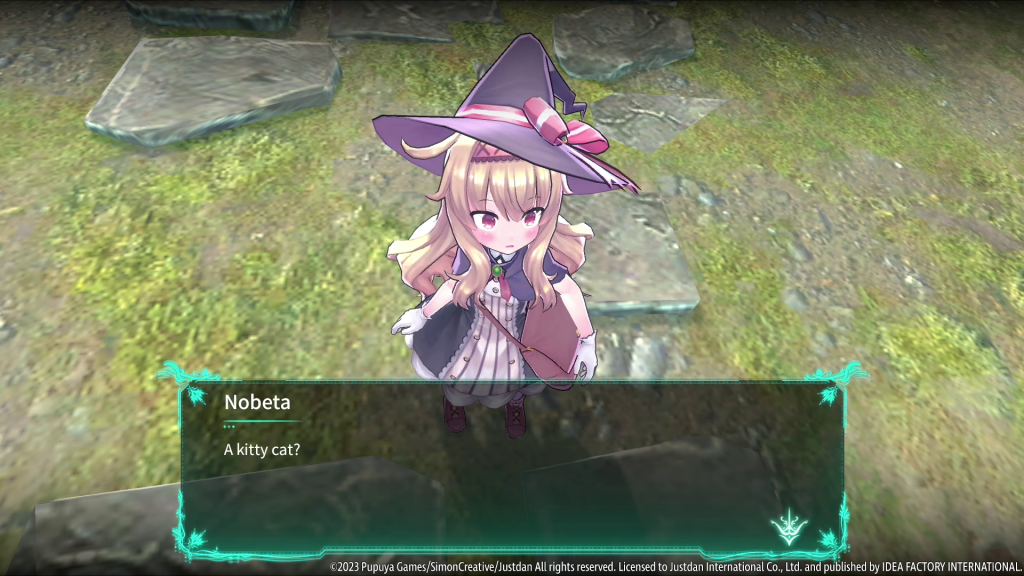
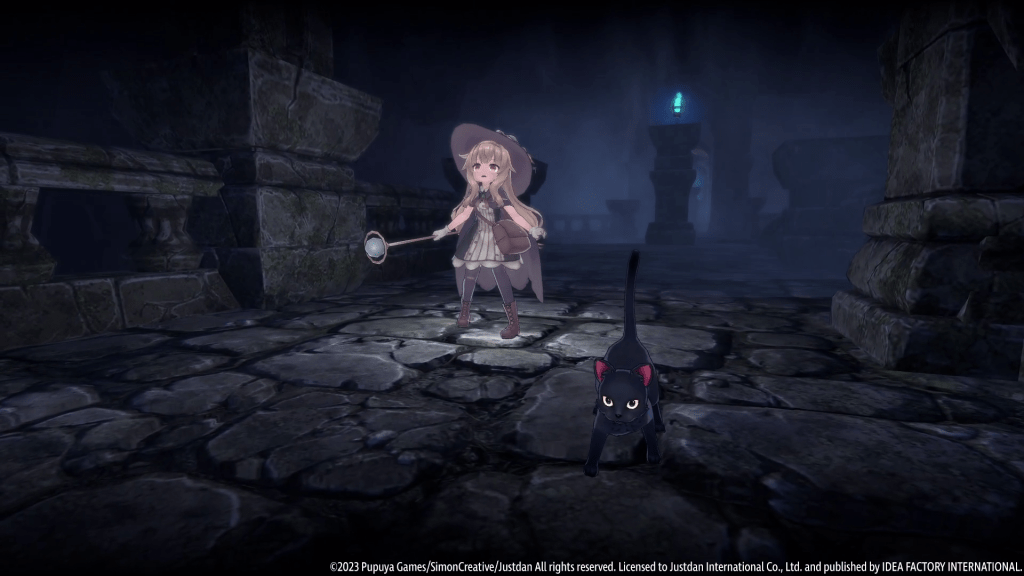
Story – Nobeta, a young witch has travelled to a mysterious castle, looking for answers about who she is and her life. As she explored the castle, looking for the throne room, she comes across a mysterious black cat with magical power. As she ventures through the castle, Nobeta will gain new magical powers, while encountering Crafted Souls, powerful beings that posess great magical power. Can Nobeta overcome the challenges, uncover the castle’s secrets and find the answers she seeks.

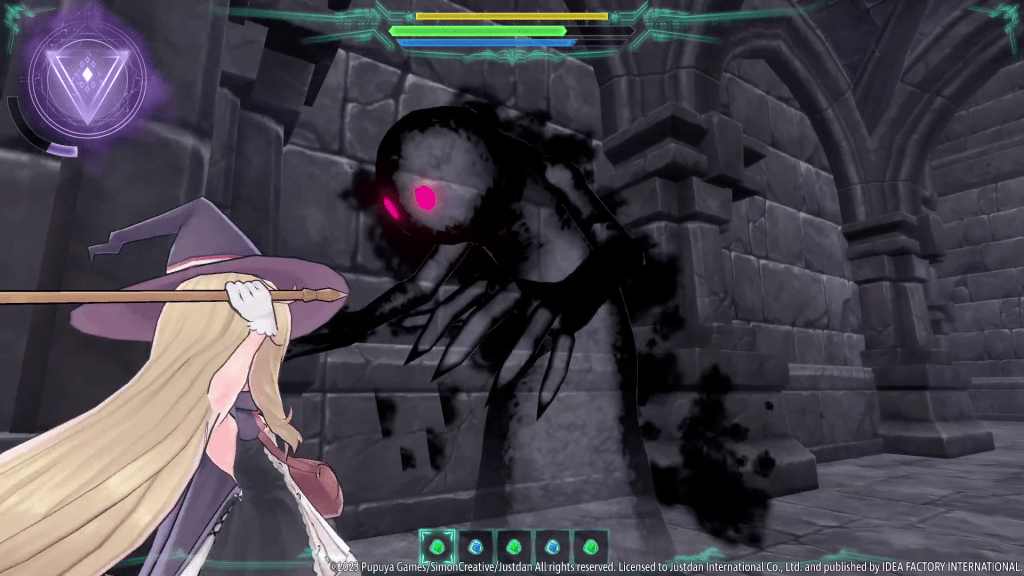
Gameplay – Little Witch Nobeta is a third person action adventure, where players take the role of the titular witch. In this adventure, players will explore the different areas of the castle, fighting monsters and taking on powerful bosses. The core game loop for this release focuses on exploration, puzzle solving and some platforming challenges. While doing this, players will encounter monsters, spirits and crafted souls that will attack the player on sight.

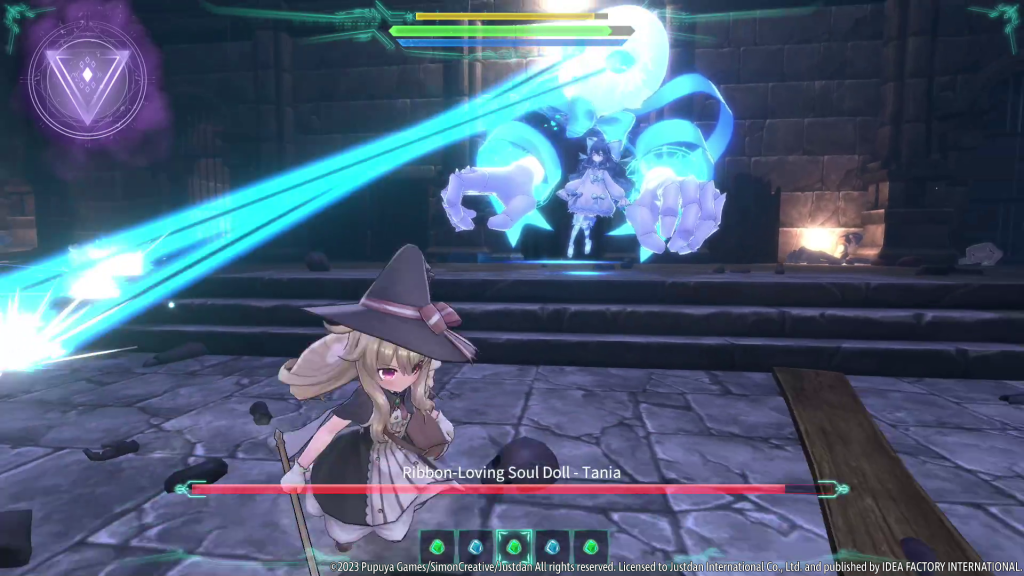
In order for the player to protect themselves from the dangers of the castle, they have access to two forms of attack. The first is the melee attack, where the player strikes enemies with Nobeta’s wand, dealing a limited amount of damage to enemies. Then there is the magic power, which consists of magical elements, with four of them being used for to fight monsters. The other two are passive effects, which can be throughout the adventure.

During combat with enemies and monsters, the player will need to stay on their toes, as there will be close quarters strikes and long range battle. To survive the battles with the dangers of the castle, players have a couple of options. Nobeta can dash, jump and dodge, which will let them avoid damage from different attacks. However, these use Nobeta’s limited stamina meter, which will cause her to fall over if she tries to run when it runs out.  

At the start of the adventure, the player will have access to the basic power Arcane, which is used as a mid-range magical attack. This is an all-round attack, which can be used to battle many of the monsters and apparitions that appear, firing single shot blasts at enemies. As the adventure progresses new magic can be found, which each have different properties with the Ice being rapid fire, Fire being a spread shot and Thunder being a long range blast.

To use Nobeta’s magic, players will use up Mana which is the essence of magic itself. Each time magic is used, Mana will be taken from the bar below the green health bar on screen. If Nobeta runs out of magical Mana energy, she will be unable to use any of her spells. Mana will be recovered naturally as players use melee attacks, defeat enemies and from blue gems in set zones. The biggest drain on Mana is through channelling magical power.

Each of the magical powers can be charged up through channelling, which will increase the power of the magic attacks. By channelling the magical power, Nobeta can unleash a powerful magical attack, dealing significant damage to enemies. This will also empower Nobeta with a special qualities, like the Ice power protecting her from fire. But be careful when trying to enhance her powers, as it can be interrupted by enemies attacking her or environmental damage. All magic powers can be upgraded by finding special books hidden in chests.

Alongside the active magical arts, there are two additional powers that can be collected which will aid the player in their exploration of the different zones. These powers are Wind and Absorption, which are passive abilities that are activated when picked up. The Wind magic allows for Nobeta to have more mobility, like double jump or air dodge. Then there is Absorption, which will let Nobeta siphon magical energy from enemies when dodging.

There is a lot of fluidity with the combat, with the magic working in a third person shooting style, alongside hack and slash melee combat. Players can change their attack style on the fly, switching between up close and distant attacks. When battling enemies, players can manually aim or use lock-on targeting, offering some flexibility to battle. Thankfully, there arent any issues when the combat becomes more frantic, or when fighting bosses.

Located at set points throughout the castle, players will encounter statues that Nobeta can pray at. These allow the player to recover health, while also acting as checkpoints that Nobeta will reappear at in the event of death. The statue also provide a levelling service, where souls collected from defeating enemies can be used, increasing Nobeta’s health, stamina, total magic and more. Players can also trade at the statue, exchanging souls for magic gems.

Inside boxes that are in the different rooms and spaces of the castle, gems can be found inside boxes. The different gems offer a variety of effects, which can be deployed whenever the player wishes to use them. Gem effects are based on their colors, with green for healing and blue for Mana recovery as the most common. However, some of these items may be cursed, taking souls away upon player death, but curses can be healed by praying at statues.

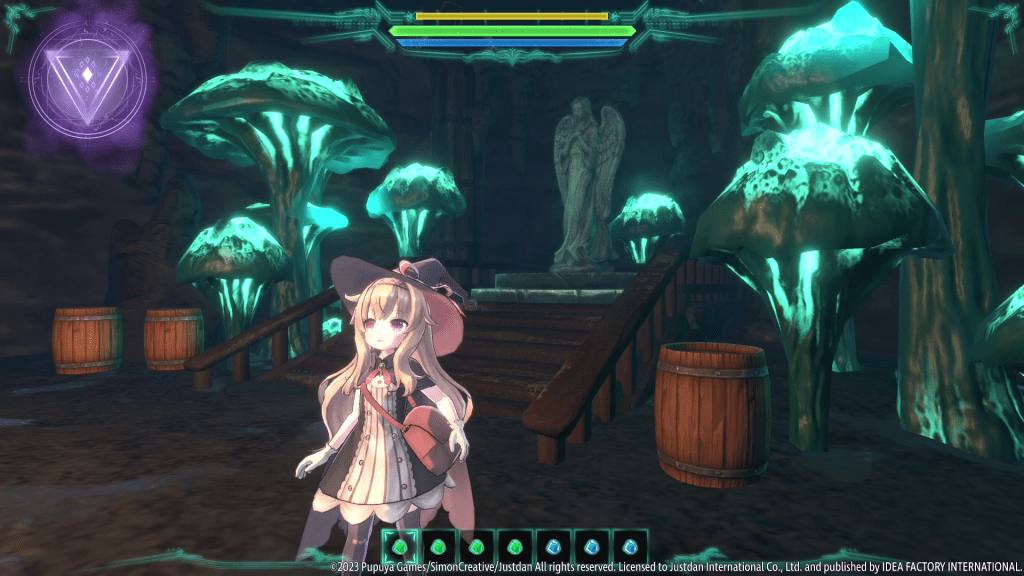
The castle itself is broken up into regions, with each of them having their own distinct thematic elements to them. There is the main castle itself, made up of grey walls and large halls, the underground cavern and the volcanic ruins that sit in lava. The different areas are mostly interconnected, with gates and locks that will block progress. To open the paths up, players will need to solve puzzles, defeat deadly enemies and destroy seal locks.

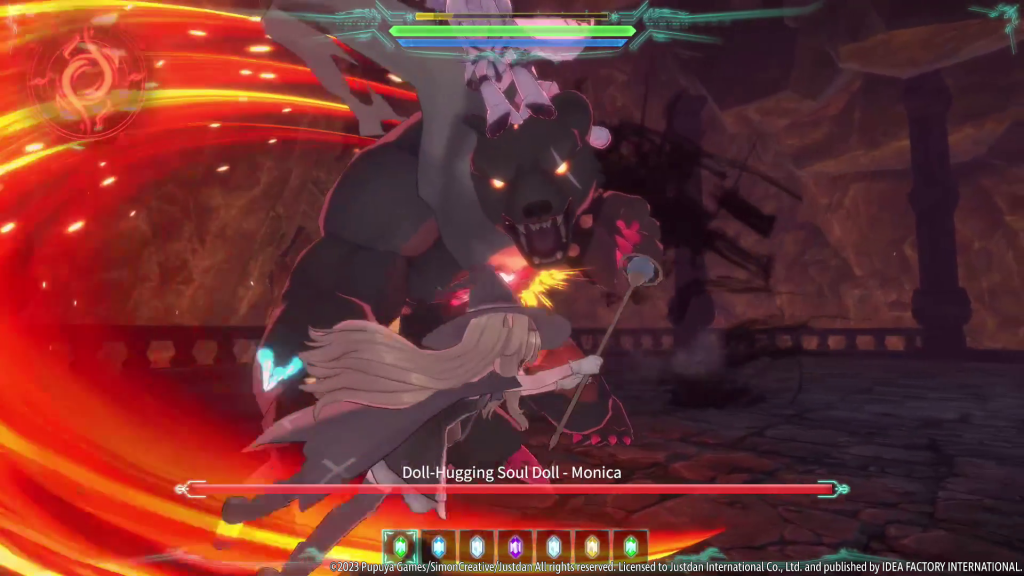
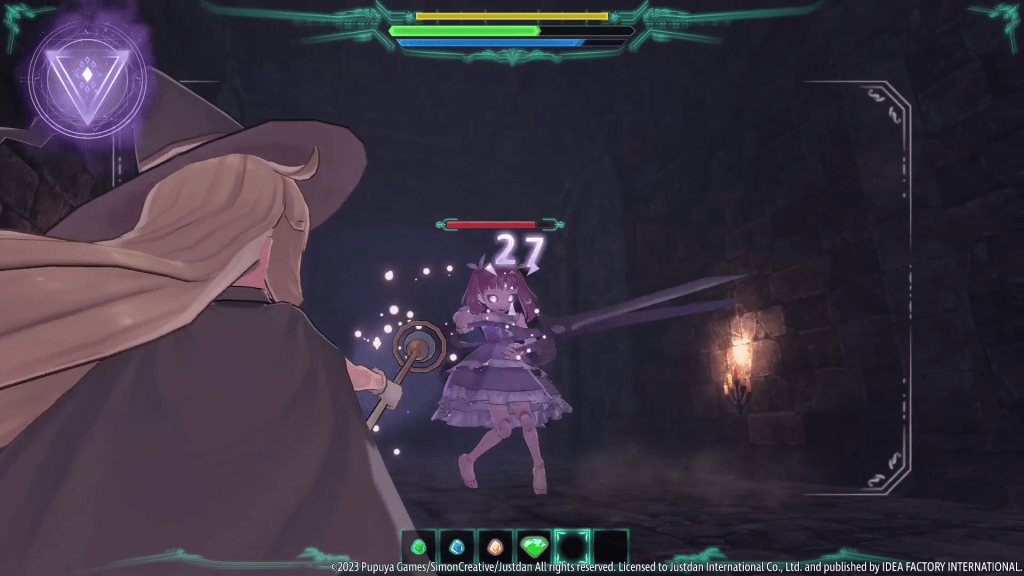
At key points in the adventure through the castle and its settings, powerful bosses will appear. These are Crafted Souls, which are puppets that have gained consciousness and act on their own. During battle with these imposing foes, players will need to focus as attacks will come thick and fast. Players will need to focus on dodging attacks during the boss phases, as they hit hard and can lead to a quick death if the player is careless.

The last thing to discuss is the side content, which consists of special unlockable content. Over the course of the adventure, players will find special items that get added to the collection, containing lore about the world. Then there are the costumes, which provide a variety of looks and cosmetics to dress Nobeta up at prayer statues. After the game has been cleared, some extra content will open up, offering even more challenges for players to dive into. (Note: Trial Tower and some costumes are post release free content)

Now with the gameplay covered, it is time to discuss the other aspects of this release, starting with the controls.

Controls – from a control perspective, this game is very comfortable to play, with all of the combat actions on the shoulders and movement/actions on the face. The general flow of action works well, without delay and or lag for inputs, especially during movement and highly tense situations. But there is one minor issue when it comes to control, which is the camera can be jittery at standard settings, but this can be remedied with a quick settings adjustment.

Difficulty – there are two difficulty settings for Little Witch Nobeta, offering players a Standard and Advanced mode to challenge. If the player chooses the Standard mode, Nobeta will get some adjustments to her abilities, making it an easier experience. Then there is the Advanced mode, which is the intended gameplay experience, with a higher difficulty and no enhancements. Both modes offer a challenging experience, with the bosses being the hardest part.

Presentation – visually, this release is a mix of cuteness and dark fantasy, which work well together making it feel creepy yet cute. The textures and on screen assets look crisp and bold, with the standout being the puppet and crafted soul enemies. There is some darkness in places, but it doesn’t spoil the game. Compared to the switch version, the appearance is improved, with sharper visuals while retaining the stable pacing and flow of action.

For the sound, there is a lot of atmospheric music that enhances the adventure, with compositions that are diverse in their instrumentation. This is achieved through soft piano, choir style harmonies, gentle chimes and strings that can build tension in the haunting areas of the castle and its grounds. The dialogue for this game is entirely in Japanese, with performances from Konomi Kohara (Genshin Impact) and Hololive talents Omaru Polka, Shirikami Fubuki and Shirogane Noel.

Final Thoughts – when I first reviewed Little Witch Nobeta a few years ago, I had a fantastic time with the switch version, so when I got a PS4 and the opportunity to play it again arose, I happily took it. Upon revisiting the game, the same feelings of wonder and emotion were still there, with the new free content being a fantastic bonus. The action flows fantastically with a soft souls-like gameplay, as the challenge doesn’t feel overly difficult, even if the boss fights can feel a little intense and frantic.

While there are areas where the challenge can spike, it isn’t punishing so the skill level required to play is very low, which is rare in the modern action adventure genre. While there are comparisons to other souls style games, the game has a unique personality and feel of its own. This is most evident with the enemy variety, like giant creepy dolls with scissors and the cute yet deadly bosses. So I am happy to recommend this to everyone looking for a new action adventure to play.

In the end, my rating and score for Little Witch Nobeta stays the same at 4.75/5. The flow of action during battle, exploration, characters and the presentation are just as good as my first time playing it, with some extra free content. There are some things that could frustrate players, like progress or soul loss upon death, but it isn’t a significant setback. If you want to check this title out for yourself, a link to each version of the game will be below.

Link to PlayStation version (HERE)

Link to Nintendo Switch version (HERE)

Please note, there is paid DLC for this release, but I did not recieve or use it during this review.

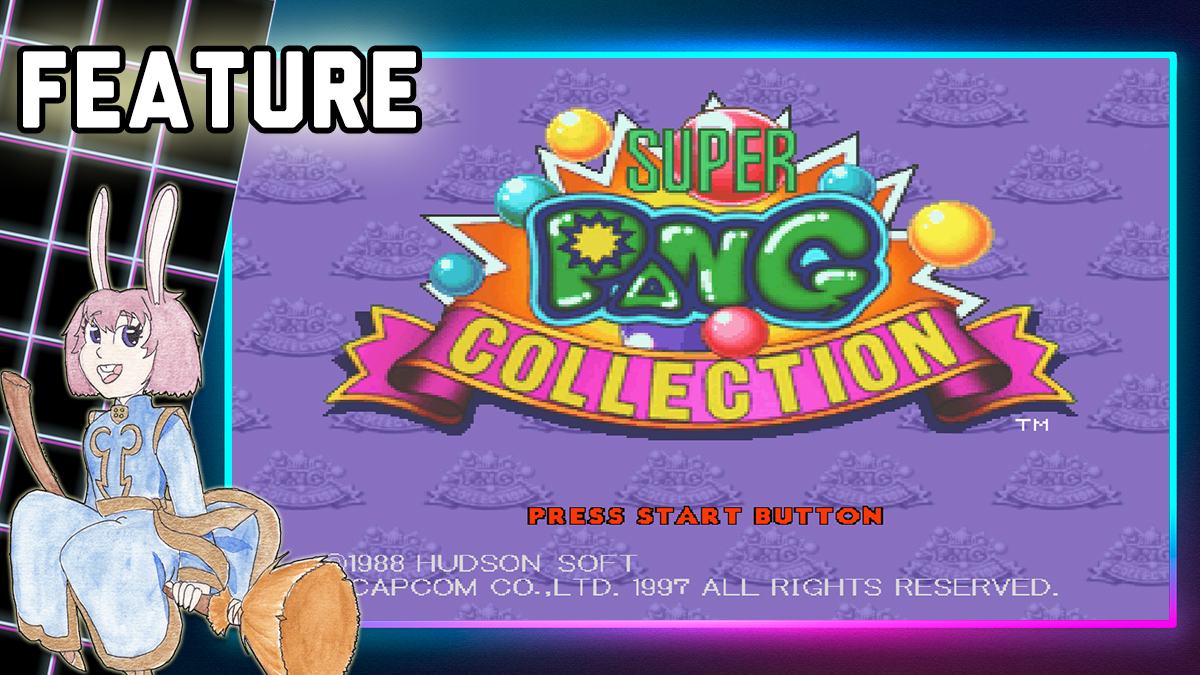
Lost Gems – Super Pang Collection (PlayStation)

Hello and welcome to the latest instalment of Lost Gems, the series where I cover games that are abandoned, removed from distribution or simply forgotten. This week I will be covering a collection of games about busting balloons, travelling the world and stealing masterpieces of art. So let’s dive into Super Pang Collection/Buster Bros Collection for the PlayStation, developed by Mitchell Corporation and published by Capcom in 97/98.

Disclaimer: While the title discussed here is no longer officially on sale, there are ways to obtain the game. This can either be through the second hand market, or via unofficial digital roms/rips. I do not condone or promote piracy, so there won’t be any links to roms or rips of the game being covered.

Now with the introductions out of the way, let’s get started. I will be discussing general game experience, then give my personal thoughts on the title.

About the game

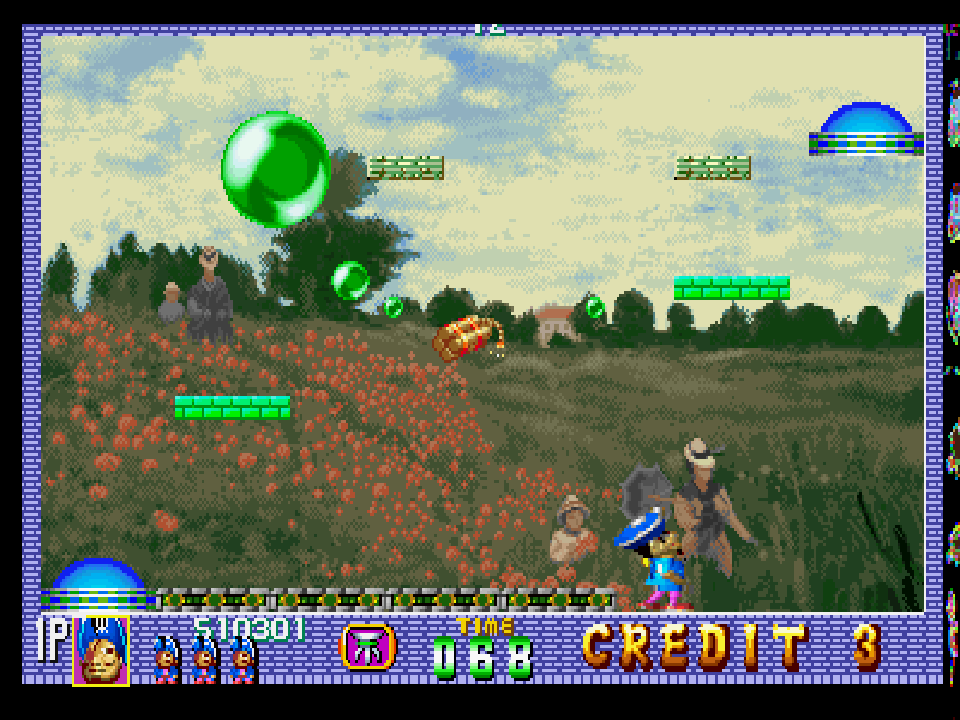
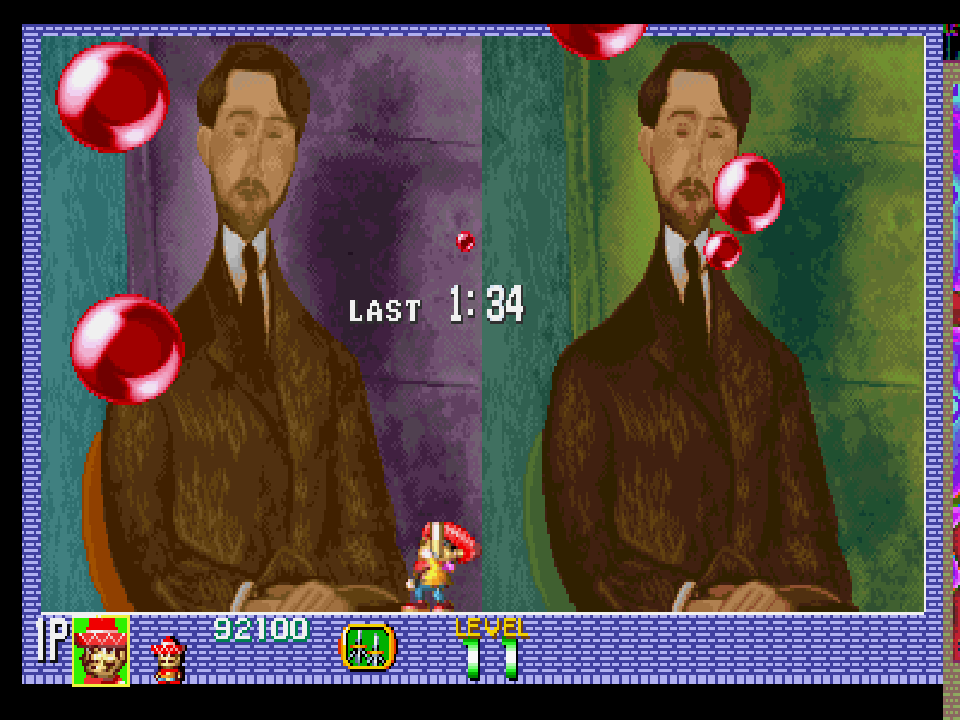
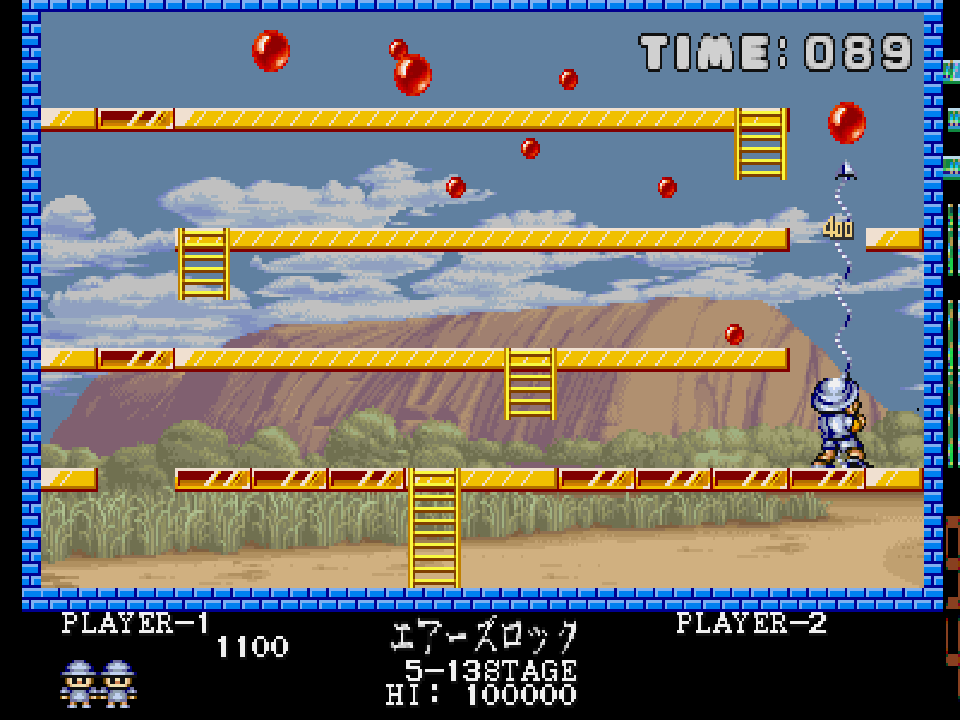
Super Pang Collection, also known as Buster Brothers Collection in North America, is a collection of three arcade bubble busting games. The titles included in this release consist of Pang/Pomping World (Buster Bros), Super Pang (Super Buster Bros) and Pang 3, all in one pack together. Each of the games is available immediately, allowing players to play any of the games they want in any order. After selecting the game, players can access settings before jumping in.

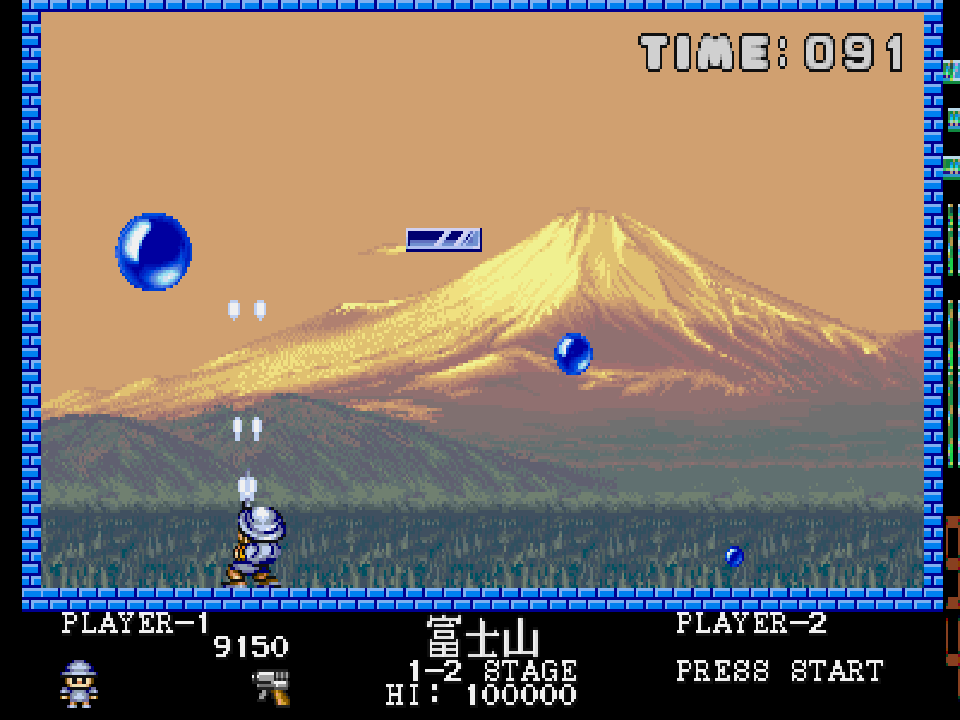
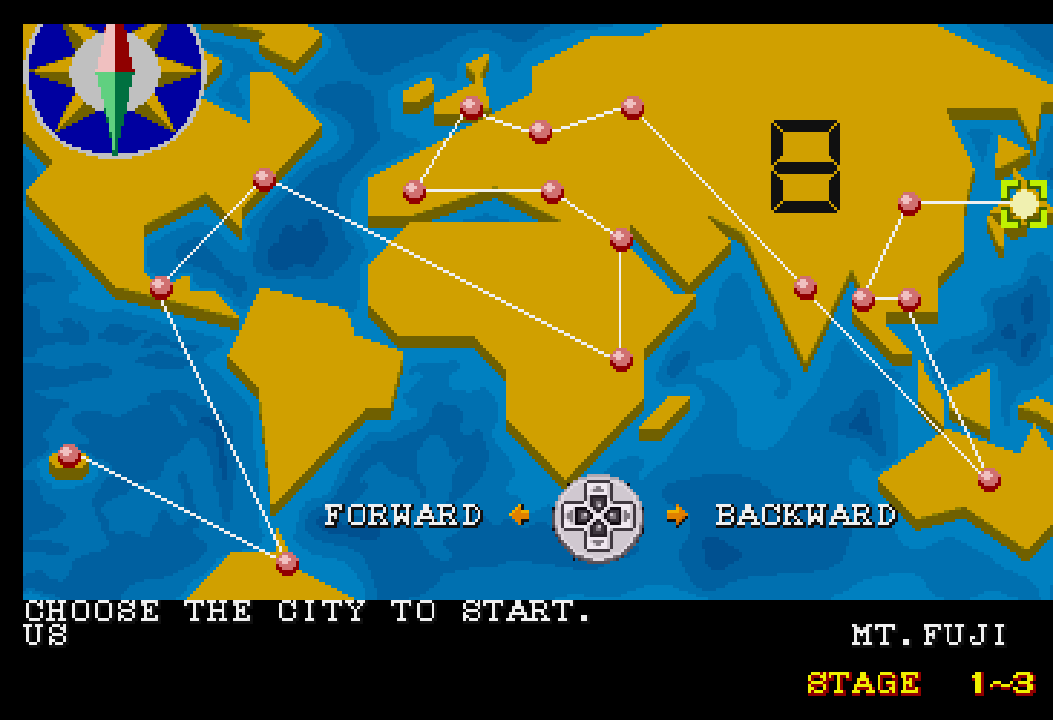
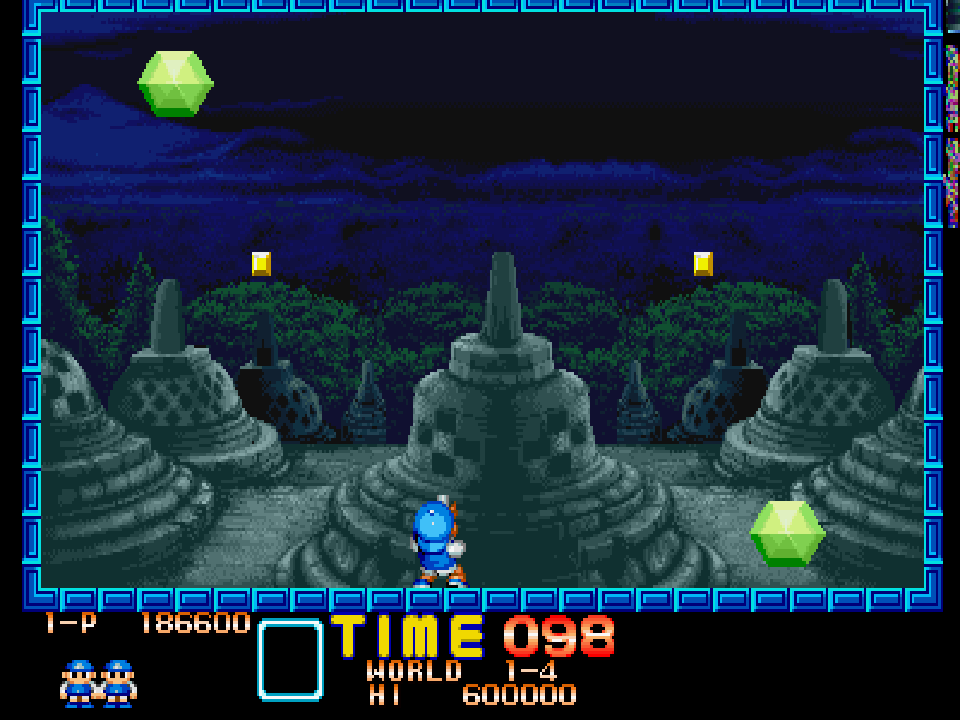
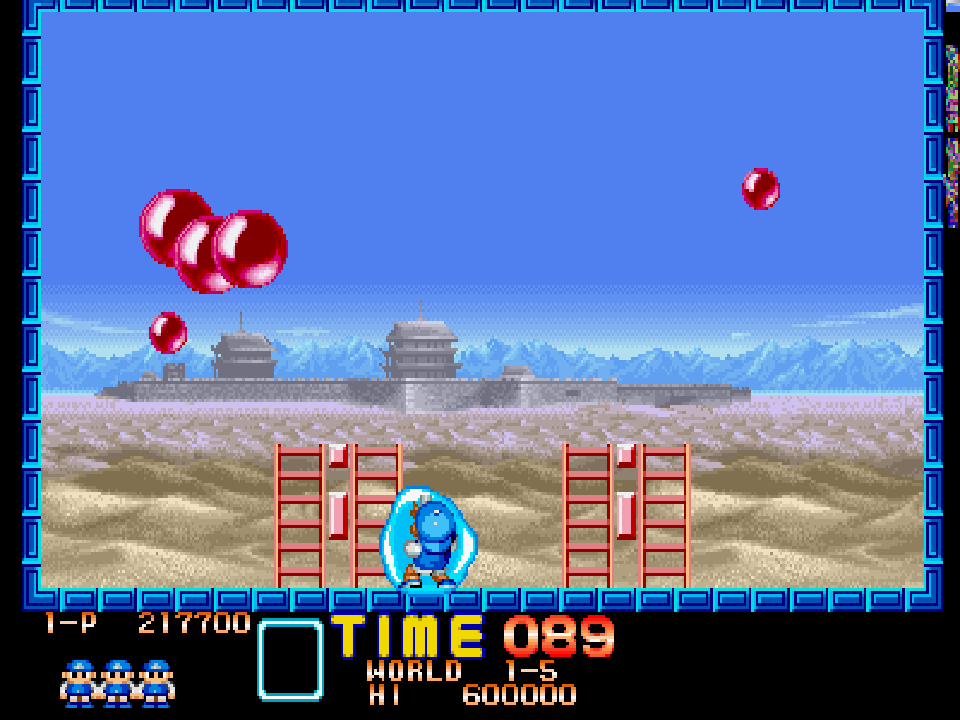
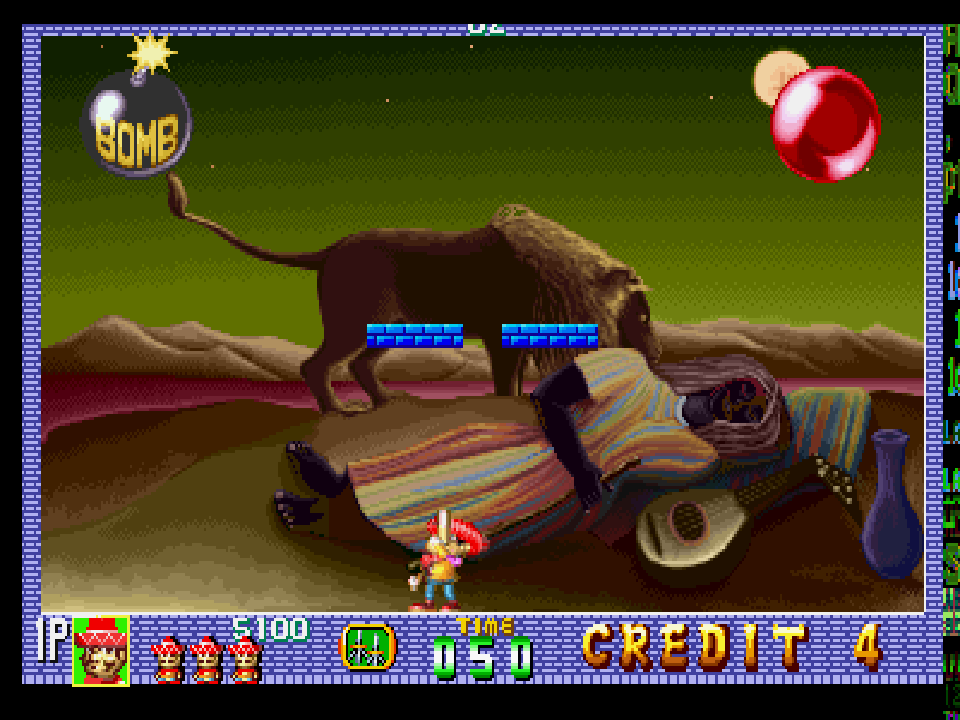
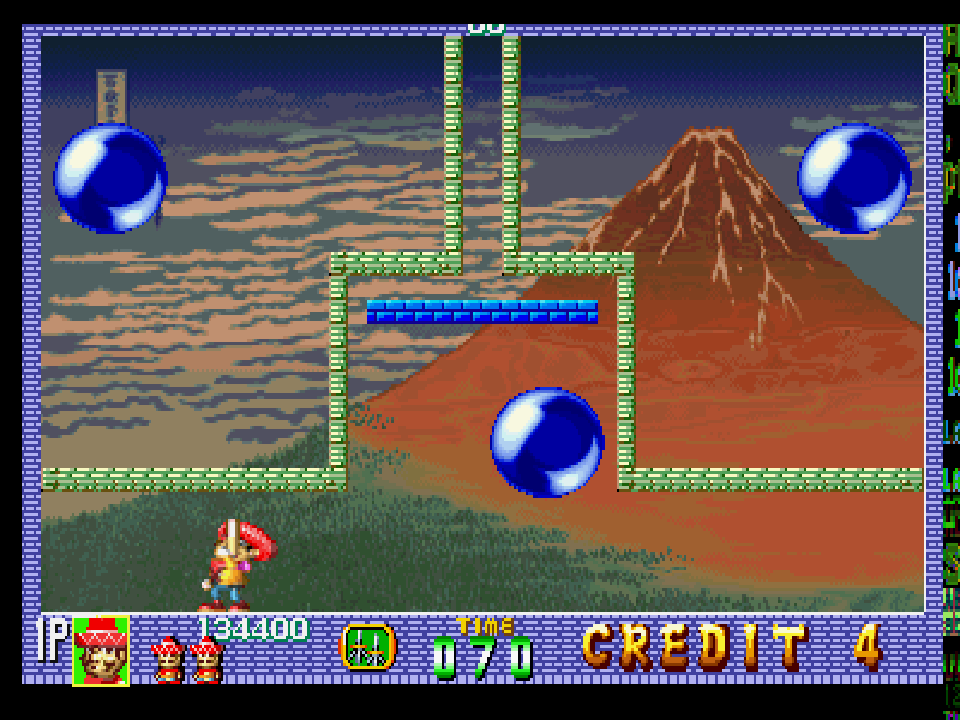
The first game Pomping world/Pang, was the first game in the series, released in 1989. The basic plot of the game is that Bubbles/Balloons have appeared around the world, being a nuisance to the people and locations. To stop the invasion of these balls, two daring heroes that set out on a quest around the world to destroy the bouncing menace. The adventure starts in Mount Fuji, then spreads across locations including the Taj Mahal, Paris and more.

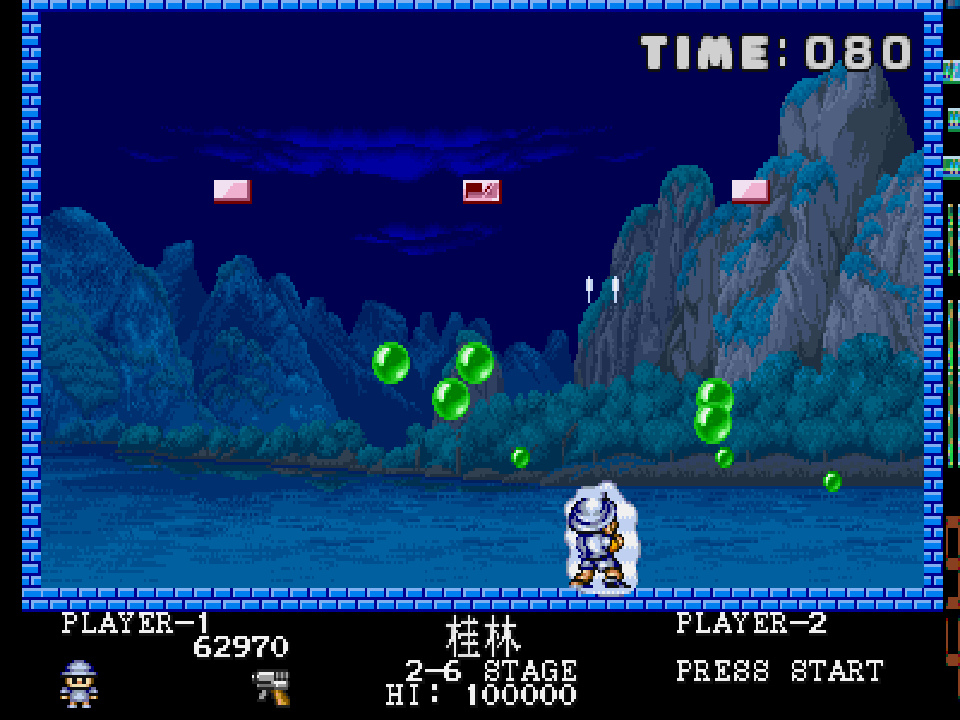
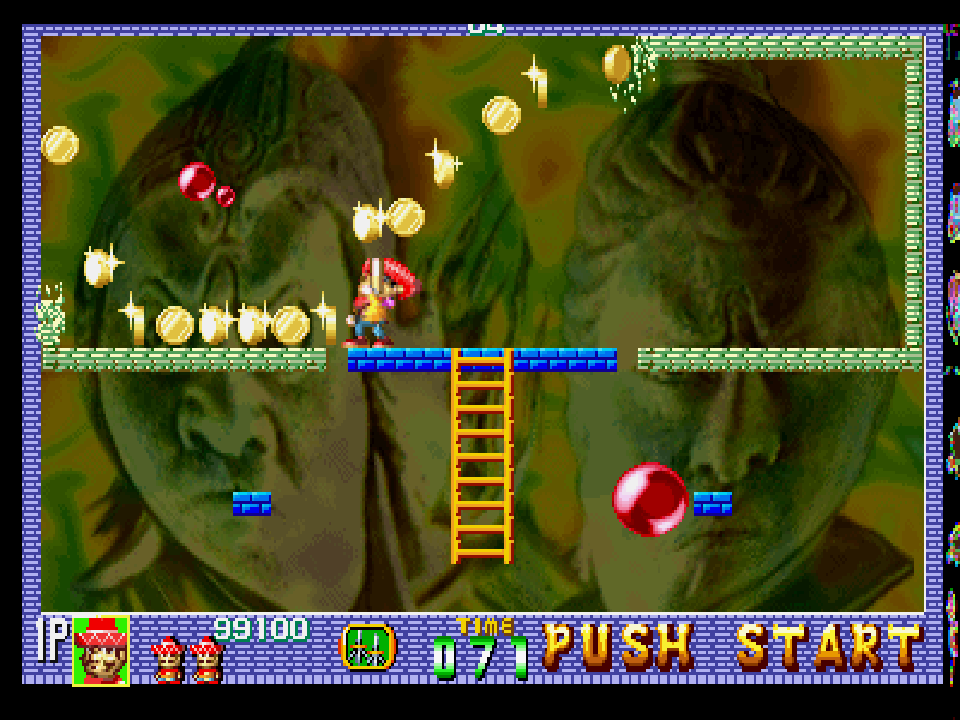
During the globetrotting adventure, the player will need to destroy the bubbles as they bounce around the screen. The player is armed with a harpoon gun, shooting directly up and stopping when it hits a balloon or the ceiling. There are several sizes of balls, which will divide if they are larger, or disappear entirely if they are the smallest size. When all of the bubbles are destroyed, the player will clear the stage and move onto the next.

By destroying the bouncing balls, there is the chance that items can drop from them. There are two different types of items, split between weapon and support items. The weapons consist of the Double Wire, which allows two harpoons to be shot, and the Power Wire grappling hook, which sticks to the top of the screen until hit or disappears. Last is the Vulcan Missile, which is a high powered gun that allows players to blast rapid shots to eliminate bubbles.

Then there are the support items, which have varying effects that can be used for the stage. There is the shield, which allows a single hit to be absorbed, the hourglass that slows bubbles down and the clock, which freezes time for a moment. The last item is the most dangerous of the support items, and it is a bundle of dynamite. This will cause all of the balloons to pop down to their smallest size, adding some additional risk to the current stage.

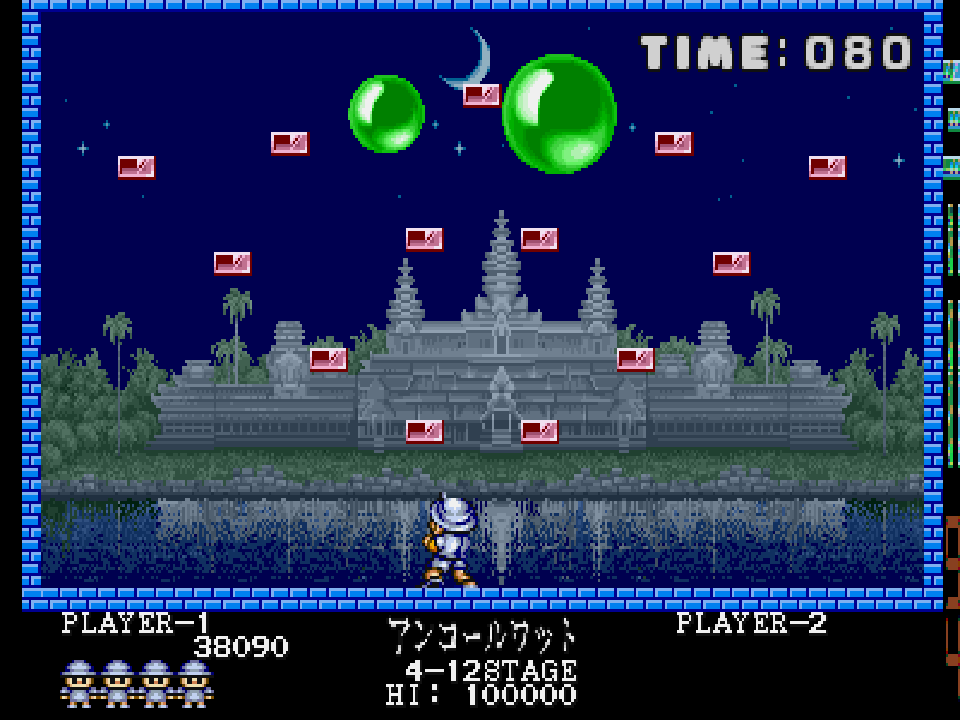
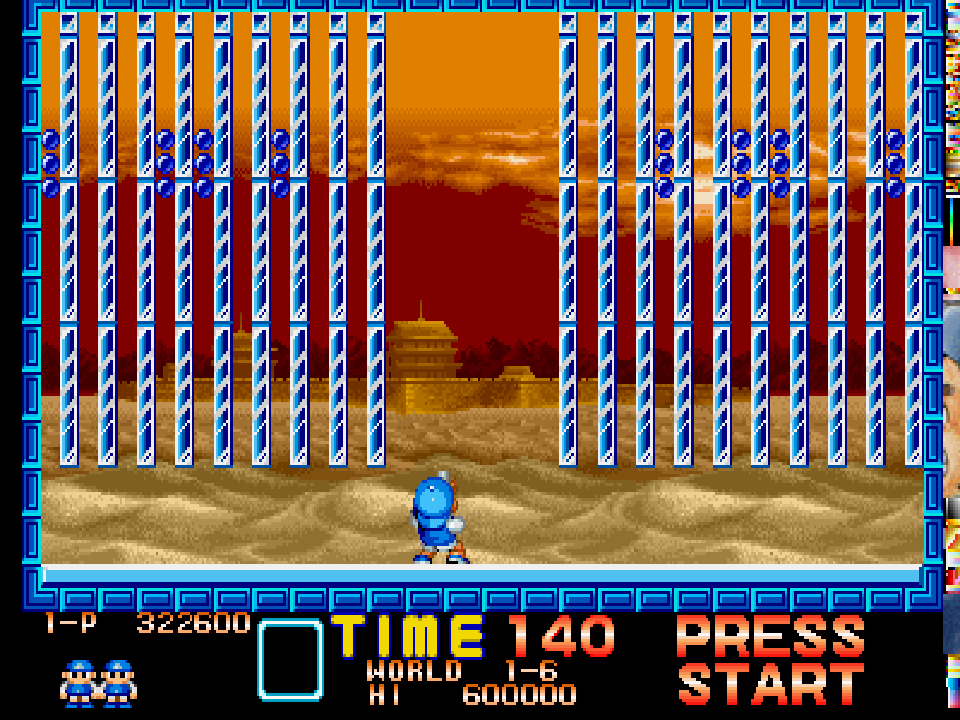
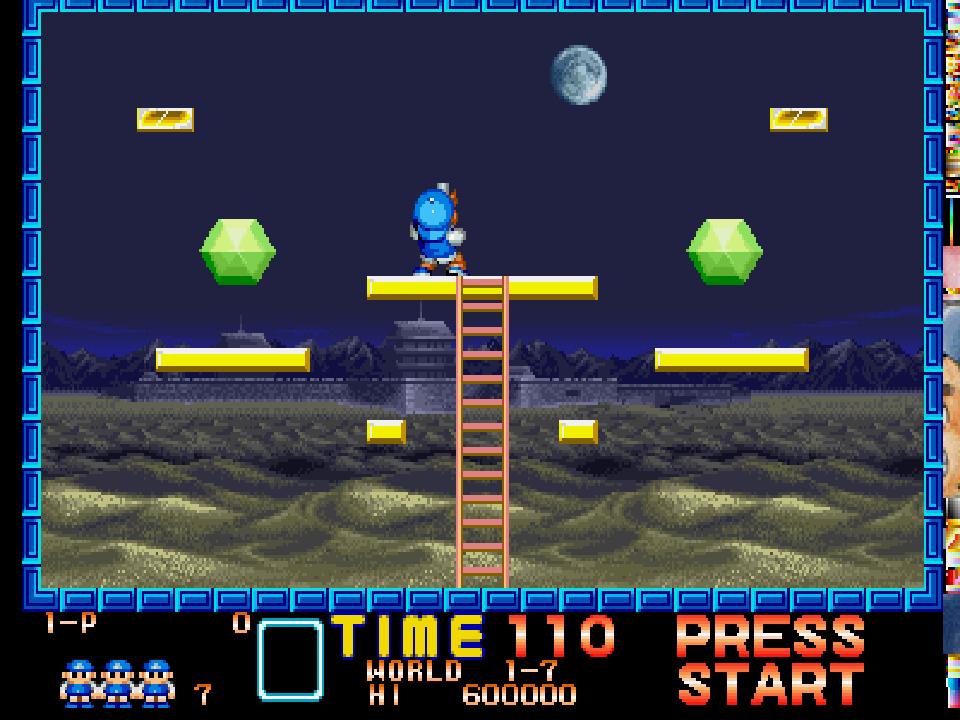
As the player makes their way through the game, the stages will become more challenging, with blocks and walls that the balloons will bounce off. There will also be ladders and platforms that add a puzzle like element to the gameplay. If the bubbles make contact with the player, they will die and start the stage over, if all lives are lost they need to use a credit to continue. Alongside bubbles, there are monsters that will appear and stun the player if contact is made.

For the adventure, there are 50 stages and 17 locations, with images of the setting in the background. As the player clears each area, they will move through to the next location. There is also a day/night transition system, where the images used for the location will go from day to night, with a setting sun in-between. This gives the world more of a lively feel, with the different transitions making it feel like time is passing.

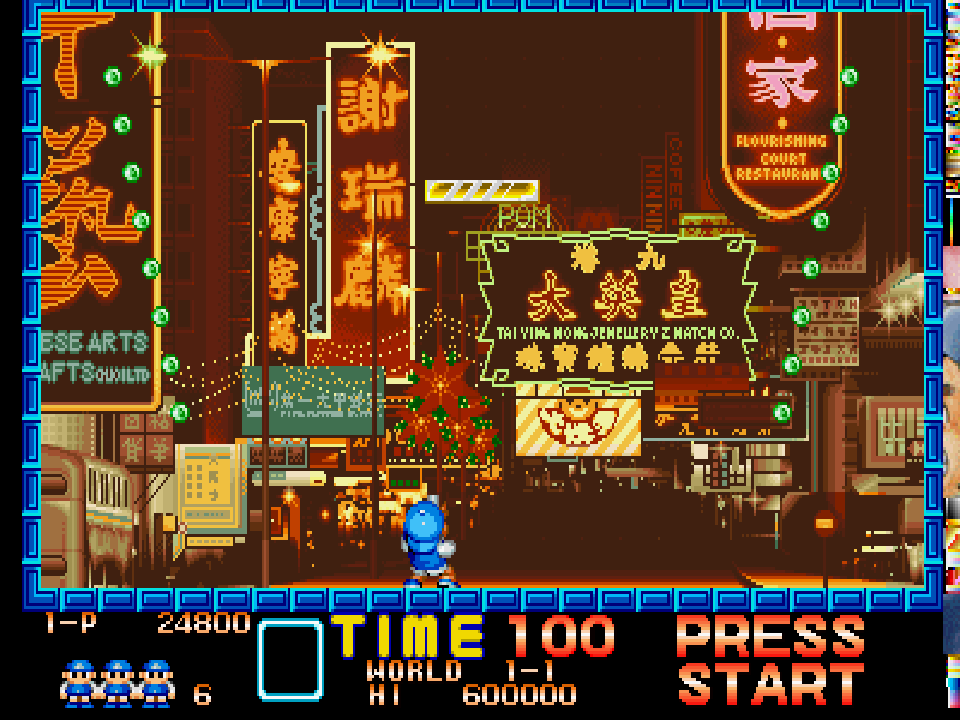
The second game in this collection is Super Pang, which came out in 1990 and takes the formula established in the first game and refines it greatly. This version of the game follows the same style of gameplay as the first, with the World Tour mode, where players travel the world to stop the bubble menace again. Just like the first game, there are real world locations that are displayed as images in the background of the stages.

There are only 40 stages in this release, with the starting in Hong Kong, then moving through the Silk Road, Istanbul, Venice and more during the adventure. The time transitions still occur here, with most stages after the first having a day, evening and night time variant to them. For this release, the core of the gameplay remains mostly unchanged, with the Bubbles returning. There are also monsters that appear, including flying creatures and dragons.

However, there is a new threat to the player, with hexagon balls that bounce off all four walls, moving in a way that is different from the regular bouncing bubbles. The item system returns with this release too, offering the same weapons as the previous game, with double harpoons, power hooks and the Vulcan gun. Support items also make their return, with the shield, hourglass, clock and dynamite, alongside foods that give a bonus.

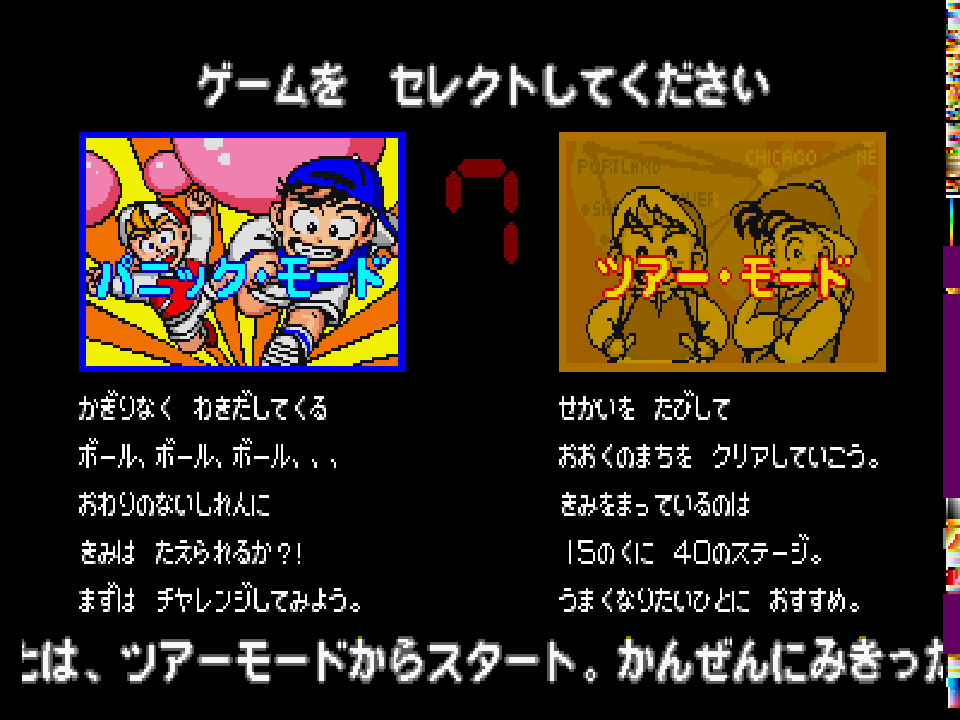
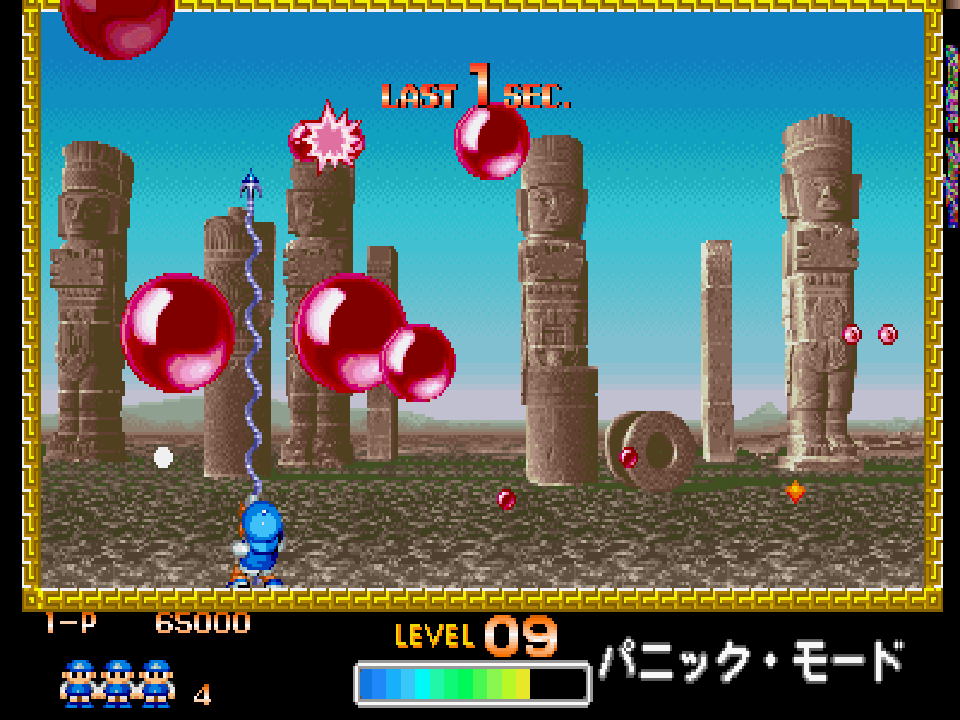
For those who are looking for a greater challenge, there is the Panic Mode as a secondary mode. This functions differently from the World Tour, as it is a single screen with bubbles and hexagons gradually dropping from the top of the screen. The player starts with the double harpoon weapon, with no additional pick-ups available. As the player pops the bubbles, a meter fills up on screen, increasing the level each time it is filled to the top.

When the level increases, there will be an increase in the speed and number of bubbles that appear, with varying sizes of ball that will drop from the top. At set points, the background for the stage will also change, with an island, castle and more as the locations for panic mode. During Panic Mode play, there will be small flashing bubbles, which will stop time for a couple of seconds, giving players a small window to pop as many balls as they can.

There is also a special bubble that has two different functions. This is the special bubble, which will appear randomly during play. Each of these bubbles start off as green clock bubbles, which will freeze time for 9 seconds, giving players a good chance to clear the screen. If the clock bubble hits the ground, it will change and become a star bubble, which will clear the screen when popped. Each time the bubble hits the ground it will change types.

In both Panic Mode and World Tour, if the player makes contact with a ball, they will be defeated and lose a life. In Panic Mode, the screen will be cleared and the player will continue at the level they reached. The world Tour Mode functions the same as the previous game, where the stage will start from the beginning if players are defeated. In the event players run out of lives, they will need to use a continue to get back into the action.

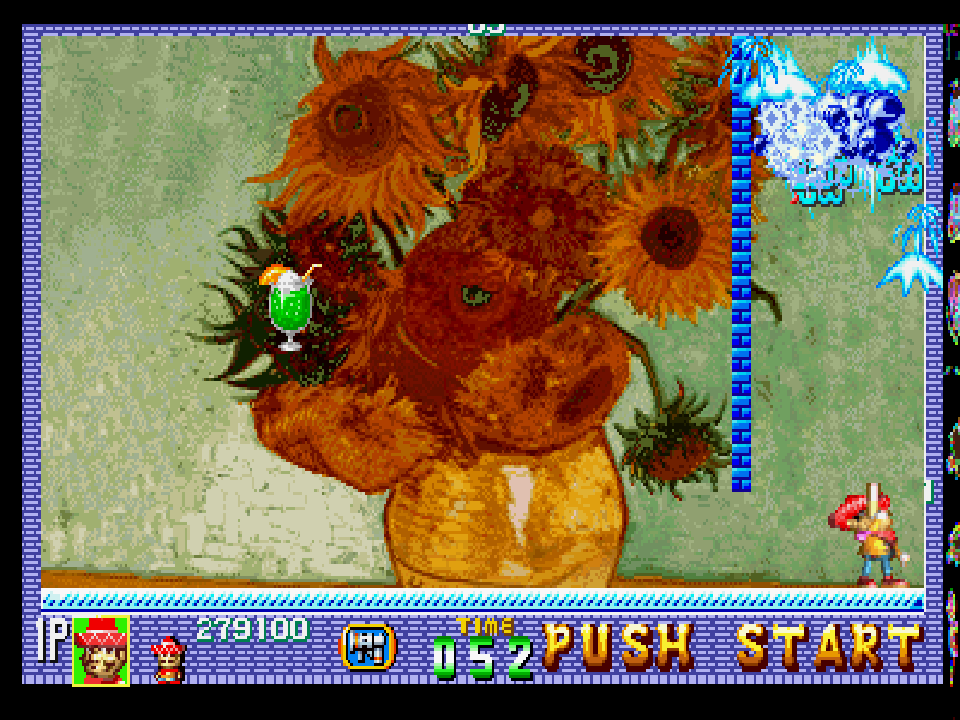
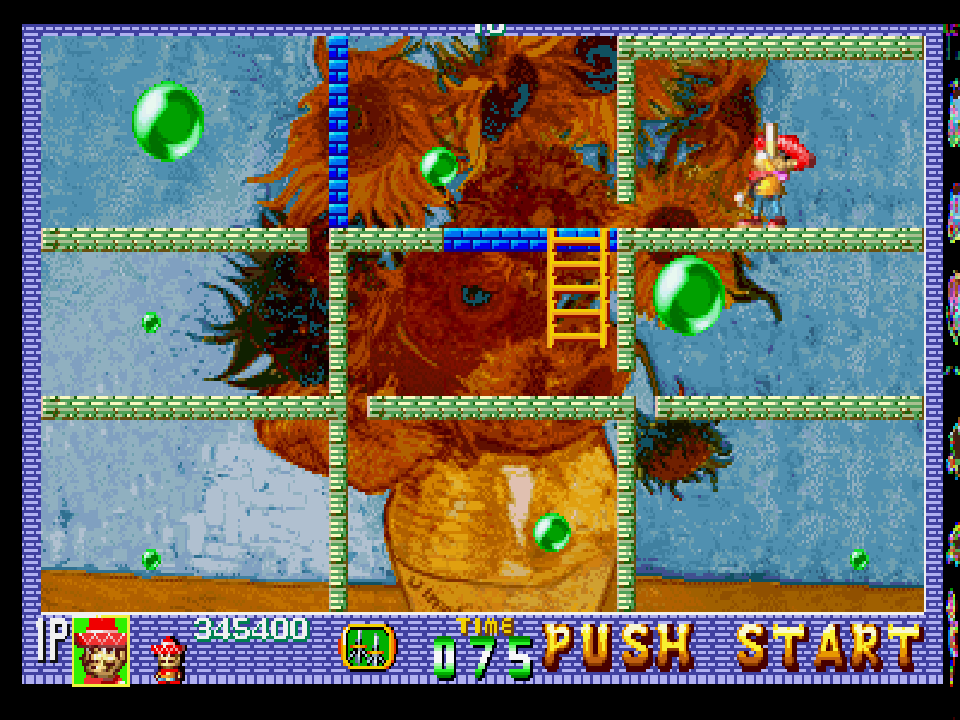
The last game to discuss is Pang 3, which is the most unique of the trilogy, taking place within an art gallery where a band of misfits are trapped. There are three game modes this time, with the Beginner mode, where players challenge 10 stages that are designed to teach the player the game. Then there is the Normal mode, where the player must collect famous art works, as well as Panic mode, where players take on a never ending stream of bubbles.

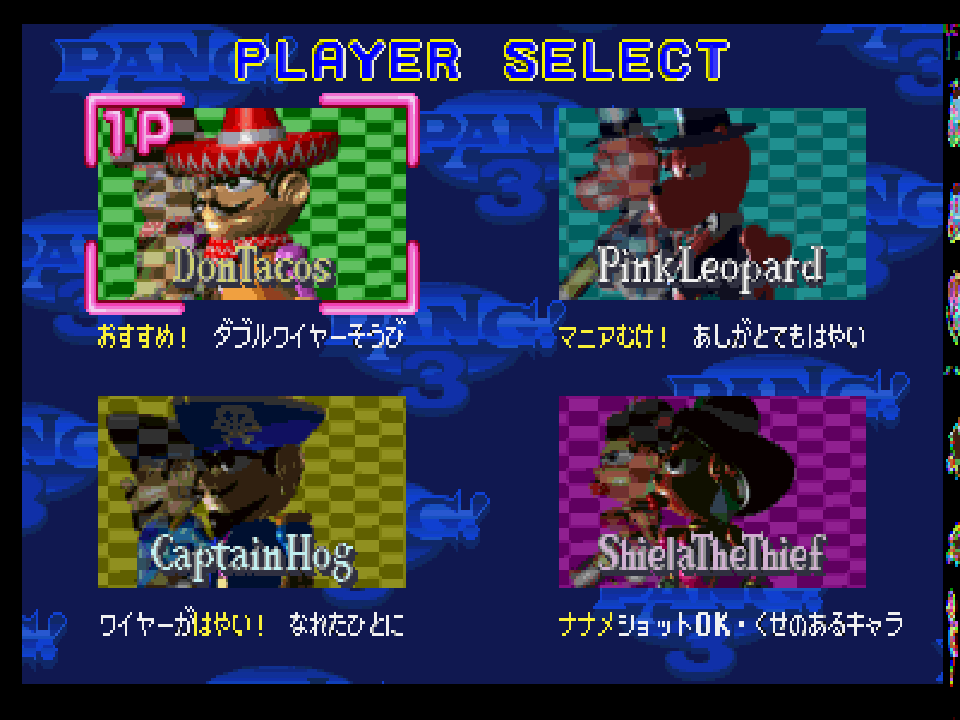
When the player starts the game, they will be able to pick one of the three modes. The Beginner mode has only one character that can use, with Don Pacos, who is armed with a double harpoon shot. In the other modes, players get to select their character, with the addition of Captain Hog, who uses a double grapple shot and Shiela the Thief who shoots at a 45 degree angle. Last is Pink Leopold, who has single shot harpoons, but he is immune to monsters.

During the Standard mode, the player can challenge a total of 50 stages, broken up into sets of 3 after the first two stages are cleared. Each of the stages follows the standard gameplay formula, where players must pop all of the bubbles, while avoiding being hit by them. As the player pops the bubbles, there will be the chance of items dropping from them. All of the support items return, but the hourglass is changed, adding time to the stage clock.

The weapon pick-ups also return from previous games, with the double shot and grapple shot staying the same. However, this time the Vulcan weapon has changed, as it is now a limited time blaster with a large spread shot. When the blaster is picked up, players have 5 seconds to get as much as they can from the weapon. This can make it very effective for clearing out the balloons as fast as possible, leading to quick stage clears.

There are new gimmicks in the stages for this release, with the introduction of Bomb Bubbles, which explode outwards to the left and right when popped. These can clear away the bubbles quickly, leading to big scores and fast stage completions. Then there are the dissolving platforms, where sections of the stage crumble when shot, alongside teleport spots that transport the player to different areas of the stage. These add more to the puzzle aspect of gameplay.

There is a major difference with the way this game progresses. This is the gallery select feature, where players will be presented with the choice of which stage set they want to play. At set points during the game, players will see the gallery and be able to jump ahead if they want to. All of the images for cleared stages, as well as skipped stages are added to the gallery between sets. When the game is cleared, the gallery will be shown off completely.

The final part of Pang 3 to cover is Panic mode, which functions the same as the previous game. The player needs to keep shooting the Balloons that keep falling down, with the player needing to get rid of them as fast as possible. Some of the smallest bubbles will flash, freezing the bubbles for a couple seconds before resuming. The bombs also appear and star bubbles, which will clear away all balloons on screen, with a clear announcement ever 10 stages.

All three of these games have settings that can be adjusted, changing the difficulty, credits and lives on offer. This allows for the player to modify the challenge at least a little bit. There is also the option for two player action in all three games, being selectable from the main screen before starting. But it is possible for players to jump right into the action, using a credit to join at any time, except for the Panic Mode which needs to be started in co-op from the main menu.

Personal Thoughts

I enjoy the pang series, having memories of playing Super Pang in an arcade with my dad when I was a kid. But I was never able to get past the first stage, as I was just not very good at the game. But the game stuck with me, so I played the Super Nintendo version and whenever I got the chance, played the games as arcade machines. Like playing Pang 3 after a doctor’s appointment in a small corner shop when I was about 12, getting about half way through the game.

So there is a lot of positive memories for me when it comes to the series, so when this was brought home one day in the late 90s, it became one of my favorites to play on PlayStation. I was still pretty bad at the games, and I still am to be honest, but I have a lot of fun playing them, to the point I will return to them frequently. They are also a lot of fun to play with friends and family, offering a challenge that can cause a lot of chaos during game nights.

This compilation features enhanced audio, which sounds clean and crisp using Red Book audio for the music. These enhancements make the game feel fresh and modern for the time, although it can have some looping issues at times. This is especially prevelant when emulating the game, as it can stutter and make a mess of the sound. But there are ways to fix this when playing the game on PC using the official discs.

As a package, there is a lot of content on offer for players, with the three games to choose from, as well as the different game modes in the different titles. Each of the game provides something different and unique, with the simplicity of Pomping World/Pang, the refinement of Super Pang and the colorful chaos of Pang 3. My personal favourite in this collection is Pang 3, as it has the most variety on offer, especially with the three playable characters.

The Super Pang Collection has only been released once, having released on the PlayStation in global territories before eventually being forgotten. Due to this it has become somewhat of a rarity with the cost of the game rising, making it on the more expensive end. But it can be found for reasonable prices, through online market places and retaillers that sell second hand games. Just be aware, the PAL version of this release has some weird overscan issues.

I have a lot of love for the Pang Series, as it is one of those distinct games that has been cloned several times. Yet most of the imitations don’t feel the same, so it would be nice to see this game being re-released. But sadly, Mitchell Corporation that owns these games is defunct, with the rights being held by Capcom who don’t seem to do much with the series. There is however, Pang Adventures, which was released on modern platforms.

If you have enjoyed this feature, then please stick around and see what else catches your eye. I cover a wide range of games in reviews, get special previews and put out regular features. I have Lost Gems, Retro Revival where I discuss re-releases and the occasional Gaming Oddities piece, where I cover weird and wacky titles. So stay a while and have a look around.

4PGP – Steam Review

Overview – developed by Vision Reelle in collaboration with publisher 3goo, 4PGP is an arcade style racing sim, where players take the wheel of a formula style car in fast paced racing. Go around the world in four grand prix cups, taking on a field of challengers to secure the top spot and take the championship. This title is available on Steam, Nintendo Switch/Switch 2 and PlayStation 5, with a link to each version of the game at the bottom of this review.

Disclaimer: before I get into the review, I would like to thank PR Hound for providing the copy of 4PGP that was used for this piece. The provision of this software has not influenced the contents of this review, all thoughts and opinions contained within are my own.

Now with the introductions out of the way, let’s get into the review. There is no plot or story for this release, so I will be going directly into covering the gameplay for 4PGP.

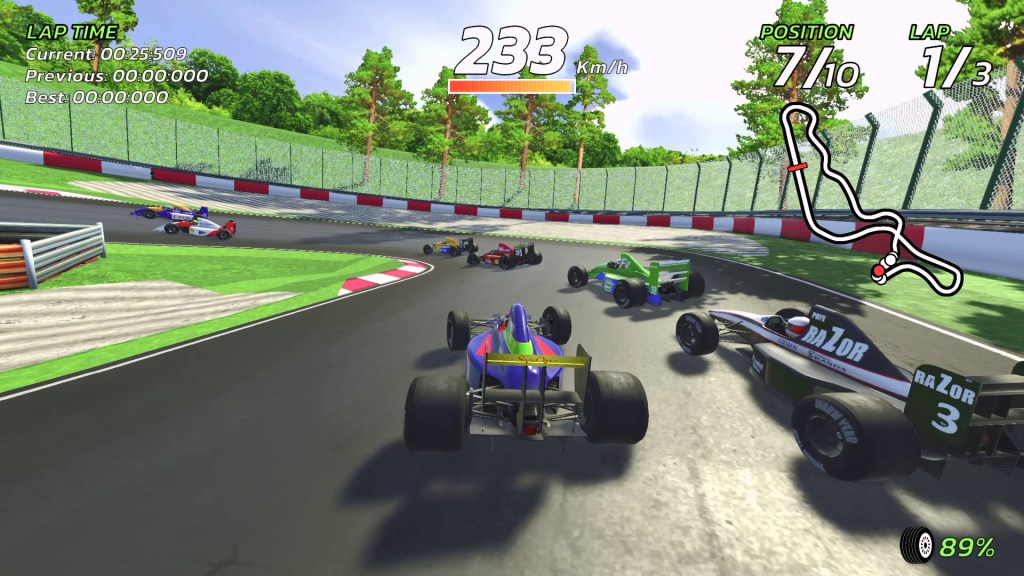
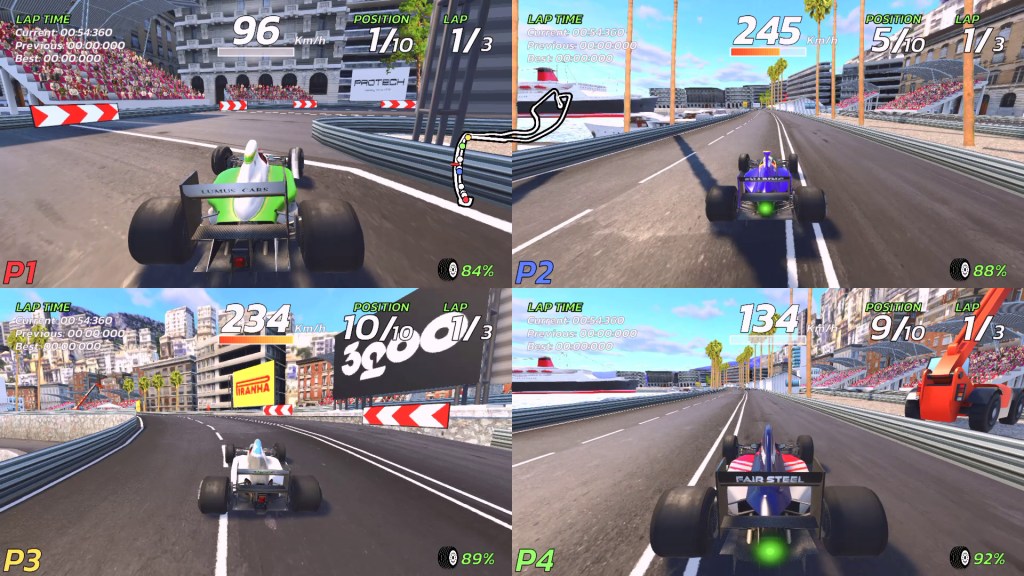
Gameplay – 4PGP is an arcade style motorsport racer, where players get behind the wheel of a formula style car, taking on circuits that are inspired by real world locations. There are several modes for players to take on, including a championship mode, where players take on four different championships. Then there is the quick race, where any track can be played (even in reverse), and Time Attack where players go for the top time on tracks.

In Championship mode, the player will play one of the four cups, consisting of three races against 9 other racers. The different Championship cups have tracks that share characteristics, like the Top Speed Cup, where players can floor it across different tracks. In the different grand prix cups, the player will need to finish in first place to win the championship. Depending on the difficulty selected for each of the cups, placing in first can unlock rewards.

At the start of the game, players will be able to use one of 9 cars, with lower level vehicles to start. However, as players complete the grand prix championships, more powerful vehicles will be made available. All of the cars in this release are based on real life vehicles, with fictionalised versions of sponsors on the cars, as well as the track. These include tyre manufacturers, motorsport gear and even a fictionalised version of Marlboro.

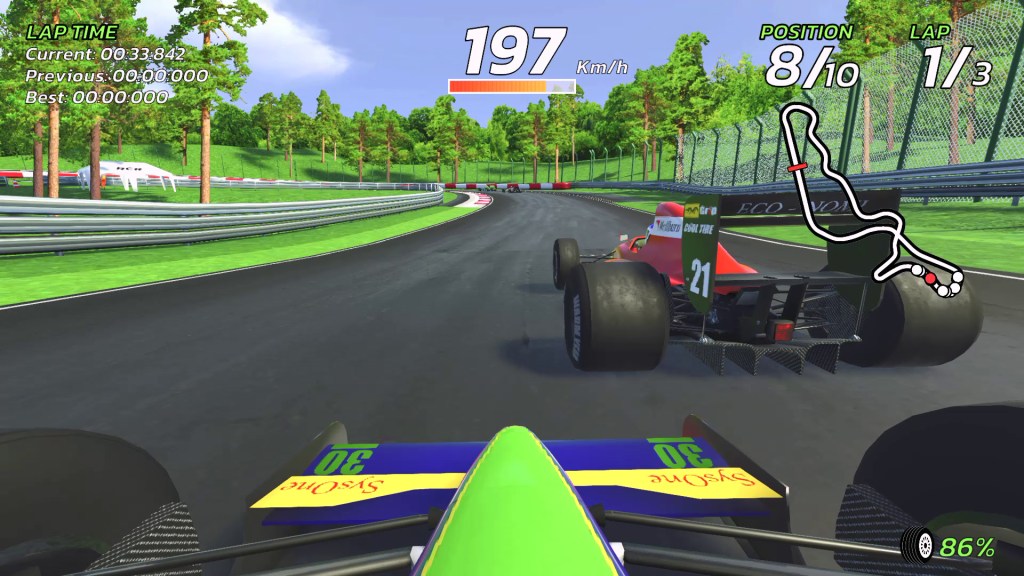
The racing itself is a mix between arcade style racing and motorsport sim, with easy to pick up gameplay at the lowest challenge levels. But players will need to take their foot off the accelerator when trying to take many of the turns, due to how tight they can be. If players don’t manage their speeds, they will go off track, losing almost all speed and quickly be overtaken. This means players will need to give the tracks a few attempts to nail the corners.

If the player does fall behind, or manages to get ahead, there is a way get even further along the track and that is the turbo boost. At the start of a race, the turbo charge for the player car will be fully charged, allowing them to use it immediately if they wish to. The boost can also be helpful for recovering if they go off track, as well as getting to speed after very tight turns. But be warned, the turbo charge is limited and does not last very long if players shotgun it.

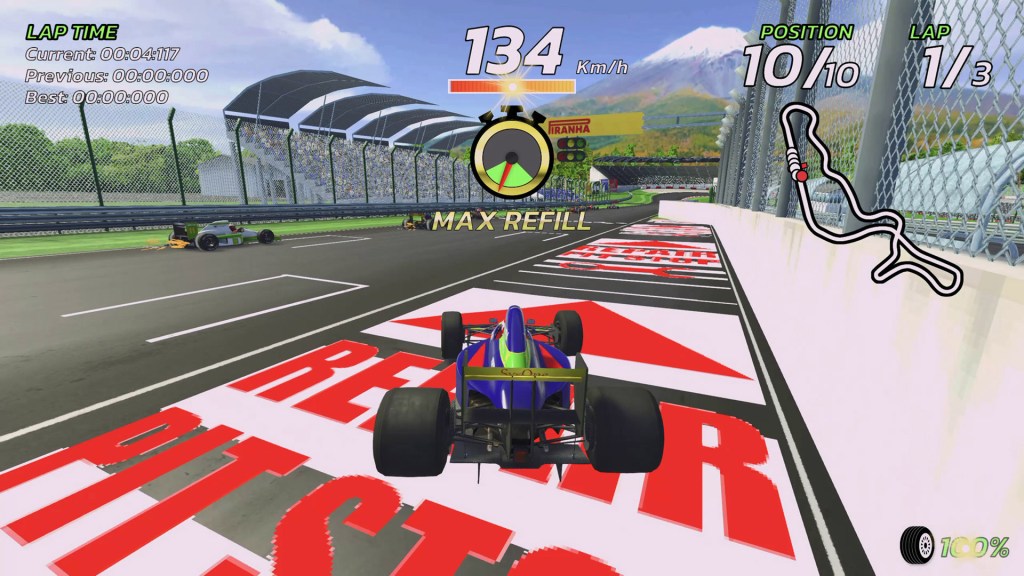
At the end of each lap, players can recharge the Turbo by hitting the pit lane, with a stopwatch appearing when they enter the lane. On this watch, there will be a green section and a spinner that will move on its own. If the player is able to stop the spinner in the green section, they will get a full charge of the turbo boost for the next lap. However, in the event this is missed only a portion of the boost is restored while in the lane.

There is also tire wear which players need to keep in mind, as the lower the percentage gets, the harder it will be to handle the vehicle. Tire condition will deteriorate during races on the track, which is made worse by hitting the off road areas. This can severely impact the player’s performance in a race, leading to crashes and losing their position in the race. The only way to restore the condition of the tires, is via the pit stop at the end of each lap.

Away from the main championship mode, players can enjoy the Quick Race and Time Attack modes. In Quick Race, players will be able to pick any of the unlocked tracks, alongside special reverse versions for free races. Then we have the Time Attack mode, where players can challenge a single track alone to set the best time. All of the tracks have DEV times, with local leaderboards that players can record their best times on.

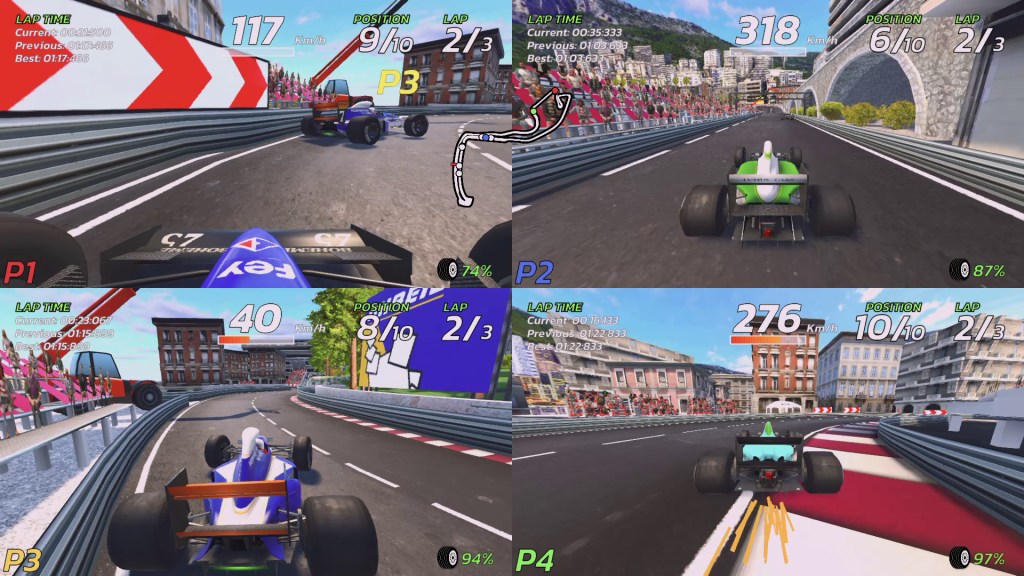
There is a special mechanic included as an accessibility feature called Assist Mode, which will nudge the player to the correct racing line. This makes learning the tracks easier, while also making the championships beatable for players who may struggle. Last is the split screen multiplayer, which allows up to four players to enjoy Championship and Quick race together. Unfortunately, I was not able to test this feature out.

Now with the gameplay covered, it is time to discuss the other aspects of this release, starting with the controls.

Controls – the controls for this release are rather easy to pick up, with only three buttons used to play the game. The player only needs to accelerate, brake and use the turbo button to get around each of the tracks. It is recommended to use a controller to play the game, with Steam input offering the best way to enjoy the high speed action. However, it is playable when using the standard keyboard, with no issues in terms of delay with any input used.

Difficulty – 4PGP is a very challenging racing title, as the hybrid arcade racing sim style can take a little time to get used to. Thankfully, there is a beginner difficulty that will let players get used to the Championship play, before progressing to Novice, Veteran and Expert to unlock content. The Time Attack and Quick Race modes can be a great way to get used to the tracks. Also for those who struggle, the Assist mode can be a great way to make it accessible.

Presentation – from a visual perspective, the style of the game feels close to classic arcade racing games, with smoothed out models for the vehicles. Then there are the tracks, which a designed well looking fairly close to their real world inspirations. I very much like the fictionalised versions of classic sponsors, which made tracks feel lively. The sound is rather good, with music that sounds like it came straight out of a SEGA arcade game.

Final Thoughts – I have an appreciation for classic arcade racers, like Virtua Racing and Daytona, so 4PGP really appealed to me. The look of the game does have that feel of the classics, with cars that have a chunky look to them, as well as clean and smooth textures. There is a good sensation of speed with the game, making it satisfying to go at full speed on the tracks, or take turns at speed. But it does take a little getting used to at the start.

There are a couple hiccups, as the CPU racers are very aggressive and can push ahead after pushing the player off road. Luckily, the turbo boost can be used to recover and catch up, but sometimes they can get far ahead to the point you cannot catch up even with boosting. Also, it can be hard to unlock the extra content, as players need to get first place for the cups. In general, I do enjoy this game, and I am happy to recommend it to racing fans.

In the end, I give 4PGP a final score of 3.5/5. This is a solid and challenging racer that mixes arcade and sim racing styles, with a retro style to the look, alongside fast and responsive racing with a good amount of content to unlock, but it does have some minor flaws. If you want to check this title out for yourself, a link to each version of the game will be below.

Link to Steam version (HERE)

Link to Nintendo Switch version (HERE)

Link to Nintendo Switch 2 version (HERE)

Link to PlayStation 5 version (HERE)

Nitro City Racing – Review

Overview – developed by Inlogic Software, with porting/publishin handed by Eastasiasoft, Nitro City Racing is a single player racing game where players must dodge and weave through traffic in several settings. As a street racer, blast down the road and avoid the other vehicles on the road at high speeds, completing missions and challenges. This title is available on all major platforms, with a link to all versions of the game at the bottom of this review.

Disclaimer: before I get into the review, I would like to thank Eastasiasoft for providing the copy of Nitro City Racing used for this piece. The provision of this software has not influenced the contents of this review, all thoughts and opinions contain within are my own.

Now with the introductions out of the way, let’s get into the review. There is no real story for this release, so I will be going directly into discussing the gameplay of Nitro City Racing.

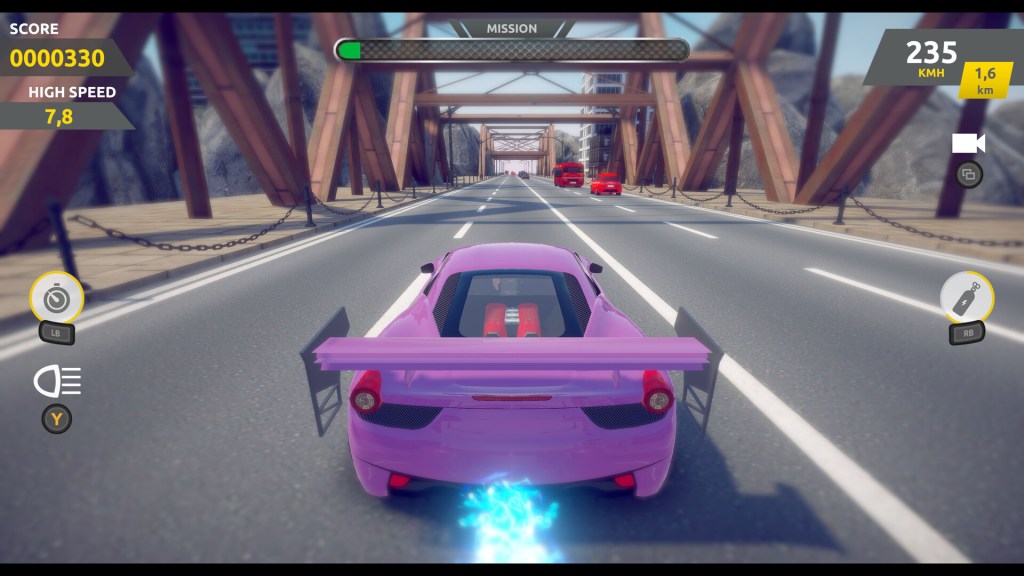
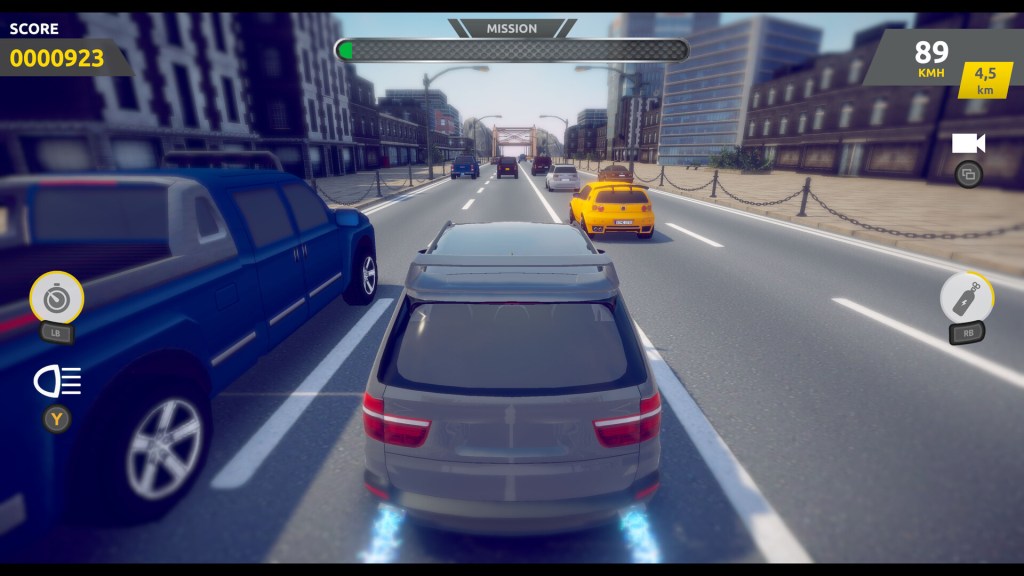
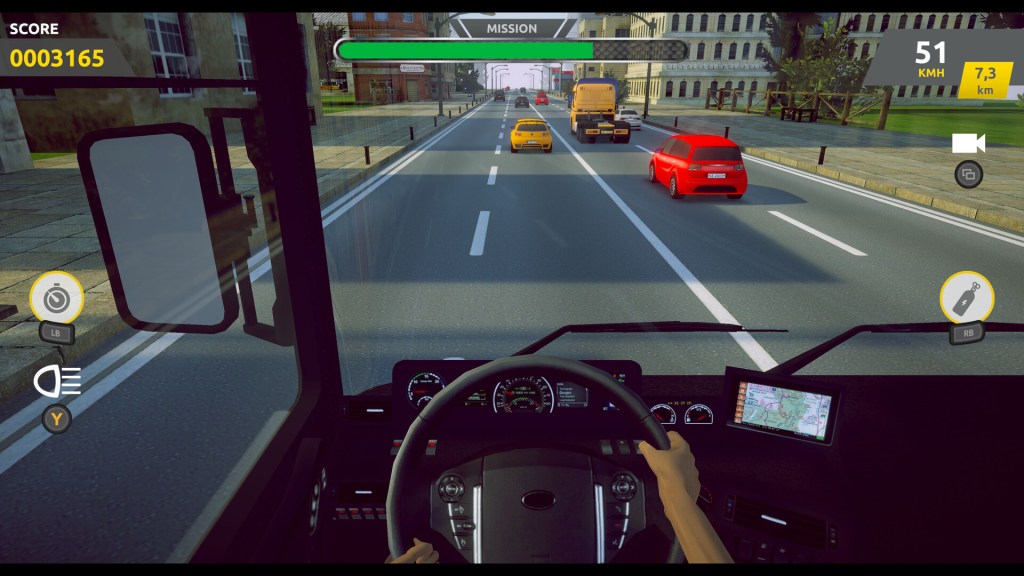
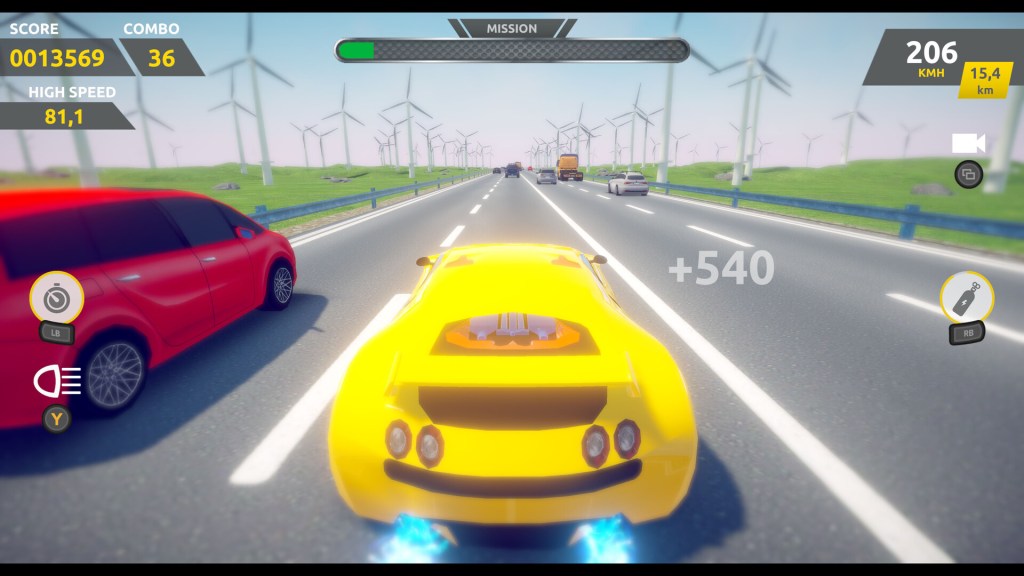
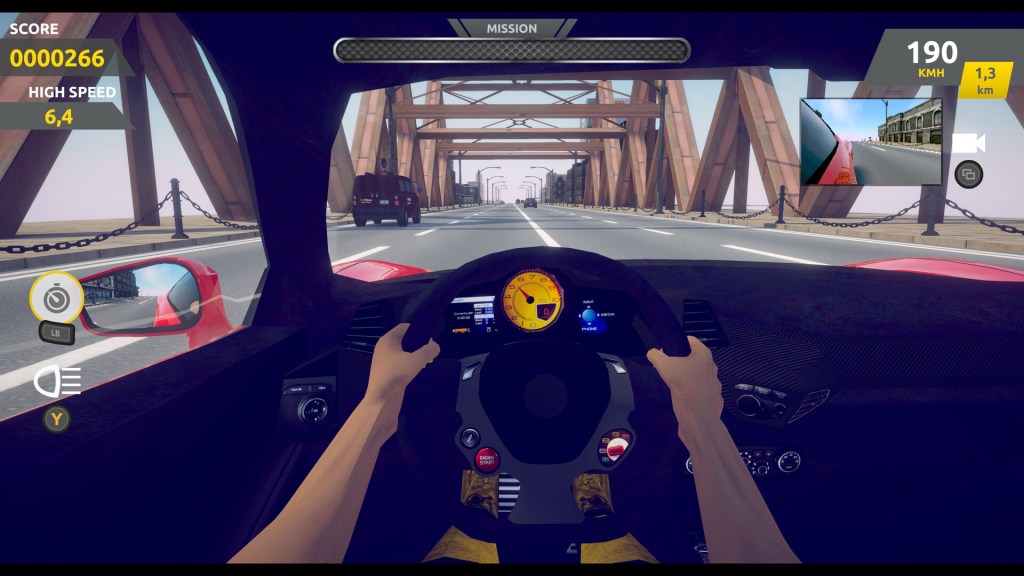
Gameplay – Nitro City Racing is an arcade style street racing game, with the objective being to drive down a straight road while weaving through traffic. Before players can get behind the wheel, they will need to select their car, starting with only one out of 10 cars to select from.  After selecting the car, players will be able to pick one of five modes. At the start of the game, there are two modes that players can jump into, Career and One Way.

In Career mode, players will be able to challenge a total of 54 missions. These all include the same basic gameplay loop, where the player must drive down a straight road, dodging vehicles on the road at high speed. However, the mission objectives vary between each of them. The challenges include covering a set distance, near missing other vehicles, driving on the other side of the road and scoring set amounts of points, some with a time limit.

The driving is very basic, with the roads being straight lines with four lanes, offering a very basic high speed driving experience. While driving, players can accelerate, brake and move to the left/right as the basic controls. Then there are the “special features”, which consist of a turbo that lasts a limited time, as well as a time slowing power that adds a black and white filter. This offers a shallow, but functional speed driving experience.

When clearing each of the missions, the player will be awarded coins for the missions, as well as for driving skills during play. The base award for the mission will be set, however, the bonuses will vary based on near misses, going on the opposing lanes and going at high speeds. All of the awards will be added to the player bank, which can be used outside of the Career mode. Players will also gain experience which will level them up and unlock new modes.

Away from the Career mode, the player can access four other game modes. These consist of One Way, where all traffic goes in the same direction, Free Ride where players can just drive endlessly. Then there is the Time Attack mode, where players score as many points as possible, and Two Way which plays out the same as One Way, but with an additional lane. Free Ride, Time Attack and Two Way unlock when players reach set levels.

During play in Career Mode, One Way and Two Way, if the player makes contact with another vehicle, the run will be ended and scores will be tallied. Yet, in the Free Ride and Time Attack mode, the player will auto-brake is the player hits another car, allowing players to continue driving. In the three challenge modes with scores, the player will be able to record their highest score, acting as a record due to the lack of any form of leaderboards.

Away from the rather basic gameplay, there are the cars and customisation options that can be purchased. After accumulating enough coins, players can purchase new cars, with different models inspired by real world vehicles. These have different stats that should affect the performance, but it only seems to affect speed. When a car has been unlocked, the player will be able to buy upgrades and new parts for their car.

The upgrade system allows players to improve their core performance and unlock turbo, with several steps for each of the performance boosts. Then we have the cosmetic customisation options, changing the look of the car, including wheels and spoilers, with several options to choose from. Players can also change the look of their vehicles with color choices, changing the palette of the car with several options to choose from on the menu.  

Now with the gameplay covered, it is time to discuss the other aspects of this release, starting with the controls.

Controls – this has a very easy control method, with only a few buttons needed to play. These are to control speed through acceleration/braking, moving across the lanes and the time stop/turbo boost. This works rather well in terms of handling and general play, with the steam version offering players the option of using keyboard, or controller if using steam input. The general performance of the game is pretty intuitive, with no issues in terms of lag.

Difficulty – this game lacks any real difficulty or challenge, as the driving is just a straight line with some swerving between traffic. The challenge itself is all about knowing how to weave between cars, get the near miss combos and maintain high speeds. Due to this rather low difficulty level, it is pretty easy to get through all of the challenges. I just wish there was more to the racing than just going along a straight road.

Presentation – from a visual perspective this game looks rather basic, with simple models for the roads, environments and assets for cars. This does look like a low budget release, with the simplified look of the game, as well as a low render distance. Thankfully, there are no issues in terms of lag or frame rate, with the game playing rather smoothly. The sound is rather basic, with a small amount of music tracks that loop and simple sound effects.

Final Thoughts – I do enjoy arcade style racing games, being a fan of the classics like SEGA Rally and Ridge Racer, so this appealed to me. However, my gameplay experience was a little bit mixed, as the game feels like more of a mobile release. This was due to the very basic menu system, alongside a very simple HUD during play. But the gameplay itself does have an element of fun to it, with a good sense of speed while going down the long roads.

I do wish there was a little more to this game, with more than just the straight never ending roads. The lack of turns and only having players drive in straight lines, does lead to the gameplay becoming tedious rather quickly. If there was a leaderboard system included, or opponent racers, then this would likely hold more staying power. If this style of gameplay does interest you, the price is very low, so it can be good as a bit of a time waster.

In the end, I give Nitro City Racing a final score of 2.5/5. This is a passable budget racing game, with a single style of play that sadly becomes tired fast, but for those who are looking for a cheap street racing game, there is a decent amount of content present. If you want to check this game out for yourself, a link to each version of the game will be below.

Link to Nintendo Switch version (HERE)

Link to PlayStation version (HERE)
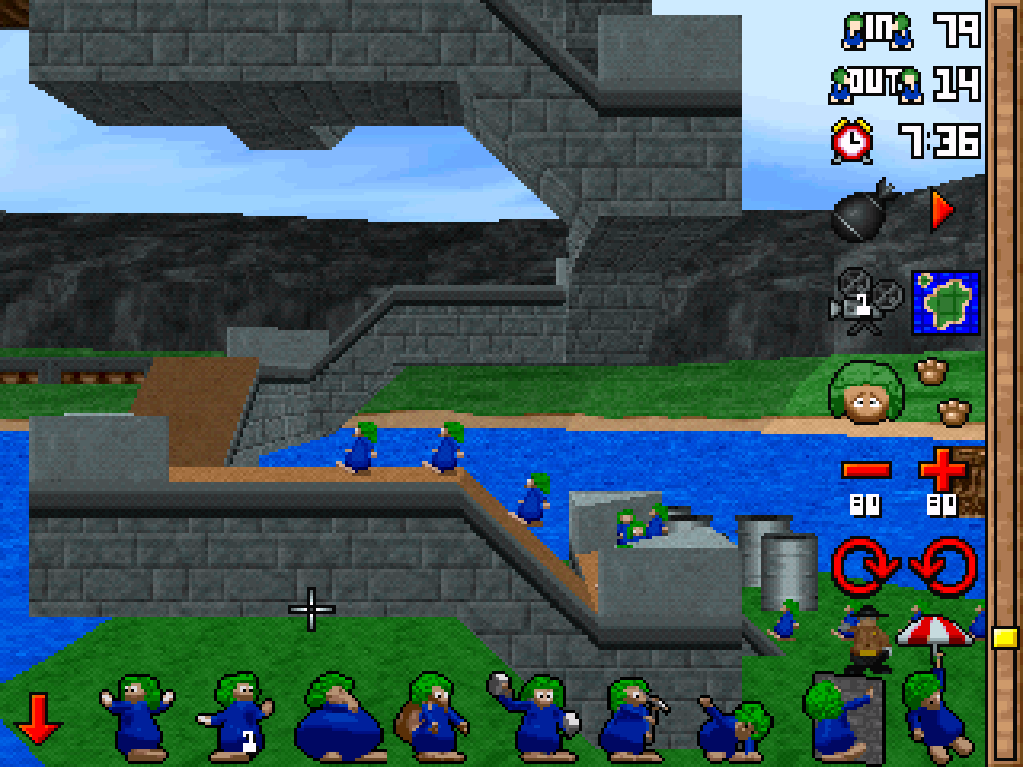
Link to Xbox version (HERE)

Link to Steam version (HERE)

The Gecko Gods – Nintendo Switch Review

Overview – developed by Inresin and published by Super Rare Originals/Gamersky Games, The Gecko Gods is a platform adventure set on mysterious islands, where players take control of a tiny gecko. As the gecko, explore the ruins of a forgotten archipelago and solve the puzzles to uncover the mysteries they hold. This title is available for PlayStation 5, Steam and Nintendo Switch, with a link to each version of the game at the bottom of this review.  

Disclaimer: before I get into the review, I would like to thank Super Rare Originals for providing the copy of The Gecko Gods used for this piece, via the Keymailer service. The provision of this software has not influenced the contents of this review, all thoughts and opinions contained within are my own.

Now with the introductions out of the way, let’s get into the review. There is little in terms of a narrative that is presented, so I will be going straight into discussing gameplay, with available plot details sprinkled throughout. Please Note, images used for this piece are taken from official sources.

Gameplay – The Gecko Gods is a relaxed puzzle-adventure, where the player takes control of a little gecko, arriving on the shore of a mysterious archipelago. While exploring the island, the player will encounter the spirits of the Gecko Gods, who will guide the player on their quest. During the start of the adventure, the player will only be able to explore one of the islands. However, as the adventure progresses, players will be able to explore more of the islands.

While on each of the islands, the player will be able to climb any surface that they come across, allowing players to cling to walls and ceilings. The little gecko will also be able to jump, dash and swim across pools of water. There will also be environmental elements to interact with, including switches, moving platforms and levers to open gates. Many of the puzzles will have multiple steps to them that need to be solved to progress.

There will also be platforming elements to the various puzzle challenges, including hitting gongs, jumping through hoops and ringing bells. By completing the different puzzle challenges and objectives, they will be marked off the list and lead to interesting effects on the islands. Upon completing the challenges of the first island, the player will be able to access the boat, which allows the gecko to explore outside of the first island.

The sailing between islands allows for players to engage with open ended exploration, where the islands away from the first can be approached in any order. As the player explores the different islands, they will encounter guides, either through tablets or birds, who will provide hints on objectives. These will then be added to the quest guide, allowing players to track their progress, with objective area shown as circles on the different maps.

While this is a rather laid back adventure, there are some dangers present during the adventure. In some areas, there will be enemies that will attack the gecko. If the player takes too much damage, they will lose their tail and then be knocked out, sending them back to the last checkpoint. But players can fight back by dashing at enemies to defeat them. The open water will also harm the gecko, causing damage if they fall into the ocean.

Away from the main objectives, the player will be able to complete side objectives while exploring. While wandering through the islands, the little gecko can eat up various insects, with each new insect being added to a special page on progress screen. There will also be relics that are hidden around the islands, which players can find as they explore. These special collectables will also be added to the special collection page.

Throughout the journey across the islands, the player will be able to collect golden symbols. The main way is from destroying jars and pots, which will drop points when they are smashed by dashing into them. Enemies will also drop the points when they are defeated by the player. These points are added to a pot that is carried throughout the course of the adventure. Players can use these points to purchase special cosmetic items for the gecko.

As players explore, they will find special mirrors that players will be able to interact with. When one of these points has been found, the player will go into the cosmetics menus, where special colors and patterns that can be purchased. These items varying amounts of points to unlock, which are deducted from the player bank. The colors and patterns that can be purchased for the gecko unlock during the adventure, with many cosmetics to discover.

Now with the gameplay covered, it is time to discuss the other aspects of this release, starting with the controls.

Controls – there is a relatively simple and intuitive control scheme for the Gecko Gods, offering players an easy to pick up and play experience. All of the inputs needed to experience the adventure are on the face, with the thumbsticks controlling movement and the camera. While the experience is generally smooth, there are a few little hiccups with control when getting stuck on corners, with the camera being difficult to control at times.

Difficulty – there is a relatively low level of difficulty, making this game approachable by players of all skill levels. This is due to a laid back and relaxed atmosphere, with the threats to the player being few and far between. The only real challenge for players is to solve the puzzles, which can require some wandering and can take time to figure out. This makes the Gecko Gods an excellent choice to be played with children, or as a family.

Presentation – visually, this title has a soft and vibrant look to it, with an excellent use of color and textures that give a soft shaded look. This works well for the game to give it a relaxed atmosphere, which is further enhanced by the music, which has soft compositions that add to the gentle feel. The game performs well, with fluid performance and no issues with lag. Sadly, there are some minor issues with pop in, as the render distance on switch is a little short.

Final thoughts – I had seen this game a few years back when the reveal trailer dropped in 2022, but there were several delays before being released this year. When the opportunity to cover the game was offered to me, I was more than happy to pick it up. I very much enjoy this adventure, as the gentle atmosphere and relaxed gameplay offer a refreshing experience. The platforming and puzzles have some challenges to them, but they are accessible by all players.

This is an excellent adventure, which encourages exploration with the ability to climb on all surfaces. However, there are some minor issues with this ability, as players can get stuck on surfaces, fall suddenly and have some difficulties finding the right direction. Thankfully, these are just hiccups that don’t sour the overall experience. I recommend this game to everyone that enjoys adventure games, as it is perfect for families and those who want a relaxed experience.

In the end, I give The Gecko Gods a final score of 4.25/5. This is an enjoyable and pleasant adventure, with a soft shaded look and relaxed environment that allows players to enjoy the game at their own pace, offering rewarding exploration and balanced platforming puzzles. If you want to check this game out for yourself, a link to each version of the game will be below.

Link to Nintendo Switch version (HERE)

Link to PlayStation version (HERE)
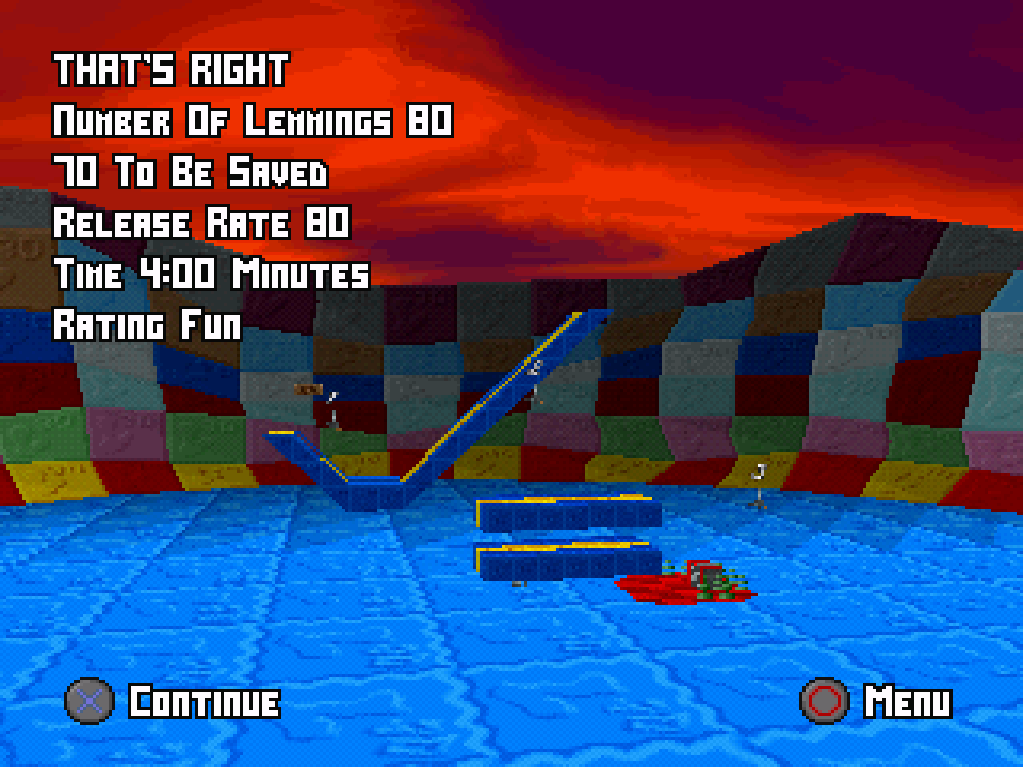
Link to Steam version (HERE)
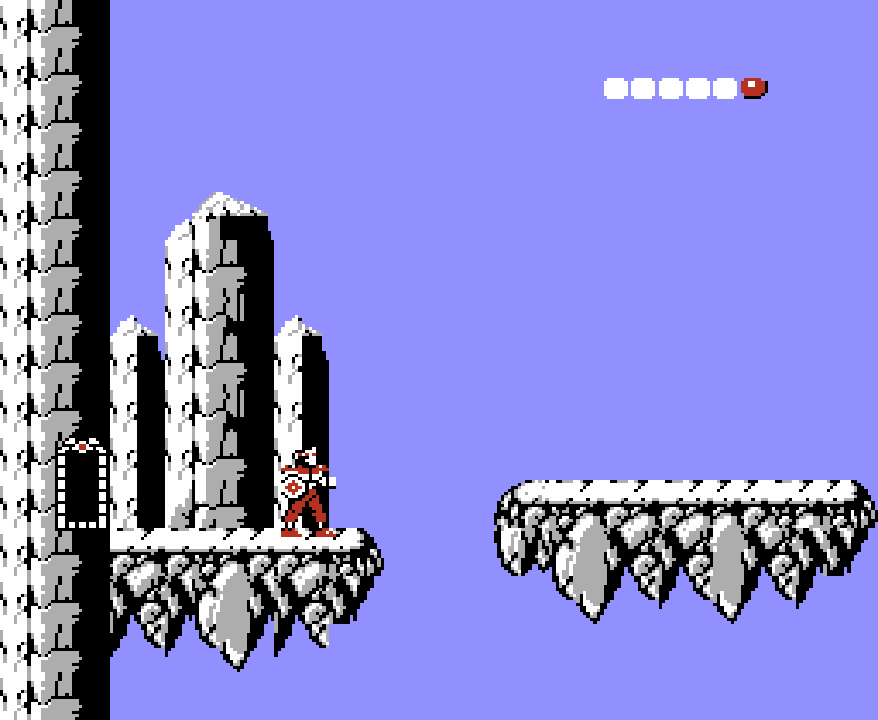
Retro Revival – ACA NEOGEO League Bowling (Various)

Hello there and welcome to the next entry in Retro Revival, the series where I cover classic games that have been given another chance at life. Here I cover HD remasters, emulated ports and compilations in part or as a whole. This week we continue going through the NEOGEO library, this time with League Bowling, a unique bowling arcade game developed by SNK in 1990. This title is available on modern platforms via the ACA NEOGEO series by Hamster Corporation.

Disclaimer: the games discussed in this feature have been my own purchases, so all opinions contained within are my own. There has been no sponsorship of the content in this feature, with links to the different versions of the game where available.

So with the introductions out of the way, let’s get started. I will be discussing the general gameplay experience, then provide my personal thoughts on the release.

About the game

League Bowling is a straight forward arcade bowling simulation, where players play through ten frames of arcade bowling action. This game can be played with up to four players, with the first two going first, then the second pair taking their turns. When starting the game, there are three modes that players can jump into to play. These modes are the following;

  • Regulation – this is the standard bowling mode, where the action plays out in the traditional format, bowling 10 frames to get the best possible score. The maximum perfect score is 300, just like real world bowling.
  • Flash Bowling – the game plays out just like regular bowling, but the scoring is different with flashing score bonuses at the top of the screen. There are three different types of bonuses ranging from 50 to 200 for spares and 100 to 300 for strikes. There are no bonus shots on the tenth frame, with a maximum perfect score of 3000.
  • Strike 90 – Similar to Regulation and Flash bowling, the player will bowl 10 frames just like the others, but like Flash bowling the score system has changed. Each time the player gets a strike, they will earn 90 points, there will be 60 points for a spare and for special trick shots, 30 points will be awarded. The perfect score for this mode is 900, with no final frame bonus shots.

After selecting the number of players and the mode, the pre-game screen will appear where players can select the weight of their ball, as well as their hand. The ball weights that can be chosen are between 8 and 15, with different colors for each of the balls to differentiate between them. The weight of the ball doesn’t seem to have any real effect on the way they work, with all balls function nearly identically with the color being the only difference.

Once all of the selections have been made, the game will begin with Pete the player on the lane. The game is played in vertical split screen, with two players being able to play simultaneously, rather than turn based as most other games are. If there is one player or three players, the empty side on the right will have Jessica the lane girl filling the space. When she is on screen she will be holding a sign with the controls to play the game.

During each throw of a frame, the player needs to line up their shots moving along the line to get into position. Then the player can set the control of the ball, using a sliding control gauge that players can stop to throw straight or add a curve to the shot. After the position and control has been set, players can use the power meter to set how hard they throw the ball. As the throw is made, there are animations at the top of the screen.

There are a variety of animations that play out during the throws, with unique animations for each strike, spare and miss. The different animations mimic the fanfare present in real-world bowling alleys, but with the added twist of animations for more than just strikes. These add a lot of charm to the game experience, elevating it above other bowling arcade titles of the time. If playing Flash Bowling, the animations are missing and replaced with the bonus scores.

At the end of the game, players will appear at an awards ceremony with the players ranked from first to last. This occurs with any number of players, with single player defaulting to the top spot, and if the player sets a high enough score they can add their name. The game is relatively short with a game taking between 5 to 10 minutes, depending on the players. But the whole game is played with a single credit, so players get the full experience every time.

As mentioned in my other ACA NEOGEO features, there is the High Score and Caravan modes, where players play through a full game. The objective is to set the highest score possible for the global rankings, as the game is rather short, both modes are mostly the same. Alongside the modes, there is the international and Japanese release, alongside the adjustable settings, digital manual and the retro CRT filter the give it an old school look.

Personal Thoughts

I have many fond memories of League Bowling, having played it both at home and at arcades while on family holidays. When I was a kid, I wasn’t too good at it as my timing was pretty terrible, but as I got older and gave it more time, I have improved. But I can still be a bit hit and miss when playing the game, adding too much spin, being in the wrong place or just being off with timing. Yet, I still have a tremendous amount of fun when playing the game.

It is as simple as it gets, being a single button game that is played with only the A button. But this doesn’t take away from the fun and challenge on offer, as players can practice and get good enough to hit that perfect 300 game. It is also one of those rare four player arcade games that only needs two controllers, as players pass the controllers after each frame. The odd players share the player 1 controller and the even players share player 2.

The game is rather short, but that adds to the replay value for it, as you can get several games done in an hour. This makes it perfect for solo and group play, as you can try to set a score and beat it, or play through several games during game nights to see who is the best bowler. It is one of those evergreen games, which you can pick up and play whenever you feel that bowling itch, or break it out when you have company around.

League Bowling was released during the first year of the NEOGEO MVS, then was released around 7 months later for the home system. Even though it is one of those early games, released as SNK were finding their feet with the system, it looks and sounds as good as the best games in the library. It is one of those that I do hope gets a re-release as part of the AES+, as the price for the original cartridge has a rather hefty price tag.  

If you have enjoyed this feature, then take a look at the other content available and see what catches your eye. There are reviews, sometimes news and features that cover a variety of games. There is the lost gems series, special Gaming Oddities and more coming in the future. So stick around for a while and check out the other content.

Link to Nintendo Switch Version (HERE)
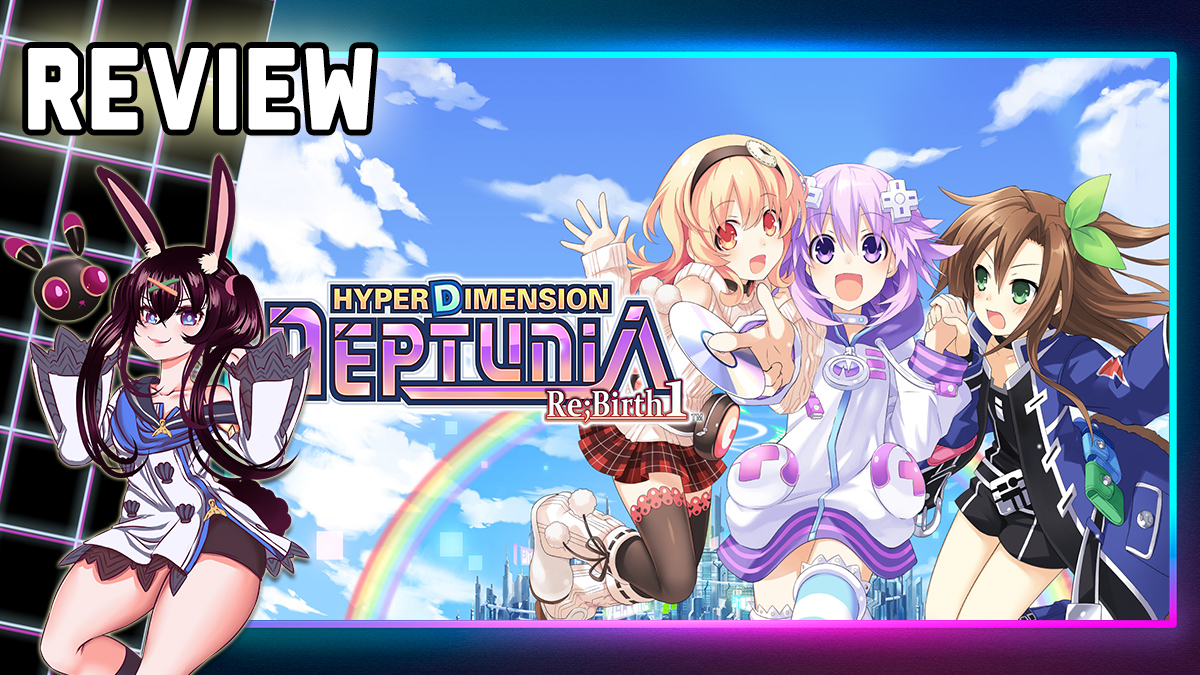
Link to Xbox version (HERE)